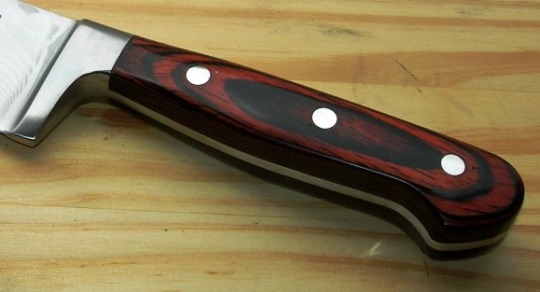
I don’t wanna like Kill The Joke but this brings up a really cool fact about swords in ~14th-16th century Germany! The only people who were allowed to own Real Swords were the royalty and nobility BUT! Everyone else was allowed to own knives. The definition of a knife, however, was based on not length but handle construction, and to some extent how it was sharpened. The handle had to be constructed Like So with 2 pieces of wood sandwiching the metal tang.
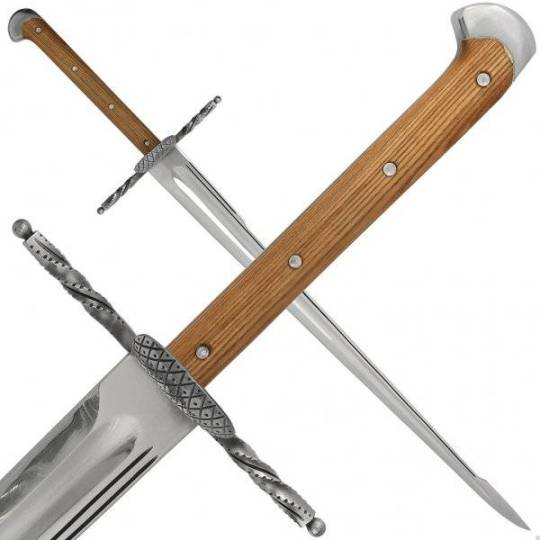
Only one edge was allowed to be sharpened, but oftentimes a small part (a couple inches) of the short edge (e.g. the edge that wasn’t sharp) would be sharpened, and weapon design often allowed for this
In this way, something that looked like This, a messer of just over a meter in length…
…would be legally considered a knife, and therefore allowable for non-nobility to possess. (you can also see the bit on the back of the tip that would be sharpened)
So @swordmutual, there’s a not definitive but certainly interesting historical perspective on your question
So the other night during D&D, I had the sudden thoughts that:
1) Binary files are 1s and 0s
2) Knitting has knit stitches and purl stitches
You could represent binary data in knitting, as a pattern of knits and purls…
You can knit Doom.
However, after crunching some more numbers:
The compressed Doom installer binary is 2.93 MB. Assuming you are using sock weight yarn, with 7 stitches per inch, results in knitted doom being…
3322 square feet
Factoring it out…302 people, each knitting a relatively reasonable 11 square feet, could knit Doom.
Hi fun fact!!
The idea of a “binary code” was originally developed in the textile industry in pretty much this exact form. Remember punch cards? Probably not! They were a precursor to the floppy disc, and were used to store information in the same sort of binary code that we still use:
Here’s Mary Jackson (c.late 1950s) at a computer. If you look closely in the yellow box, you’ll see a stack of blank punch cards that she will use to store her calculations.
This is what a card might look like once punched. Note that the written numbers on the card are for human reference, and not understood by the computer.
But what does it have to do with textiles? Almost exactly what OP suggested. Now even though machine knitting is old as balls, I feel that there are few people outside of the industry or craft communities who have ever seen a knitting machine.
Here’s a flatbed knitting machine (as opposed to a round or tube machine), which honestly looks pretty damn similar to the ones that were first invented in the sixteenth century, and here’s a nice little diagram explaining how it works:
But what if you don’t just want a plain stocking stitch sweater? What if you want a multi-color design, or lace, or the like? You can quite easily add in another color and integrate it into your design, but for, say, a consistent intarsia (two-color repeating pattern), human error is too likely. Plus, it takes too long for a knitter in an industrial setting. This is where the binary comes in!
Here’s an intarsia swatch I made in my knitwear class last year. As you can see, the front of the swatch is the inverse of the back. When knitting this, I put a punch card in the reader,
and as you can see, the holes (or 0′s) told the machine not to knit the ground color (1′s) and the machine was set up in such a way that the second color would come through when the first color was told not to knit.
tl;dr the textiles industry is more important than people give it credit for, and I would suggest using a machine if you were going to try to knit almost 3 megabytes of information.
It goes beyond this. Every computer out there has memory. The kind of memory you might call RAM. The earliest kind of memory was magnetic core memory. It looked like this:
Wires going through magnets. This is how all of the important early digital computers stored information temporarily. Each magnetic core could store a single bit – a 0 or a 1. Here’s a picture of a variation of this, called rope core memory, from one NASA’s Apollo guidance computers:
You may think this looks incredibly handmade, and that’s because it is. But these are also extreme close-ups. Here’s the scale of the individual cores:
The only people who had the skills necessary to thread all of these cores precisely enough were textile and garment workers. Little old ladies would literally thread the wires by hand.
And thanks to them, we were able to land on the moon. This is also why memory in early computers was so expensive. It had to be hand-crafted, and took a lot of time.
When I was a student at Cambridge I remember an anthropology professor holding up a picture of a bone with 28 incisions carved in it. ‘This is often considered to be man’s first attempt at a calendar,’ she explained. She paused as we dutifully wrote this down. ‘My question to you is this – what man needs to mark 28 days? I would suggest to you that this is woman’s first attempt at a calendar.’ It was a moment that changed my life. In that second I stopped to question almost everything I had been taught about the past. How often had I overlooked women’s contributions? How often had I sped past them as I learned of male achievement and men’s place in the history books? Then I read Rosalind Miles’s book ‘The Women’s History of the World’ (recently republished as ‘Who Cooked the Last Supper?’) and I knew I needed to look again. History is full of fabulous females who have been systematically ignored, forgotten or simply written out of the records. They’re not all saints, they’re not all geniuses, but they do deserve remembering.
evidence that ancient paleolithic venus statues were made by women who were examining their own bodies and sculpting them from their own point of view, not, as previously assumed, exaggerated features from an outside perspective
lilith was created before eve from the same soil as adam to be his wife
she refused to lay beneath him, wishing to be his equal, only willing to have sex with him if she was on his side or on top
adam tried to force her to have sex with him the way he wanted, so she left him and became a demon…
…go off
i mean we could talk about how lilith was a badass who’d rather be a demon than be subservient to a man or we could talk about the allegory here where a woman who demands agency is LITERALLY demonized… or the reality that this story means that the first man in the bible (or the first man ever, if you subscribe to that) was a rapist! great start, boys
this is so important.
I wonder how different shit would be if Adam attempting to rape Lilith was the “original sin” instead of Eve eating the apple.





 Loki is the Philosopher King