And i think he might have already known about this ‘cause that could be the reason he and Elizabeth Olsen were chosen to be at the Comic Con.
My number one meeting Tom Hiddleston fantasy is that we become platonic best friends forever and just have dates all the time where we drink tea and talk Shakespeare and Loki meta for hours, and my second one is that I have the opportunity to ask him each and every single question on my list, but my third one is to go to an event like this and have the confidence to sidle up to him when it’s my turn for a picture or whatever and be like, “I will slip $50 in your pocket right now if you just confirm or deny that Loki is alive, no bs, and I won’t tell a soul,” and I really wouldn’t, but even if he didn’t tell me, I bet the look on his face would be priceless.
(I am joking, I wouldn’t actually do this. The first two fantasies are true though.)
And then there was this interview, with this interesting little excerpt:
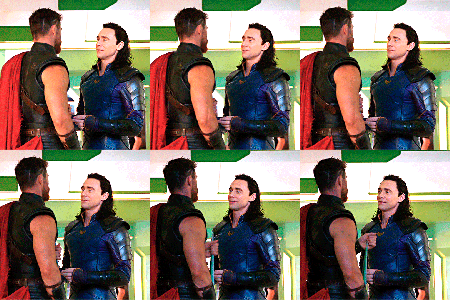
Thor: Ragnarok’s director Taika Waititi – New Zealander of the Year, blossoming fashion icon, and man of a thousand poses – is swift to launch into a description of Loki, the unbeloved son of Asgard, as, “someone who tries so hard to embody this idea of the tortured artist, this tortured, gothy orphan.”
“Swift to launch into” this description, huh? Kind of sounds like someone with an idée fixe, a preoccupation, a grudge… probably a secondhand grudge, on behalf of one Chris Hemsworth, but one he has made charmingly his own.
What gets me most about this is using “orphan” as sth degrading. Not to mention disregarding someone’s pain: “tortured, gothy orphan”. And as someone who loves gothic art, I have to ask what’s wrong with being a goth and gothic things?
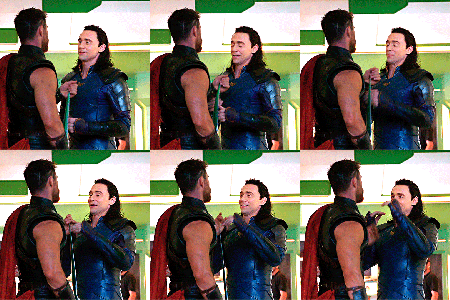
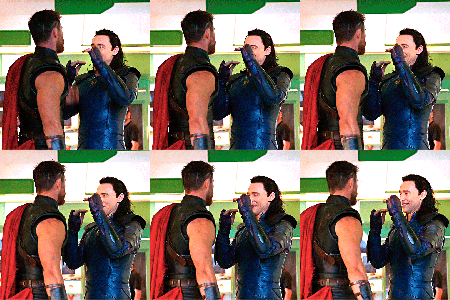
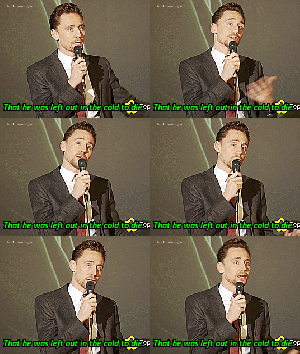
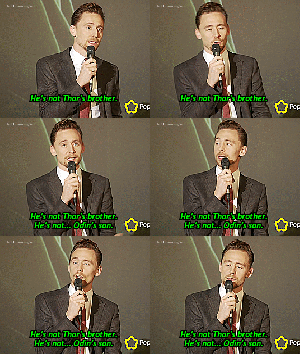
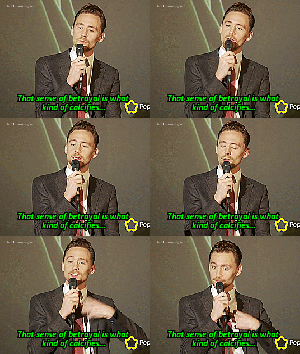
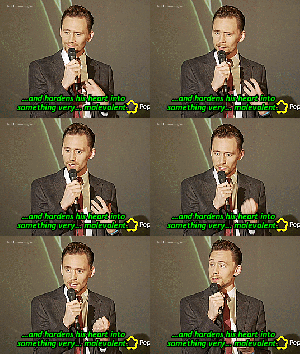
Waititi is trying to make it sound like Loki is a big fake and a phoney, “trying” to be tortured, “trying” to be artistic, “trying” to be emo and goth, like, Loki’s legitimate pain, heartbreak, and suffering is something he is faking so that he will be seen as these things. The whole thing is really insulting, and along the lines of stereotyping. And Tom Hiddleston had said these things, Loki’s soul was tortured, he had deep, inner reservoirs of pain, and yeah, Loki had a sensitive, artistic relationship with Frigga. He compared it like Thor being the star quarterback, and Loki being the sensitive artist. But Waititi is trying to say Loki is a big faker and a poser that just wants attention and to stab his brother.
And there is nothing wrong with being goth! I love gothic music too! ❤❤❤❤
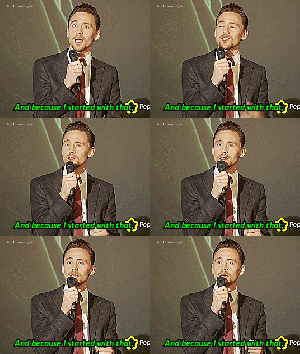
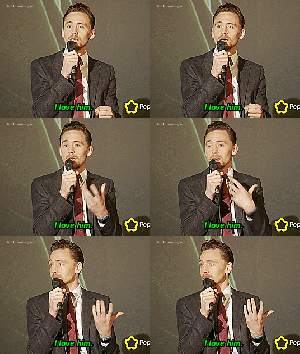
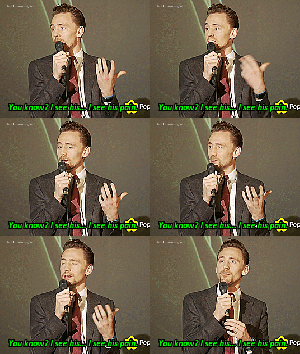
When you bring up those quotes from Tom, it makes me wonder whether Taika was really saying it about Tom under the guise of saying it about Loki: that Tom is trying so hard to make Loki into a tortured, artistic orphan with real trauma and pain.
Taika sounds like the most callous kind of neurotypical or “mentally healthy” person who thinks everyone with mental illness must somehow be faking it for attention or as an excuse for behaving badly.
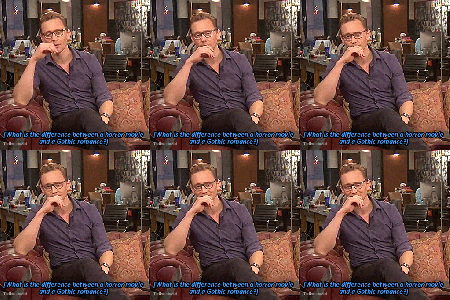
So, for all of you who’re curious enough to visit this post of mine, here’s the actual link/source of the Empire Podcast full interview of Tom Hiddleston that already existed since 4 months ago:
So, this article only contained the shortened version, it certainly couldn’t post all of the word Tom Hiddleston said in the interview. But of course, I find this article interesting in the way they published his answer, but I just want to highlight one part of what they published:
Talking to Taika Waititi before Ragnarok Taika and I went out for a bowl of pasta before Ragnarok and he said ‘I’m gonna change quite a lot. But I’m not gonna change you.’ And I took that as a huge compliment. I’ve always felt a responsibility to both honor the respect in which the character is held but also to try and progress it on.
Here’s the minutes in which its sentences was taken for the writing purpose:
From 9:38 – 9:50: Taika and I went out for a bowl of pasta before Ragnarok and he said ‘I’m gonna change quite a lot. But I’m not gonna change you.’ And I took that as a huge compliment.
From 10:12 – 10:25: I’ve always felt a responsibility to both honor the respect in which the character is held but also to try and progress it on.
As you see, there’s the space of between this word “I took that as a huge compliment”, and the word “
I’ve always felt a responsibility to both honor the respect in which the character is held but also to try and progress it on.”
For those of you who’re curious of those missing words (Tom Hiddleston’s words which cut off by the article writer, of course), here’s the real continuation right after “And I took that as a huge compliment.” part, with the bonus of full words taken from 9: 38- 9: 52 minutes.
“Taika and I went out for a bowl of pasta before Ragnarok and he said ‘I’m gonna change quite a lot, but I’m not gonna change you.’ And I took that as a huge compliment.
BUT that he (waititi) did change things actually (9:50-9:52 minutes)”
Anyone else is curious on why did the writers take this two seconds part —->>> “but he did change things actually”?? (Feel free to interpret this on your own to make your answer, as I already have mine).
P.S.: It’s ironic how Ragnarok zealots calling us as “ignoring Tom Hiddleston’s own words” when in reality, they’re the one who ignoring Tom Hiddleston’s words just because it doesn’t fit their own agenda.
I think part of it is, obviously, the tendency to accuse other people of the thing you’re guilty of yourself (e.g., accusing Loki fans who hate Ragnarok of ignoring Tom’s own words while they ignore Tom’s own words).
And I think there’s also an aspect of a tendency I see in discourse about politics all the time, wherein most people don’t actually read full articles or identify nuance. They see a headline or a blurb and they take that at face value instead of determining the context of what they’ve just read.
Obviously, neither of those fallacies are exclusive to Ragnarok/Taika zealots; they’re just generally a human tendency. But I definitely see them at work a lot with people who will defend Ragnarok to the death.
As to why the writers of the article decided to omit that short additional portion of his answer (for the fullest possible context; here is word-for-word absolutely everythingTom said in between “I took that as a huge compliment” and “But I’ve always felt a responsibility…”):
“But that he also–we did change things, actually. But [Taika] was really–of course, as we’ve–everyone’s seen Ragnarok, he radically changed things. Specifically with regards to Thor. You know, just, break him down, chop his hair off. And, uh… and Asgard too. But also, I do feel like it’s different every time, in a way that I’m not fully conscious of.”
….good question. And I am curious, actually. Specifically because in the fullest context, what he said in the omitted portion seems fairly neutral to me. He doesn’t speak especially positively or negatively about the changes Taika made. The main point I’d just want to highlight is that he never says Taika didn’t change Loki. Ragnarok lovers use this interview to claim that Tom approves of what Taika did with Loki in Ragnarok, but he never says that. He says Taika told him he wouldn’t change Loki. There’s no indication that he believes they didn’t change him. So at best, these fans are making an argument from silence. And at worst, they’re being intentionally disingenuous little assholes.
Thank you so much for doing the research, @seiramili7! I listened to the full interview, and you’re right that the context makes it ambiguous whether he thought Taika didn’t change Loki. It’s interesting that he remembered that conversation… I guess if it was one of his first significant interactions with him, it might stand out.
Speaking of making arguments from silence… it’s interesting to me that Tom has never said that he likes the way Ragnarok changed Thor as a character and the tone of the movies. He gushes about Kenneth Branagh and the depth that the original scriptwriters gave Loki; there was that similarly gushy e-mail to Joss Whedon where he said how much he loved the role:
It’s high operatic villainy alongside detached throwaway tongue-in-cheek; plus the “real menace” and his closely guarded suitcase of pain. It’s grand and epic and majestic and poetic and lyrical and wicked and rich and badass and might possibly be the most gloriously fun part I’ve ever stared down the barrel of playing. It is just so juicy.
I love how throughout you continue to put Loki on some kind of pedestal of regal magnificence and then consistently tear him down. He gets battered, punched, blasted, side-swiped, roared at, sent tumbling on his back, and every time he gets back up smiling, wickedly, never for a second losing his eloquence, style, wit, self-aggrandisement or grandeur, and you never send him up or deny him his real intelligence.
What Tom did say in praise of Taika in the Empire podcast was that he, like the other directors he’s worked with, “respected the brotherly relationship between Thor and Loki.” I would definitely side-eye that claim; there were some brotherly shenanigans, but they reflect a fundamentally unequal relationship in which Loki’s whole world revolves around Thor but Thor scarcely gives a thought to Loki’s feelings or inner world. And I’m sure some brotherly relationships are really like that. It was also interesting how Tom said that Ragnarok gave us a “capitulation or reconciliation” regarding Loki’s fraught relationship with his family. He then went on to talk about Odin’s acknowledgment of Loki as his son rather than Loki’s relationship with Thor. Still, interesting choice of word.
As a bunch of people have been saying, Tom is far too gracious to publicly criticize his co-workers or the films he’s been in (unlike Chris Hemsworth…). I don’t think I’ve ever heard him say a bad word about anyone, except maybe indirectly Donald Trump. So I’m not sure that we can take his positive words or omissions of criticism at face value. His omissions of praise, given his general tendency to gush about people and writing that really impress him, may actually be more significant. His downcast, disaffected demeanor and body language throughout the press for Ragnarok – but not so much for Infinity War, interestingly – could mean any number of things. Maybe he had just filmed the death scene in IW and he was depressed about that, about saying goodbye to the role; maybe he was getting a little too into his stage role as Hamlet, or was stressed out about preparing for it; maybe something else was going on in his personal life that we don’t know about because it’s none of our business. I don’t think we can determine for sure either way whether he approved of the direction in which TW and CH took the Thor franchise and the characters of Thor and Loki.
But as a bunch of people have also been saying, even if Tom thinks Taika didn’t ruin Loki, and even if Taika really didn’t intend to change Loki, that doesn’t prove what the TR/TW/CH stans want it to prove: that Taika did not, in fact, ruin Loki’s character. Tom is, in general, a sophisticated reader of texts and characters… but he’s not infallible, and he has an obvious motivation to see the best in his role in Ragnarok. And what an artist “intended” to do in advance of creating their work is often not the same as what they end up doing. Many of the things Taika has said in interviews do reflect contempt and lack of sympathy for Loki; I found this collection of quotes from him, but there was another compilation, I think by @yume-no-fantasy, that has even more evidence and I’m having trouble finding it, so if someone could help me out… I do remember a quotation of him saying “Not to want to humiliate Loki throughout the whole movie…” that reminded me strongly of when Trump says “I’m not even going to talk about X” and then proceeds to rant about X.
But even if Taika didn’t have malicious intent, even if he didn’t want to make Loki look like a shallow, incompetent narcissist with no understandable motives beyond “I did it for the lulz” and no legitimate grievances against anyone in his family… what matters is what the work shows.And the work does show contempt for Loki and an inability and/or unwillingness to understand his problems and motivations in previous films. My considered view, given the evidence both in interviews and in the tone of the film itself, is that this was malicious; but perhaps it was just the result of incomprehension and/or incompetence. My evaluation of the movie would not change even if Tom and Taika held a press conference in which Taika very earnestly and sincerely said that he was trying his best to do justice to Loki’s character and Tom said that he believes Taika succeeded; I would just say that they were wrong about the film that was actually made. Everyone on here is perfectly happy to say that even if Joss Whedon was trying to be feminist in his oeuvre, he failed and in fact made non- or anti-feminist works (I would dispute that generalization, but that’s not the point here). Artists can be wrong about the import of their work, the message or perspective it conveys. “The proof of the pudding is in the eating,” as they say; and the only way to determine the content or attitude of a piece of media is to examine it carefully and critically.








 Loki is the Philosopher King