

I’m not quite sure why I feel compelled to make this declaration, though it may be vaguely related to posts I have seen floating around making statements about Loki and/or Thor that just flat out seem to defy logic. So here are a couple of short lists.
1. Things that are true in my head:
· When we first meet Thor he really would have made an awful king.
· Thor is not a dumb jock. He is intelligent, but at the start of the first movie he is really arrogant and lacks both empathy and the willingness to think about the long-term consequences of his actions.
· That Loki was marginalized by Thor’s friends but not flat-out bullied. That for years he was the annoying little brother who they really didn’t want around but who wouldn’t leave. (As a little sister who grew up in a neighborhood where there were no other little girls to hang around with, I know exactly what it looks and feels like to be Big Brother’s Tag-along).
· When Loki tells Thor that Odin is dead, it’s bc he still thinks Thor would be a horrible king and wants to make sure he stays on earth.
· When Loki sends the Destroyer after Thor, he has no reason to believe Thor has changed at all.
· When Loki sends the Destroyer to eliminate Thor, Loki has also kind of started to go off the rails with self-loathing and is Not Thinking Rationally, and at this time he really did intend to inflict serious, permanent damage. Frigga really should have recognized this and shaken Loki by the collar. I am not sure why Marvel chose to portray Frigga so passively here. She is a an objet d’art in this movie, which is unfair to her character.
· Loki fully intended to commit suicide when he let go of Odin’s spear, both bc of his perceived rejection by Odin and his internalized racism.
· Thor really does love his bro and showed amazing self restraint in not pulverizing him when they fight on the Bifrost, esp bc he has no idea why his little brother is acting like a psychopath.
· Thanos tortured Loki before sending him to earth (come on! look at that after credits scene with Selvig!).
· When Thor initially shows up in the first Avengers movie, he was totally ready to take Loki back to Asgard and give him All The Hugs.
· Loki would have taken All The Hugs had he not been scared shitless of Thanos.
· When Loki dropped Thor from the helicarrier and when he stabbed him, his aim was to incapacitate Thor not kill him. Loki never believed anything he did would cause more than minor injury Thor (c’mon—that tiny little dagger? That’s like an Asgardian mosquito bite; plus, he probably thought Thor would get stuck in that glass cage long enough to stay out of the way–I will never be convinced that Loki believed the fall would be fatal).
· Loki fully expected to lose the battle in NY and honestly figured being in jail on Asgard was the safest place to be.
· Odin is a dick.
· Loki really did get run through by Kurse’s blade trying to save his brother’s life. (and honestly this is the movie where I pinpoint his redemption arc, and I think that giving him a redemption arc in Ragnarok was redundant)
· Loki really did almost die.
· Loki disguised himself as Odin in order to hide from Thanos.
· A couple of years in a nursing home would in no way hasten Odin’s death nor did Loki intend it to, though I’m sure Loki took great delight in the seeing his all-powerful dick of a father reduced to being spoon fed by someone who used baby talk (“Open wide, Mr. Borson! We don’t want your tummy to get upset when we take our medicine!”).
· Thor is still not a dumb jock, but he is now capable of introspection and occasional outburts of humility. Jury’s still out on empathy, but I’m willing to be convinced.
2. Things in my head that I hope are true:
· That before Thanos showed up Loki and Thor at least talked about the fact that Loki took a big ass sword right through his sternum.
· That they really did hug.
· That Tony and Loki get shit-faced drunk together at some point and bitch about their shitty dads.
@foundlingmother–I’m not entirely sure I would call MCU Thor compassionate, because I think in order to feel compassion, one has to first be able to imagine what it’s like to be someone else, and as I said, I’m not entirely convinced Thor has developed much capacity for empathy. I’m thinking particularly in Ultron when Banner is traumatized over the destruction caused by the Hulk, and Thor goes all Viking warrior about the screams of the dead. Not so empathetic. (though, as I said, I am willing to be convinced if some one wants to take up that discussion).
I would say, however, that Thor has an incredibly strong senses of duty, honor, and obligation. That’s why he’s polite when he’s really supposed to be (hanging up Mjolnir when he goes to Jane’s apartment like the good boy his mother raised). That’s why he works so hard to save Asgard from Hela–it’s his duty. That’s why he finally gives in and agrees to be king–obligation.
I would also repeat that he really loves his brother, dammit, and no one can convince me otherwise. So I think you are absolutely correct, @lola-zwietbeste, there is no way Thor knew that Loki had been tortured when he dragged him back home in chains. And even though he was a dick, I don’t think Odin knew, either. Certainly they would both have felt honor bound to revenge Loki’s torture as a slight against family and realm, though it is bit odd that no one thought to do a little bit of forensic investigating. Again, Odin=dick.
@writernotwaiting not one single thing here I disagree with. So refreshing to see rationality in this fandom.
I agree with @writernotwaiting on virtually all of this, except for two minor points:
1. I do think that it is partially accurate to say that Loki was “bullied” by Thor and his friends. I base that claim entirely on things we actually see in the movie and in the “Never doubt that I love you” deleted scene that we all accept as canon (so nobody go off on me about it having been deleted). Nonetheless, I do not hate them or entirely blame them for this. Consult my explanations at the bottom of the threads here and here.
2. I think that throughout the movies before Ragnarok, Thor is working on developing… sympathy, if not empathy. He slips up every now and then; he doesn’t really get why someone would be distraught over having killed enemies, but he catches on when Steve and Tony signal that he’s saying the wrong things and tries to backtrack. There’s something a bit incongruous about expecting someone from a warrior culture like Asgard to feel compassion, to treat someone else’s suffering as one’s own. As ever, I find Nietzsche’s contrast between noble and slave values enlightening: compassion and the imperative to relieve suffering are very distinctive of slave morality; of course Thor is driven by honor and duty – and respect for those he regards as his peers (if not his equals), including the human Avengers. Respect involves being aware of someone’s feelings, taking them into account, but also holding the person to the standards you accept for yourself – which explains why Thor flips out on Tony about the Ultron situation.
Finally: as you know, because I’ve said it a lot, I don’t think the version of Thor we see in Ragnarok, whom I call Thor* to mark the difference, is the same character as the Thor we see in Thor 1 through Age of Ultron. For that reason I think it’s misleading to try to track a development through Ragnarok and (to a lesser extent) Infinity War. It would be like trying to draw conclusions about the character of Thomas Jefferson from his depictions in 1776 and Hamilton (for the musical nerds out there…). The fact that different writers are involved isn’t necessarily prohibitive, because comics series can go through a number of different writers without losing continuity; it’s about whether the new writer respects the characterization that has been developed by previous writers and builds on it in a psychologically realistic way.
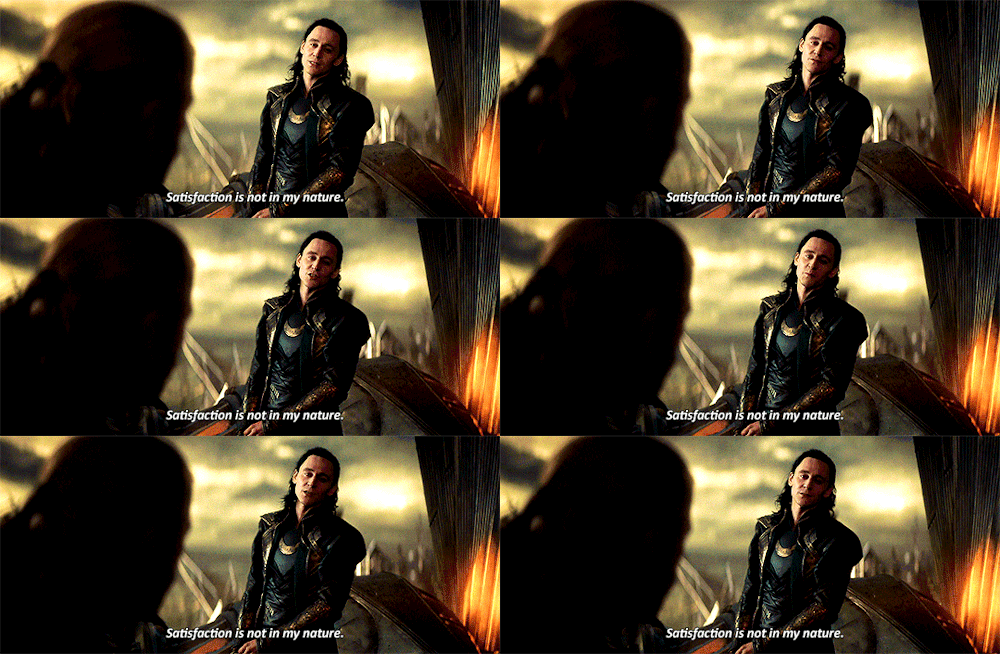
I’ve been thinking about this line a lot. And I’m not sure it’s given all the credit it deserves. It is well overshadowed by Thor’s immediate response (”surrender’s not in mine”), and by the line that steals this whole scene: “Trust my rage.”
But there’s something about this line that gets me, and I think it’s because it is probably the truest thing Loki has ever said about himself.
Loki, as we well know, is a master of avoiding his own problems, or else manipulating them to look like everyone else’s. He has told himself so many lies that he has begun to believe them: that he is hated, that he is alone, that he will never be anything but Loki. Frigga even points this out: “Always so perceptive, about everyone but yourself”. Loki can read everyone else, but when it comes to reading himself? Oh, Hel no. Those are dangerous waters, and he would rather not drown there.
And that’s why this line is so surprising and just so good. The fact that Loki is never satisfied is, when you think about it, pretty much the root of all his problems (at least ones that he can control). As a child and young adult, he appears to have mastered magic, but that was never enough, because it wasn’t like Thor, it wasn’t what Asgard wanted, it wasn’t what Odin wanted (or so he thought). He wants to be Thor’s equal, little realising that in many ways he is, but that, too, is not enough. He tries to be Thor, and is never satisfied. He tries to be Loki, and is never satisfied. He goes out of his way to prove himself to his family, and still he craves more. And so it escalates. A throne. A planet. He keeps reaching and reaching, oblivious to the fact that whilst he is grasping for the mountain’s peak, the rocks beneath him are slipping away.
And now we come to Ragnarok, and Loki has what he claims he has always wanted: the throne. A chance to rule. And I don’t think for a moment it is what he expects. Because once he has something, it no longer fulfills him; and he is stuck without a family, bearing the weight of the kingship, and I’m nintey-nine percent sure all he can do is sit there thinking ‘Well. Now what?’
And this is why happiness is so foreign to Loki, and always will be, and why he has doomed himself: for contentment, he must learn to settle, and because he is Loki, he will never settle. And so the cycle continues, and he proves time and time again that Loki’s worst enemy will always be Loki.
On some points, I agree. Without a doubt, Loki’s greatest and most persistent enemy is himself. Fueled by insecurity, he twists words and/or his own thoughts/memories, refuses to trust and doubts/denies the love that others show him, and avoids confronting problems by pushing them aside, running, or retaliating with some prank (or worse). “Satisfaction is not in my nature,” is one of the truest lines Loki’s spoken. There is an element of never settling. Intelligent people often struggle with restlessness. There’s an urge for more, more, more to satisfy a brain that keeps turning (especially when that brain will turn on itself if left to its own devices). However, a far bigger reason that satisfaction is not in Loki’s nature is because he struggles with mental illness. Happiness is foreign to Loki not because he refuses to be content with what he has, but because he’s incapable, through no fault of his own, of being happy.
Now, till this point I’ve allowed the assumption that Loki should be content if he were capable of being so, but that’s not the case.
As a child and young adult, he appears to have mastered magic, but that was never enough, because it wasn’t like Thor, it wasn’t what Asgard wanted, it wasn’t what Odin wanted (or so he thought).
There’s no indication Odin wanted Loki to master magic. Odin never, in any movie, showed he felt an ounce of pride in Loki’s accomplishments. He does mention that Frigga would be proud, and perhaps it’s implied that he’s impressed as well. Asgard, too, doesn’t respect Loki’s skills. We’re given a clear example of this in a deleted scene (the servant laughing when Thor says that some do battle while others just tricks). Asgard adores Thor. They eat up his showboating when he enters his coronation.
He wants to be Thor’s equal, little realising that in many ways he is, but that, too, is not enough.
It’s true that Loki is Thor’s equal in many respects. He’s powerful and cunning. His strengths are Thor’s weaknesses, and vice versa. They balance one another out. However, Asgard does not treat them as equals. Even Thor slips into putting Loki in his place. We are shown this on Jotunheim.
Even if Loki’s problem was that he refuses to be content, that does not mean that that refusal is unjustified or unhealthy. Should he be content in a position where he’s disrespected, where he’s reminded of his place when he attempts to council Thor, and where people are quick to mistrust him? (Regardless of the fact that Sif and the Warriors Three are correct about Loki’s crimes in Thor, they come to that conclusion with little to no compelling evidence, and become angry that Loki told a guard to go to Odin despite the fact that this saved their lives.)
And now we come to Ragnarok, and Loki has what he claims he has always wanted: the throne. A chance to rule.
Loki claims he wants a throne. However, Loki’s never desired a throne because he wants to rule. He desires a throne because he wants respect and deference and freedom (which power supposedly provides).
I think people assume that Loki got a chance at everything he desired in between TDW and Ragnarok, and found, unsurprisingly, it wasn’t enough. The truth is Loki has never had what he wants. What he wants is freedom and for people to respect and accept him for who he is. He wants this without having to compromise what makes him Loki (and another struggle, of course, is discovering what exactly it means to be Loki, and whether Loki’s someone worth being). Disguised as Odin, Loki is not respected. Odin is. It’s true he rules, but under another’s name and face. Nothing about his time as Odin achieves Loki’s desires save for, perhaps, a feeling a security against the looming threat of Thanos.
It’s entirely possible that even if Loki had respect, freedom, acceptance, and good mental health he’d still feel discontent, but that’s not the situation we see in the MCU. The Loki we see deals (very poorly and (self-)destructively) with legitimate grievance about his treatment, and suffers from wretched mental health. The fix for that is not, and never will be, to learn to settle for what you’ve got. Or, to put it in the terms of so many people I’ve encountered in my life, to “choose happiness”.
I think @foundlingmother is exactly right about what Loki’s problem is and what he ultimately wants. But I suspect it’s not so easy to draw a line between his shoddy treatment in Asgard and his mental illness. We know very little about the etiology of mental illness: how much is inherited, how much is acquired due to environmental factors. Early childhood experiences seem to be very important in the development of a person’s “attachment style,” so called; though of course Loki does not remember being abandoned as a baby and spending a day or two hungry, cold, and alone, that experience might still have imprinted itself on his emotional systems and left him extremely insecure and convinced, regardless of the evidence, that anyone he cares about will eventually abandon him.
Whether or not that was a factor, his insecurity about his own worth and his reliance on the approval of others was almost certainly reinforced by all the signals he received throughout childhood and youth, subtle or explicit, that he was not as good as Thor, and that his talents were less valuable. Take a close look at his interactions with Thor and the Warriors Four in the first Thor movie – including Hiddleston’s body language – and you can take a guess at what his childhood was like: he’s quiet, withdrawn, a little strange; the other kids think he’s weird and don’t really like him but put up with him because he’s Thor’s brother; Thor knows him well and values his opinions, at least in private, but in front of other people he pushes Loki aside to assert his own authority. Was Loki quiet and withdrawn to begin with because he already had social anxiety, innately or due to early childhood trauma, or just because he’s an introvert? Or did he develop social anxiety because of this inconsistent treatment (Do Thor & friends like/respect me or not? How can I tell?) and become more quiet and withdrawn as a result?
To be completely clear: I do not hate Thor and the W4; I do not (unlike some Loki stans) think they’re nothing but terrible abusive bullies. I think Thor had his own insecurities and took them out on Loki; I think Loki probably was kind of a little shit independent of all the other stuff, and the W4 may well have had some legitimate reasons for not liking him. Like many fans, I characterize Loki as being very similar to myself, and I know that I am an acquired taste; I have a dry, very nerdy, sometimes pretentious, often bitchy sense of humor; I’m an unabashed snob (about some things) and misanthrope. People who are very earnest tend not to like me, and that’s fine. Loki’s problem may have been that he had trouble finding people in Asgard who shared his mindset, and he ended up going along with Thor’s friends by default. I get the sense that Fandral was the one of Thor’s friends who liked Loki the most (he’s the first to jump to his defense when Hogun accuses him in Thor, and in TDW, he never threatens to kill Loki for betrayal), and that makes perfect sense if Loki is like me in the ways I’ve suggested.
Finally, a bit of completely unnecessary riding of my own hobby horse: you know who wrote that perceptive line, “Satisfaction’s not in my nature” (as well as the beautiful and memorable lines that follow it up)? That’s right: Joss Whedon. Perhaps Tumblrites should consider that the next time they insist as proof of their own moral purity that he’s a terrible writer of character and dialogue.
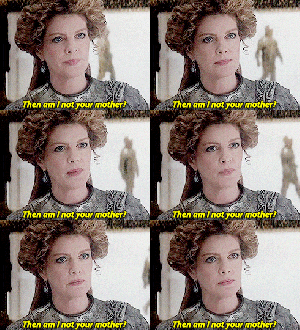

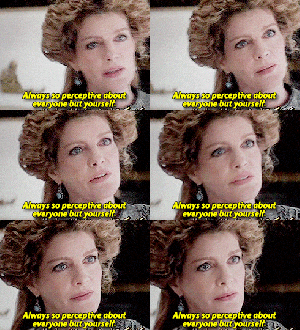

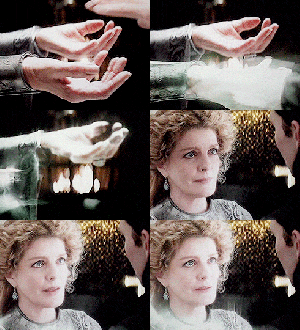
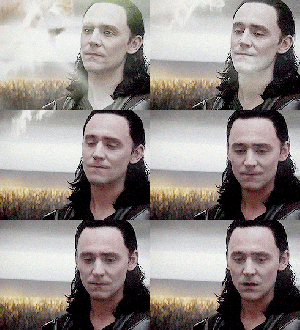
Something about this scene really struck me. In this scene, why does Loki deny Frigga? The correct answer is obviously ‘yes.’ It’s obvious he wants to say ‘yes.’ There’s no spiteful pleasure or sarcastic glee in his face when he says it, so he’s not enjoying it. So why does he say no?
Because the way this conversation has been set up, admitting that Frigga is his mother consequently means he admits he was lying (or at least, recants) his denial that Odin is his father. He can’t have one without the other. By yoking the two together in this way, Frigga is basically holding her motherhood of Loki hostage on the condition of Loki admitting that Odin has parental authority over him and that is something Loki will not – can not – do.I’m certain that the equivocation (if not the cruelty inherent in it) was deliberate on Frigga’s part. Frigga has always played the role of peacemaker in this family – she did in the first movie and she’s doing it again here. She asked the question in that way precisely because she wants to force Loki to admit that Odin is his father. She’s angling to get Odin and Loki to reconcile – whether as part of a campaign to get Loki’s sentence reduced, part of a campaign to get Loki’s services available once more to the crown, or simply aiming to reduce the conflict in their household (or possibly all three.)
But to Loki, Odin is not only the man who put him here, but the liar and the hypocrite who fucked up his life in ways beyond counting. Frigga wants him to submit to Odin’s authority not only as a king, but as a parent, meaning that Odin not only has the right to sentence him legally but also to chastise him emotionally and Loki simply can not stand that, not now. So he denies Frigga – even though it is obviously hard and painful for him to do so – because it would hurt him more to have Odin as father than it would help him to have Frigga as mother.
Loki said what he did not to be cruel and spiteful to Frigga, but because he was backed into a corner. Which is kind of the story of his life lately, really.
mcu characters ranked on a scale of how down they are to commit treason
one end of the scale is heimdall and the other is okoye
Heimdall: it’s not treason if you’re the only functional member of the government
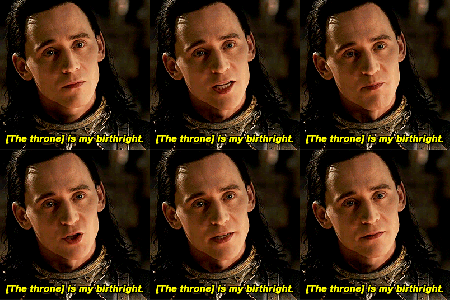
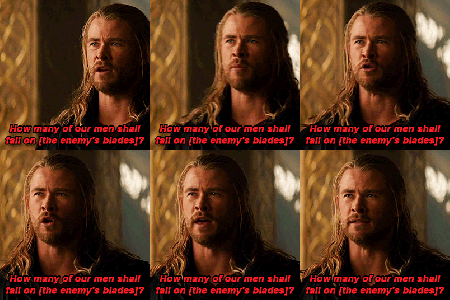


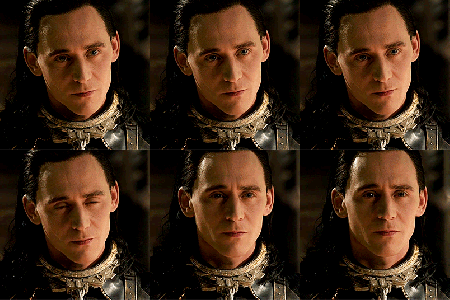
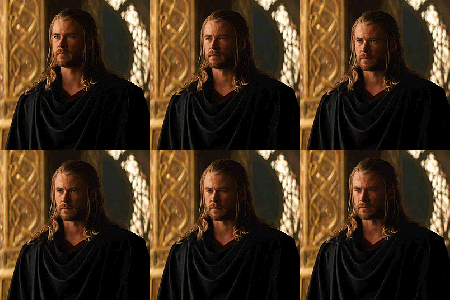
The lowering of the gaze – the difference between the two.
This whole comparison reads like a John Mulaney joke.
“So I could never understand how someone would want to take over a planet. Like how could someone just go to someone else’s planet and try to rule it. And then I met his dad and I was like, “Oh, okay. I’m not going to do it, but I totally get it now.”
The one thing good that came out of Loki discovering the truth about being Jotunn? No more lowering his gaze when Odin speaks. It still hurts, but Odin saying that validates every thought Loki’s had about how Odin screwed him over. Compare “Your birthright was to die!” to “You were both born to be kings.” Daddy dearest lost all authority over Loki.
The same thing happens to Thor after Ragnarok. Hela and Odin’s past reveal that there’s no worthiness to be gained in respecting Odin’s authority or leadership example. Thor’s free to be a good man and a king. Those no longer need be necessarily at odds to facilitate idolizing his father.
You’re right about Loki in TDW. I wish you were right about Thor in Ragnarok, but the movie isn’t that deep or even self-consistent: Odin still appears to Thor in a vision to offer him wisdom and Thor says that he’s not as strong as Odin was. I think Ragnarok was just ignoring that “good man vs. great king” line the way it ignored most of the rest of the previous films.


And here I hadn’t thought it could get much gayer…







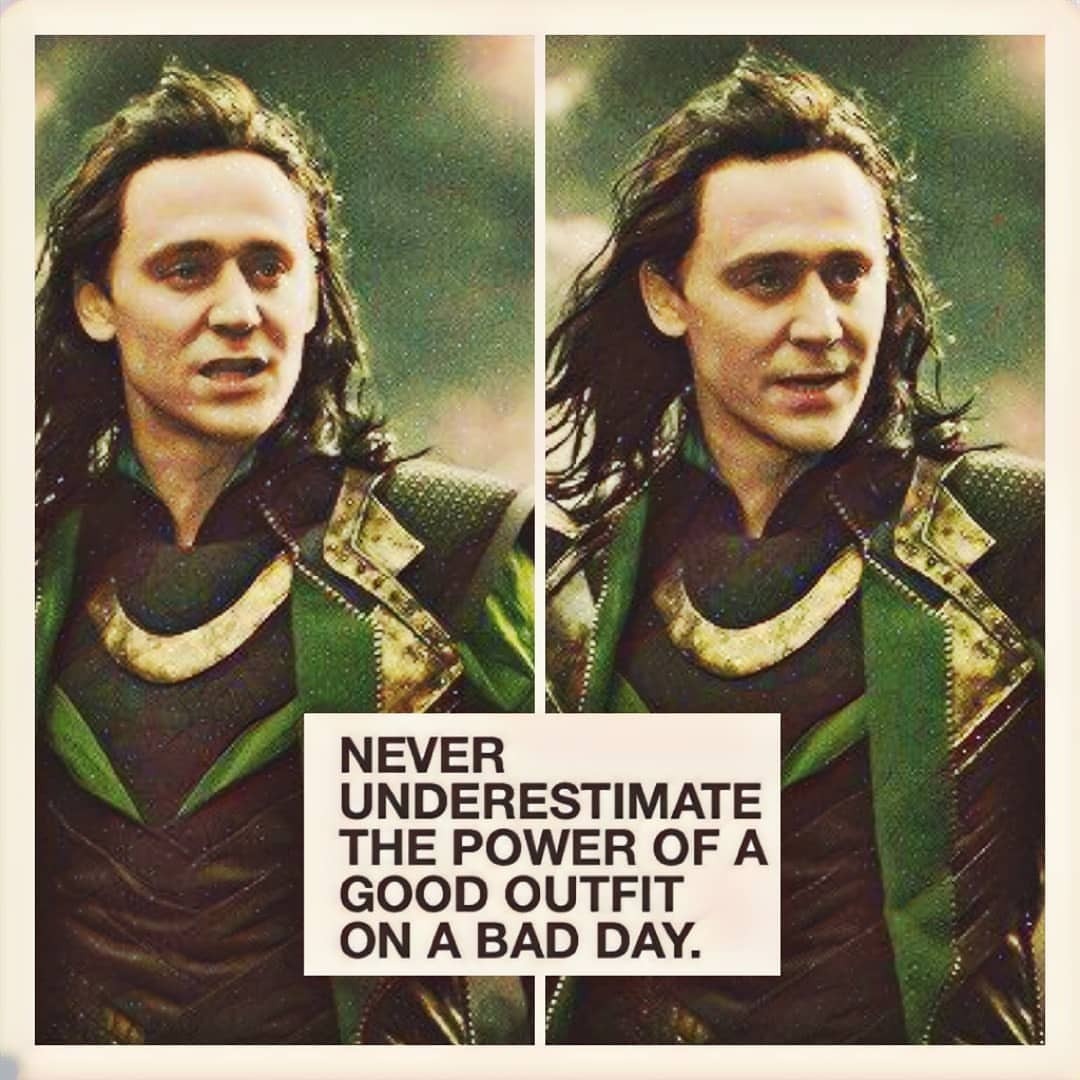
 Loki is the Philosopher King