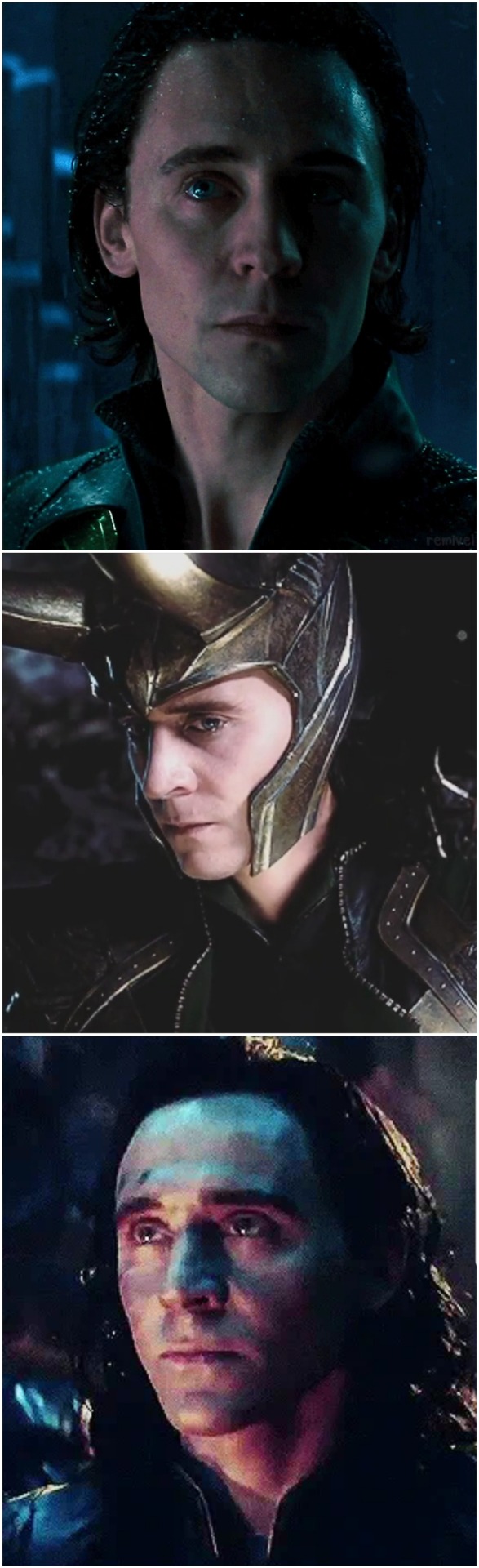
How can you come from a monotheistic family and have a deep understanding of polytheism?

philosopherking1887:

For background, this is in reference to (my bitching about) the post claiming that Taika Waititi has a better understanding of the gods of Norse mythology than Bad White Christian Joss Whedon, first (presumably) because he’s Maori and therefore closer to paganism (never mind that a significant proportion of the Maori population has been Christian since the 19th century), and then, according to a later commenter, because he’s Jewish (on his mother’s side) and therefore has a more down-to-earth conception of God.

This is not completely crazy, because while Judaism only recognizes one god, it has not always been strictly monotheistic in the sense in which Christianity and Islam are. According to ancient Jewish religion, the gods of other tribes/nations do exist, but we only worship one god, and there’s only one god worth worshiping, because he’s cooler than all the other gods (he created the world, so there) and can kick their asses any day. (There’s actually a story about that in First Samuel, when the Ark gets stolen and put in a Philistine temple and God comes out at night and breaks the idol of their god.) That’s why the Hebrew Bible says all that stuff about God being “a jealous god”; that wouldn’t make a whole lot of sense if God just didn’t want us wasting our time praying to gods that don’t exist. God has a personality, and it’s not always perfect; he’s jealous, he’s vengeful, he gets angry easily.

Since then, Judaism has become more properly monotheistic under the influence of Christianity in Europe and Islam under the medieval Caliphate (Maimonides, one of the most important Jewish theologians, lived in Caliphate-ruled Spain and wrote in Arabic. Sometimes empires can be cool). The God of Judaism has gotten closer to the omnipotent, omniscient, unfailingly benevolent God of philosophical monotheism, which runs you into the problem of evil… and that has definitely been a problem in Jewish history, especially recently. The main respect in which Judaism differs from Christianity (I don’t know about Islam) is that it doesn’t emphasize how sinful and unworthy human beings are compared to God. Sure, there’s some of that “what are we that You should take notice of us?” stuff in the psalms… but the fact remains that God has not only taken notice of us, but made an agreement with us on more or less equal terms; that’s what the covenant is. Paul claimed that the whole point of the covenant was to demonstrate that human beings are incapable of living up to God’s standards of goodness on their own, which is why they needed God to step in and save them (from Himself, apparently). Jews don’t buy that. Yes, it’s hard to do what God demands of us. Try anyway. When you mess up, apologize to God and to the people you’ve wronged, then try again.

I’m honestly not sure what any of that has to do with Taika Waititi’s and Joss Whedon’s portrayal of Thor and Loki, except that maybe someone raised Jewish is used to the idea of a god being an asshole and going overboard on punishing people (*cough*electrocution*cough*), which God definitely does in the Books of Moses. But rabbinic Judaism is as likely to try to justify that as Christianity is. And also I just don’t think it’s true that Whedon was trying to portray Thor as a perfect Christ figure and Loki as a completely evil Satan. European Christian culture has evolved; we have Milton’s Satan, we have Goethe’s Mephistopheles, we have flawed and human versions of Jesus. Whedon is well-read and educated; he refers to existentialist philosophy and the canon of great Western literature – including pre-Christian classical literature – in his work. If all people are seeing is a simplistic black and white Jesus vs. Satan, that’s their problem, not his.

I spent way too long writing this little essay, so I’m reblogging it in hopes that someone will actually see it.

How can you come from a monotheistic family and have a deep understanding of polytheism?

For background, this is in reference to (my bitching about) the post claiming that Taika Waititi has a better understanding of the gods of Norse mythology than Bad White Christian Joss Whedon, first (presumably) because he’s Maori and therefore closer to paganism (never mind that a significant proportion of the Maori population has been Christian since the 19th century), and then, according to a later commenter, because he’s Jewish (on his mother’s side) and therefore has a more down-to-earth conception of God.

This is not completely crazy, because while Judaism only recognizes one god, it has not always been strictly monotheistic in the sense in which Christianity and Islam are. According to ancient Jewish religion, the gods of other tribes/nations do exist, but we only worship one god, and there’s only one god worth worshiping, because he’s cooler than all the other gods (he created the world, so there) and can kick their asses any day. (There’s actually a story about that in First Samuel, when the Ark gets stolen and put in a Philistine temple and God comes out at night and breaks the idol of their god.) That’s why the Hebrew Bible says all that stuff about God being “a jealous god”; that wouldn’t make a whole lot of sense if God just didn’t want us wasting our time praying to gods that don’t exist. God has a personality, and it’s not always perfect; he’s jealous, he’s vengeful, he gets angry easily.

Since then, Judaism has become more properly monotheistic under the influence of Christianity in Europe and Islam under the medieval Caliphate (Maimonides, one of the most important Jewish theologians, lived in Caliphate-ruled Spain and wrote in Arabic. Sometimes empires can be cool). The God of Judaism has gotten closer to the omnipotent, omniscient, unfailingly benevolent God of philosophical monotheism, which runs you into the problem of evil… and that has definitely been a problem in Jewish history, especially recently. The main respect in which Judaism differs from Christianity (I don’t know about Islam) is that it doesn’t emphasize how sinful and unworthy human beings are compared to God. Sure, there’s some of that “what are we that You should take notice of us?” stuff in the psalms… but the fact remains that God has not only taken notice of us, but made an agreement with us on more or less equal terms; that’s what the covenant is. Paul claimed that the whole point of the covenant was to demonstrate that human beings are incapable of living up to God’s standards of goodness on their own, which is why they needed God to step in and save them (from Himself, apparently). Jews don’t buy that. Yes, it’s hard to do what God demands of us. Try anyway. When you mess up, apologize to God and to the people you’ve wronged, then try again.

I’m honestly not sure what any of that has to do with Taika Waititi’s and Joss Whedon’s portrayal of Thor and Loki, except that maybe someone raised Jewish is used to the idea of a god being an asshole and going overboard on punishing people (*cough*electrocution*cough*), which God definitely does in the Books of Moses. But rabbinic Judaism is as likely to try to justify that as Christianity is. And also I just don’t think it’s true that Whedon was trying to portray Thor as a perfect Christ figure and Loki as a completely evil Satan. European Christian culture has evolved; we have Milton’s Satan, we have Goethe’s Mephistopheles, we have flawed and human versions of Jesus. Whedon is well-read and educated; he refers to existentialist philosophy and the canon of great Western literature – including pre-Christian classical literature – in his work. If all people are seeing is a simplistic black and white Jesus vs. Satan, that’s their problem, not his.

edge-of-silvermoon:

foundlingmother:

Monthly (or there abouts) reminder that…

  1. My problems with Loki in Ragnarok have nothing to do with him being hedonistic, more overtly sexual, a tad ridiculous, and just more lighthearted in general. I didn’t buy into the characterization of MCU!Loki as a dark, twisted creature standing on the precipice above total psychopathy. That’s not who I think MCU!Loki was. Ever. My problem is with the implication that he’s just a trickster with shallow motivations, if any motivations at all, and with his legitimate issues and traumas being made into punchlines or brought up only to be shoved aside, left unresolved, as though they are unimportant.
  2. My problems with Thor in Ragnarok have nothing to do with him being smart, capable of the same tactics Loki uses, or even him being angry at Loki (it makes perfect sense to me that Thor would be upset–his father has just died and Loki did betray him for, from his perspective, no good reason). I didn’t buy into the characterization of MCU!Thor as a stupid jock who smiles, praises, and forgives Loki through every betrayal or attempted mass murder/genocide. That’s not who I think MCU!Thor was. Ever. My problem is with the way he derives enjoyment, apparently, from witnessing Loki in serious pain (he feels way more dudebro to me in this movie, and that’s exactly what Thor isn’t), that some of the jokes and dialogue sound more like Hemsworth than Thor, and the fact that he doesn’t have a character arc.
  3. I welcome all of the new and returning fans that Ragnarok brought in. Your talent is welcome. Your thoughts are welcome. I don’t think you’re wrong to enjoy the film.

“that some of the jokes and dialogue sound more like Hemsworth than Thor”, I am pretty sure that’s because it is (more like Hensworth than Thor). They proudly proclaim that in Ragnarok Hemsworth “is not even acting”, and well, we all see the results. They never thought about how Thor would have behave, would have acted, they just want to make him more fun to play for Hemsworth, and care little about anything else. I think that’s a ridiculous way to make character decisions.

My friends have taken to call Ragnarok Thor “Chris Odinson” just to make a distinction with the previous Thor, and I don’t think I can fault them.

Ooh, “Chris Odinson” is good. I’ve been using “Thor*” because people in philosophy use the asterisk to mark something that you might think matches up to the concept under discussion, but doesn’t really, or would be a really unusual way of using the concept. Like if you’re trying to come up with a good account of the concept of friendship, and as a first pass you propose “a non-sexual relationship with someone whose company you enjoy,” but then you point out that there are such things as friends with benefits, and you might want to call a sexual/romantic partner your friend as well, so then friendship* is the thing described by your first proposed definition. (That was really rough, sorry.)

It also occurred to me to call him “Shmor,” because the Yiddish shm- word beginning is another thing philosophers use to indicate a “close but no cigar” interpretation of a concept or another philosopher. So you know how if you’re skeptical about whether something counts as belonging to a certain category, you say the category name and then rhyme it starting with shm-? For example, if someone says they’re going to give me chocolate and then they give me white chocolate, which contains no actual cacao, I’d say “chocolate, shmocolate.” And when contemporary philosophers want to talk about a cartoon version of a historical philosopher that they know is not really an accurate representation of their view, they’ll use “Shmaristotle” or “Shmittgenstein” to note that. So “Shmor” would have been appropriate given that usage, but it also sounds weird and is even more confusing than Thor*.

I’m kind of attached to my nerdy convention, but “Chris Odinson” really does get the point across. Or “Thor Hemsworth.” Or “Hemsthor.”

foundlingmother:

Monthly (or there abouts) reminder that…

  1. My problems with Loki in Ragnarok have nothing to do with him being hedonistic, more overtly sexual, a tad ridiculous, and just more lighthearted in general. I didn’t buy into the characterization of MCU!Loki as a dark, twisted creature standing on the precipice above total psychopathy. That’s not who I think MCU!Loki was. Ever. My problem is with the implication that he’s just a trickster with shallow motivations, if any motivations at all, and with his legitimate issues and traumas being made into punchlines or brought up only to be shoved aside, left unresolved, as though they are unimportant.
  2. My problems with Thor in Ragnarok have nothing to do with him being smart, capable of the same tactics Loki uses, or even him being angry at Loki (it makes perfect sense to me that Thor would be upset–his father has just died and Loki did betray him for, from his perspective, no good reason). I didn’t buy into the characterization of MCU!Thor as a stupid jock who smiles, praises, and forgives Loki through every betrayal or attempted mass murder/genocide. That’s not who I think MCU!Thor was. Ever. My problem is with the way he derives enjoyment, apparently, from witnessing Loki in serious pain (he feels way more dudebro to me in this movie, and that’s exactly what Thor isn’t), that some of the jokes and dialogue sound more like Hemsworth than Thor, and the fact that he doesn’t have a character arc.
  3. I welcome all of the new and returning fans that Ragnarok brought in. Your talent is welcome. Your thoughts are welcome. I don’t think you’re wrong to enjoy the film.

I would also like to add (on a much less friendly note, sorry):

4. My (our) problem with Loki in Ragnarok had nothing to do with his being presented as more obviously gay/queer. It would have been great if they’d given Loki a semi-canon relationship with another man (I wouldn’t be surprised if he and Fandral had been involved at some point). Instead, they gave wink-wink nudge-nudge hints about a truly creepy “sugar baby” relationship with a murderous slave-trading monster and we’re supposed to be thrilled about the queer representation. And alongside the more overt but still not explicit gayness, they present Loki as petty, narcissistic, and incompetent. Way to subvert stereotypes, amirite?

5. I don’t just dislike Thor in Ragnarok because he’s mean to Loki. He’s also a complete asshole to Bruce and the Hulk, despite professing to be their friend. He’s self-absorbed and manipulative with regard to them as well as Loki. And while he is shown displaying cunning, most notably in that “tricking the trickster” sequence that culminates with his grotesque display of sadism, he shows no emotional intelligence whatsoever (except, perhaps, in his ability to manipulate Loki’s emotions). What the hell was that rambly speech to Valkyrie about how much he loves women? Is it supposed to be cute that in response to Loki’s concern about his reception on Earth, Thor says “Earth loves me,” indicating that he only ever thinks about himself? I have no problem with a little bit of humor at the hero’s expense – the Iron Man movies are full of it – but when the effect of the humor is to make him completely unlikable, you’ve gotta wonder what the point is.

incredifishface:

philosopherking1887:

@foundlingmother replied to your post

“Ugh, I really don’t like it when people reblog stuff about Loki’s…”

Yeah, Thor 100% has the capacity to understand Loki’s grievances, he just didn’t get a chance to because he wasn’t even in Ragnarok, Thor* was. Heimdall might not be a saint, but I think it’s wrong to assume he saw Loki with Thanos. It seems unlikely he would have mentioned none of that. As for Loki pulling a double-cross… while I get the appeal of this, it seems like such an unrealistic culmination of Loki’s arc even ignoring Ragnarok.

I’m not sure I think it would have been Whedon’s angle.

I mean, I know that Thanos behaves kind of stupid in GotG, but I feel like having him accept Loki as his ally with all that happens… would have undermined him as a villain.

Right… I wasn’t completely on board with all of @juliabohemian‘s analysis on my other post. She and I seem to fundamentally disagree about Thor’s moral character and disposition toward Loki as shown in previous films: I think the character called “Thor” in Ragnarok is a radical departure from Thor as we’ve seen him in previous movies, which is why I refer to him as Thor*; she, and many other non-Thorki-shipping Loki fans, think that Ragnarok amplifies Thor’s previous tendencies toward self-absorption and insensitivity, but is not completely discontinuous with the character. I don’t see us coming to full agreement on that issue anytime soon, and that’s fine.

As to the issue of the double-cross being “an unrealistic culmination of Loki’s arc”… I actually disagree with you there. If you just mean it would have been unrealistic for Thanos to accept Loki as his ally, I do see where you’re coming from there, but there are ways around it. The idea of having Thanos take Thor as a hostage is one way. That way Thanos wouldn’t have to trust Loki; he would just have to trust Loki’s unwillingness to allow harm to come to Thor, which given what Thanos knows about him he absolutely would and should. I think that would appeal to Thanos for a couple of reasons:

(1) Good old-fashioned sadism. Whedon’s Thanos clearly wasn’t into any of that pseudo-benevolent Malthusian bullshit; the reference to “courting death” in the Avengers tag scene indicated that Whedon was picturing a Thanos obsessed with Lady Death like he is in the comics. No attempt would have been made to make that Thanos sympathetic. That Thanos is a creepy fucker who would have gotten a kick out of torturing Thor physically (just a little) and torturing Loki psychologically with the knowledge that a step out of line would mean pain and/or permanent damage to Thor. Ooh, maybe he would have cut off a finger or a toe when Loki made a decision to undermine Thanos that he was just barely able to pass off as an incompetent fuck-up. And Loki would have known that… and wouldn’t have hesitated to trade his own pain, but when it’s Thor’s it’s so much worse. (Should I be worried about myself, coming up with this shit?)

(2) It would mean that Loki wasn’t a completely wasted investment. If Thanos were a good economist (which clearly he isn’t…), he wouldn’t buy into the sunk costs fallacy, and he’d be perfectly happy cutting his losses and cutting Loki loose… but I think he’s into narrative neatness (OK, this is just “Abyss” Thanos now, never mind what Whedon would have done) and he would like the idea of making Loki useful after all. Plus, there must have been a reason he thought it was a good idea to trust Loki with the Tesseract retrieval mission – and the Mind Stone! – in the first place; he must think he’s good at some stuff.

If by “unrealistic culmination of Loki’s arc,” you mean it wouldn’t be a realistic place for Loki’s character progression to go, then I definitely disagree. Part of what was so objectionable about Thor*’s treatment of Loki in Ragnarok was that he was effectively demanding that Loki become a different person as a condition of maintaining a relationship with Thor* (classic sign of an abusive relationship, btw). Of course, that demand was also based on the faulty premise, assumed by Ragnarok but by none of the previous films, that Loki’s basic nature or “essence” was the “god of mischief” who betrays people out of hedonistic self-interest or just because he thinks it’s fun. I mean, it’s not unreasonable for Thor to demand that Loki stop betraying him, but when you’re working on the assumption that that’s what Loki has been doing their whole lives, instead of just for the past 6 really shitty years out of 1000+, and that it’s just in his nature to do that, then you’ve really gotta wonder why Thor put up with it for as long as he did… and also you don’t give an abusive “change fundamentally or I’m leaving” ultimatum; you just fucking leave.

One of the best parts of TDW, which totally got me the first time I watched it, was when Loki makes a show of betraying Thor to trick Malekith into drawing the Aether from Jane. That was absolutely brilliant because it was Thor and Loki, together, taking advantage of some of Loki’s most distinctive features – illusion magic, acting ability, and a reputation for treachery – to achieve a good aim they shared. Having Loki pull a long con on Thanos would be that gambit writ large. And ideally, this time – in order for it to represent a progression from the incident in TDW rather than just a replay – Thor would not be on on the plan… but he would indicate, perhaps while conversing in a dungeon with one of Thanos’s other unfortunate prisoners, that he believes Loki is still on his side and is planning to double-cross Thanos in the end. He doesn’t know; he harbors some doubts; but he believes. That would represent character growth for both Thor and Loki: Thor is forced to trust Loki for a long period of uncertainty; and Loki is, on some level, trusting Thor to trust him. That, too, would be a source of anguish for Loki – wondering whether Thor thinks that Loki has betrayed him again, more grievously than ever – but he hopes, and maybe even believes (William James will-to-believe style, because it helps), that Thor believes Loki is doing the right thing, in his indirect, strategic way.

@fuckyeahrichardiii@illwynd@incredifishface, @seidrade, I’m bringing y’all in on my harebrained IW do-over ideas because I’m curious to know what you think. (I’m never writing this as a fic, because I’m not that good at plot details, but just the outline.)

i appreciate it, but I think I’ll pass. I can’t engage this level of mind power into fixing a movie I wouldn’t even have made. I simply don’t want to give Thanos a second of my mental time. He’s a stupid character with stupid motivations and he bores me. I would have preferred ye olde “rule the universe hur hur hur” kind of villain 145977577647 times, and failing that, the Thanos in love with Hela / Death was a good route to go to.  

So all the artistic and narrative decisions started from a point which for me was already irreparably stupid and boring. they killed Loki in the first 5 minutes, and that’s when they lost me and never got me back. 

If I was to conjecture ways to improve this film, it would be with an entirely different villain, with different motivations, and so my contribution as to what part Thor and Loki played in that imaginary story that never was is moot. 

i’m bitter and miserable and you’ll find me in the universe next door raving about the Transformers. Now THAT is a plot.

I completely agree with you about the version of Thanos we saw in Infinity War, as written by those dimwitted hacks-turned-freshman boys in philosophy seminar Markus & McFeely and made “sympathetic” by the equally sophomoric Russos. I’m only interested in reimagining the movie with the Thanos who was in love with Death/Hela, largely because in the fic I’ve been writing about what happened to Loki between Thor and The Avengers, that was the motivation I was assuming (and actually wrote in, long before we got the ridiculous movie version of Thanos). And also because I’m fantasizing about the version of IW that Joss Whedon would have written if he hadn’t gotten fed up with Marvel’s meddling in AOU. I really don’t think he would have killed Loki in the first 5 minutes, because he was the one who established the connection with Thanos in the first place and would have wanted to give it a satisfying payoff, and aside from that all the evidence suggests that he was genuinely impressed with the work Hiddleston and Branagh put into building Loki’s character and was invested in continuing to give him depth and interest.

I’m also vaguely assuming in this imagining that we got the version of Ragnarok that we deserved, though I’m also not completely clear on what that would have looked like. Thor and Loki would have had a real fucking conversation, for one thing. I think it was written and directed by Guillermo del Toro. Hela actually had half of her face missing (Guillermo loves that shit), and she and Loki bonded over being seen by the world and themselves as monsters. Maybe she was Loki’s mother, not Thor’s sister. And she definitely didn’t die at the end, because she needs to show up as Thanos’s would-be love interest in IW.

@juliabohemian replied to your post “@foundlingmother replied to your post “Ugh, I really don’t like it…”

I consider Ragnarok Thor to be woefully inconsistent with other films. My analysis of Ragnarok Thor is based on the premise that the film is intended to be part of a continuous narrative -despite its failure to be so. All of my analysis is based on my study of human behavior/child development & has zero to do with who I do or do not ship. I do not mind you disagreeing with my views & continue to enjoy your discourse. But I do not wish to be misunderstood.

No, I didn’t think it was a consequence of your not shipping Thorki; sorry for giving that impression. If anything it would be the reverse: Loki fans who have a darker view of Thor to begin with are unlikely to ship him with a character they love. (That doesn’t really explain the Thor*-stanning Thorki shippers who seem to believe that Loki has absolutely no redeeming characteristics, maybe beyond physical attractiveness… but then I don’t really expect consistency from people who don’t seem to know what it is.)

Thanks for clarifying on the issue of continuity of character. I’m operating on the assumption that the creators of Ragnarok honestly didn’t give a shit whether the narrative and/or characterization was continuous. In fact, I think they were banking more on the assumption of continuity with Loki than with Thor: they were trying to remove or forestall people’s sympathy for Loki by reframing everything he had ever done as merely an expression of his asshole-ish trickster nature, while they made it pretty clear that they were “reinventing” Thor.

@foundlingmother replied to your post

“Ugh, I really don’t like it when people reblog stuff about Loki’s…”

Yeah, Thor 100% has the capacity to understand Loki’s grievances, he just didn’t get a chance to because he wasn’t even in Ragnarok, Thor* was. Heimdall might not be a saint, but I think it’s wrong to assume he saw Loki with Thanos. It seems unlikely he would have mentioned none of that. As for Loki pulling a double-cross… while I get the appeal of this, it seems like such an unrealistic culmination of Loki’s arc even ignoring Ragnarok.

I’m not sure I think it would have been Whedon’s angle.

I mean, I know that Thanos behaves kind of stupid in GotG, but I feel like having him accept Loki as his ally with all that happens… would have undermined him as a villain.

Right… I wasn’t completely on board with all of @juliabohemian‘s analysis on my other post. She and I seem to fundamentally disagree about Thor’s moral character and disposition toward Loki as shown in previous films: I think the character called “Thor” in Ragnarok is a radical departure from Thor as we’ve seen him in previous movies, which is why I refer to him as Thor*; she, and many other non-Thorki-shipping Loki fans, think that Ragnarok amplifies Thor’s previous tendencies toward self-absorption and insensitivity, but is not completely discontinuous with the character. I don’t see us coming to full agreement on that issue anytime soon, and that’s fine.

As to the issue of the double-cross being “an unrealistic culmination of Loki’s arc”… I actually disagree with you there. If you just mean it would have been unrealistic for Thanos to accept Loki as his ally, I do see where you’re coming from there, but there are ways around it. The idea of having Thanos take Thor as a hostage is one way. That way Thanos wouldn’t have to trust Loki; he would just have to trust Loki’s unwillingness to allow harm to come to Thor, which given what Thanos knows about him he absolutely would and should. I think that would appeal to Thanos for a couple of reasons:

(1) Good old-fashioned sadism. Whedon’s Thanos clearly wasn’t into any of that pseudo-benevolent Malthusian bullshit; the reference to “courting death” in the Avengers tag scene indicated that Whedon was picturing a Thanos obsessed with Lady Death like he is in the comics. No attempt would have been made to make that Thanos sympathetic. That Thanos is a creepy fucker who would have gotten a kick out of torturing Thor physically (just a little) and torturing Loki psychologically with the knowledge that a step out of line would mean pain and/or permanent damage to Thor. Ooh, maybe he would have cut off a finger or a toe when Loki made a decision to undermine Thanos that he was just barely able to pass off as an incompetent fuck-up. And Loki would have known that… and wouldn’t have hesitated to trade his own pain, but when it’s Thor’s it’s so much worse. (Should I be worried about myself, coming up with this shit?)

(2) It would mean that Loki wasn’t a completely wasted investment. If Thanos were a good economist (which clearly he isn’t…), he wouldn’t buy into the sunk costs fallacy, and he’d be perfectly happy cutting his losses and cutting Loki loose… but I think he’s into narrative neatness (OK, this is just “Abyss” Thanos now, never mind what Whedon would have done) and he would like the idea of making Loki useful after all. Plus, there must have been a reason he thought it was a good idea to trust Loki with the Tesseract retrieval mission – and the Mind Stone! – in the first place; he must think he’s good at some stuff.

If by “unrealistic culmination of Loki’s arc,” you mean it wouldn’t be a realistic place for Loki’s character progression to go, then I definitely disagree. Part of what was so objectionable about Thor*’s treatment of Loki in Ragnarok was that he was effectively demanding that Loki become a different person as a condition of maintaining a relationship with Thor* (classic sign of an abusive relationship, btw). Of course, that demand was also based on the faulty premise, assumed by Ragnarok but by none of the previous films, that Loki’s basic nature or “essence” was the “god of mischief” who betrays people out of hedonistic self-interest or just because he thinks it’s fun. I mean, it’s not unreasonable for Thor to demand that Loki stop betraying him, but when you’re working on the assumption that that’s what Loki has been doing their whole lives, instead of just for the past 6 really shitty years out of 1000+, and that it’s just in his nature to do that, then you’ve really gotta wonder why Thor put up with it for as long as he did… and also you don’t give an abusive “change fundamentally or I’m leaving” ultimatum; you just fucking leave.

One of the best parts of TDW, which totally got me the first time I watched it, was when Loki makes a show of betraying Thor to trick Malekith into drawing the Aether from Jane. That was absolutely brilliant because it was Thor and Loki, together, taking advantage of some of Loki’s most distinctive features – illusion magic, acting ability, and a reputation for treachery – to achieve a good aim they shared. Having Loki pull a long con on Thanos would be that gambit writ large. And ideally, this time – in order for it to represent a progression from the incident in TDW rather than just a replay – Thor would not be on on the plan… but he would indicate, perhaps while conversing in a dungeon with one of Thanos’s other unfortunate prisoners, that he believes Loki is still on his side and is planning to double-cross Thanos in the end. He doesn’t know; he harbors some doubts; but he believes. That would represent character growth for both Thor and Loki: Thor is forced to trust Loki for a long period of uncertainty; and Loki is, on some level, trusting Thor to trust him. That, too, would be a source of anguish for Loki – wondering whether Thor thinks that Loki has betrayed him again, more grievously than ever – but he hopes, and maybe even believes (William James will-to-believe style, because it helps), that Thor believes Loki is doing the right thing, in his indirect, strategic way.

@fuckyeahrichardiii@illwynd@incredifishface, @seidrade, I’m bringing y’all in on my harebrained IW do-over ideas because I’m curious to know what you think. (I’m never writing this as a fic, because I’m not that good at plot details, but just the outline.)

juliabohemian:

philosopherking1887:

philosopherking1887:

Ugh, I really don’t like it when people reblog stuff about Loki’s death scene in Infinity War as if it’s touching or redemptive. It was just stupid. He would have done Thor a lot more good if he’d actually tried to be a mole in Thanos’s campaign and pull another long con. As far as he knew, Thanos was just going to kill Thor as soon as he’d killed Loki; he did, in fact, leave Thor to die, and Thor was just lucky the Guardians happened to be close by. If Loki had actually tried to make a go of the double-cross, Thanos might have kept Thor alive to use as leverage over Loki. Which would not have been fun for either of them, but at least Loki would have known that he was safe-ish, and it would have bought both of them time to figure out a way to get the better of Thanos.

I’m never going to write that better version of Infinity War, because I don’t really know how to write comic book movies and also I don’t have time. But in my head there’s a vague version of what it would have been like if Joss Whedon had been writing it, including Loki pretending to be on Thanos’s side for most of the movie(s) and setting up some truly ingenious way to betray him at the end. And maybe he would then die heroically or maybe he would actually survive to start over with Thor, I don’t know. But his arc would have been worthy of the character as Hiddleston, Miller & Stentz, Branagh, and Whedon had established him.

Oh, and we would have found out WHAT FUCKING HAPPENED with Loki and Thanos in between “Thor 1” and “The Avengers.”

I think that some people are choosing to interpret aspects of that scene as touching or redemptive because it makes them feel better. Because the alternative is embracing that it was utterly pointless and that Loki’s death was just torture porn, a plot device to hype Thanos as a villain and to fuel Thor’s manpain. And that is a bitter pill to swallow.

What I mostly can’t handle are posts that say shit like:

Aww…isn’t it sweet how Odin forgave Loki in Ragnarok. No. Because that’s not what actually happened at all. And Loki’s list of grievances against Odin are far greater than anything Odin might hold against him. One might be able to argue that Odin voluntarily stayed in exile because he realized what a piece of shit he was and felt guilty about it. Perhaps Odin learned what happened to Loki when he fell from the Bifrost and felt bad for imprisoning him. But since nothing was explicitly stated, we can’t know that for sure.

Aww…isn’t is touching how Thor forgave Loki at the end of Ragnarok. No. Because that’s not what happened. Loki realized that in order to make things work with Thor, he would have to set aside his long list of valid grievances and accept that Thor was simply never going to understand his suffering. Thor was never going to understand him. And Loki finally embraced that his quest to be regarded Thor’s equal was a futile one. This isn’t to say Thor is a bad person either. Just that he doesn’t have the capacity to accept or understand what Loki has experienced or to give him what he needs. As I have stated in previous meta, Thor is a product of a flawed society and flawed parenting, just as Loki is.

Aww…isn’t it sweet how Heimdall accepted Loki at the end of Ragnarok. Well no. Because that’s not what really happened either. Heimdall is no saint in all of this, although I suspect he’s a good deal more responsible than most of the people who surround him. He is aware of a lot more than anyone else too. Meaning he has no plausible deniability. He should have been aware of at least SOME degree of Loki’s interaction with Thanos, even if he didn’t see any of the possible torture or abuse. He was also probably aware that Odin chose to stay on Earth, instead of reclaiming the throne, and of all the positive things that Loki did while posing as Odin (such as separating infinity stones and sending them far away) which is why he does not attempt to arrest Loki for his deception.

Aww…isn’t it cute how Loki accepted who he was in IW? No, it’s not cute. Yes, I do believe that Loki said Odinson and looked at Thor as a way of saying “we are brothers, regardless of all the other bullshit”. It may have been his way of saying goodbye. But a lot of his dialogue during this scene comes from a place of deep dysfunction. Thor’s last words to Loki are words of disapproval. Which is appropriate, since the bulk of their exchanged dialogue is basically Thor either judging or disapproving of Loki in some capacity. Loki accepting that he is Jotun is good, in a way. But it still does not address the racism that prevented him from doing so sooner. Loki stating that he is the god of mischief is actually rather confusing. Because the word mischief implies a lack of purpose. It implies just doing random shit for laughs. And that is actually the opposite of the Loki we saw prior to Ragnarok.

People interpret things in a way that comforts them. A lack of continuity is frustrating. So they will knit things together in a way that makes them feel consistent, even if they are most certainly not.

I mean, Thor was also a victim of unbelievably shitty writing – or should I say “writing”? since so much was improvised or just dictated on the spot by TW – in Ragnarok.

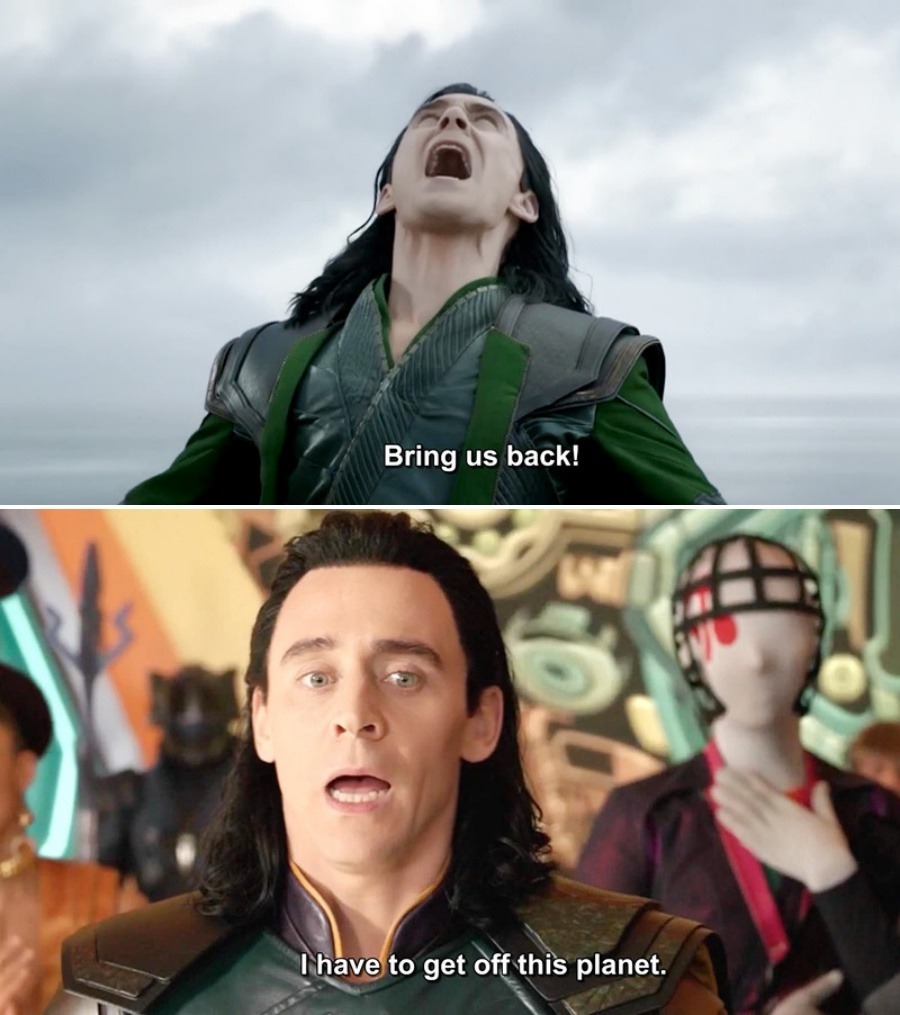
The terrible interpretation of Loki’s character in Thor: Ragnarok

yume-no-fantasy:

Things that Thor: Ragnarok director Taika Waititi said of Loki:

  • “Not to really wanna humiliate Loki all the way through the film, but because he was most definitely over-powered for a lot in the other films in terms of presence and his story, and kind of overshadowed (…) a little bit… This one, it was just nice to kind of switch it around, after all the shitty things that Loki’s done in the last few films…” (Source: Empire Film Podcast)
  • “space orphan”
  • “someone who tries so hard to embody this idea of the tortured artist, this tortured, gothy orphan”
  • “…this little emo goth hanging out by himself. He was like the kid in Harry Potter [Malfoy].”
  • has been trying to kill Thor his entire life
image
image
image
image

A number of significant ways in which Loki’s character was retconned in Ragnarok:

1.

Tom: Loki’s death on Svartalfheim was written as a death, and Chris and I played that scene for real. That was meant to be sort of that he redeemed himself. He helped save his brother and helped save Jane Foster, but he, in the process, sacrificed himself.

Ragnarok!Thor: You FAKED your own death

2.

TDW!Thor: Loki, for all his grave imbalance, understood rule as I know I never will.

Ragnarok!Thor: And what do I find, but the Nine Realms completely in chaos. Enemies of Asgard assembling, plotting our demise, all while you, Odin, the protector of those Nine Realms, are sitting here in your bathrobe, eating grapes.

3.

Tom: The best thing about Loki is that if he is afraid he won’t show it. He’s been highly trained through the experience of his slightly traumatic life to shield his fear. 

Loki in all other films:

image

Gagnarok!Loki:

image

Bonus:

image

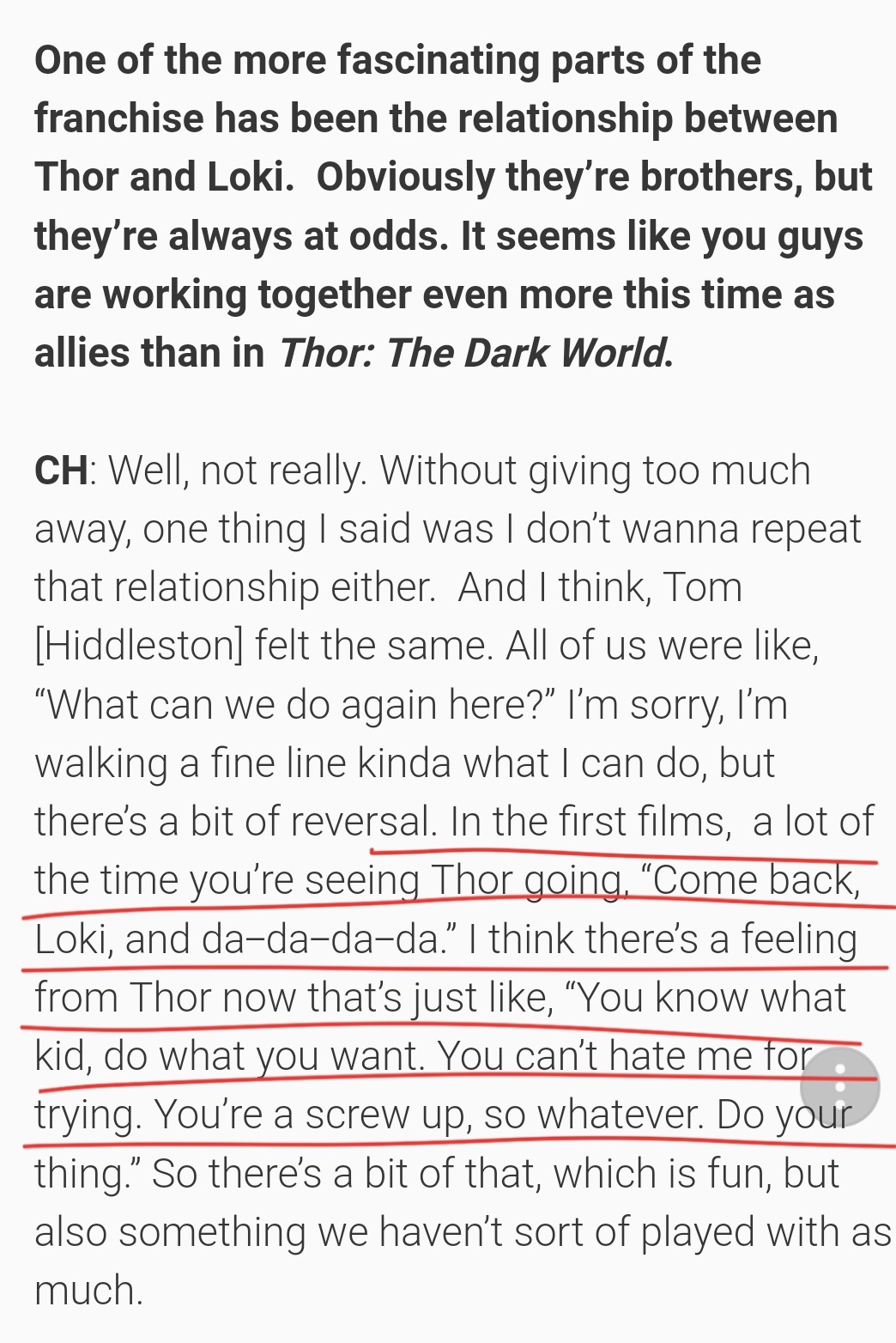
“You’re a screw up, so whatever.”

For the people out there who still don’t believe that Taika Waititi *and Chris Hemsworth* have been overtly contemptuous of Loki.

NB: this is not a spewing of venom, it is a presentation of evidence. (I don’t endorse the “Gagnarok” label, on grounds of taste rather than substance.)

Okay, I really hope I’m not bothering you too much, but what about Alan Taylor director of The Dark World? Idk how much it leans towards Christianity versus Norse mythology, but that was the film that really made me fall in love with Loki. Hiddleston’s portrayal was heartbreaking and the whole narrative with his mom?? Why are people not talking about Alan Taylor?

Nope, not bothering me, and I will get to your other question eventually…

The reason I don’t talk much about Alan Taylor is because I don’t really think of him as an artist with a distinctive voice or vision, the way Kenneth Branagh, Joss Whedon, and Taika Waititi are. That might be unfair to him, but I only really know him as one of a rotating cast of directors on Game of Thrones, where the writer and the director are almost always different people, and the “voice” of the series, if there is one, belongs either to George R.R. Martin or to Benioff & Weiss (especially in the last season… what a mess of disappointing clichés).

Now, it’s also true that the writer and the director of Thor 1 and Thor: Ragnarok were separate people: Thor 1 was written by Ashley Miller & Zack Stentz; Ragnarok was, in theory, written by Eric Pearson. However, by all accounts TR was about 80% “improvised,” which is to say, Taika Waititi suggested/shouted things to say instead of what was in the script… and Jeff Goldblum came up with his own shit. One of the more egregious examples of directorial departure from the original screenplay appears to be the infamous bit where Loki plans to betray Thor to the Grandmaster and then Thor outsmarts him by putting the obedience disk on him, gives him a smug little lecture about growth and change while he’s convulsing in pain, and then leaves him there incapacitated and defenseless (which I still think is unbelievably cruel, negligent of Loki’s safety, and OOC). According to people who have read the novel version (which I haven’t but maybe should) – @whitedaydream might be the person I got this from, or @lucianalight – that entire sequence was completely absent from the novelization. And we seem to have some evidence that they filmed a version without it: in some of the trailers: Loki shows up on the Bifrost with the rest of the Revengers rather than arriving later with the big ship. So even if the outlines of the plot were provided by Eric Pearson’s screenplay, the tone and character of the movie – its “humor,” if you liked it, or its soulless flippancy and cruelty (to both characters and fans), if you didn’t – indubitably came from Taika Waititi.

Thor 1 adhered more closely to the screenplay – which is available on IMSDb, if you’re interested – so I consider Miller & Stentz to have more of a role in its creative vision than Pearson did with TR. Stentz has even commented on Twitter about the theme of internalized racism; and that writing team also did X-Men: First Class, in which you can see some of the same themes and also the (totally unintentional…?) homoerotic tension between the two main male characters. That said, you can definitely see Kenneth Branagh’s distinctively Shakespearean sensibility in the way some of the important confrontations are presented – and that’s a major part of what gives that movie its overall tone and emotional power. (Also, as this post notes, Branagh & Hiddleston made some notable departures from the acting instructions in the screenplay that contributed to its tragic and also gay-incestuous vibe.)

The Dark World, as much as I loved it for its Thorki fic realness and ANGST, was kind of a creative mess. Patty Jenkins was supposed to direct it, but then backed out for reasons I’m not completely clear on, and Alan Taylor was brought in kind of last-minute. The screenplay was mostly written by Christopher Markus & Stephen McFeely, who wrote the Captain America movies, Infinity War, and Avengers 4, and whom I am fond of calling dimwitted hacks because that’s what they are. (The First Avenger was fine; The Winter Soldier is massively overrated and frankly kind of boring and confusing IMO; Civil War was a disaster of muddled, unsympathetic characterization and missed opportunities for interesting philosophical exploration; Infinity War was similarly disastrous, and showed us exactly why dimwitted hacks should not be attempting to explore philosophical issues.) I say “mostly” because Joss Whedon was brought in as a script doctor (one of his original jobs in Hollywood) to rewrite some scenes that weren’t working, including an “emotional” scene between Thor and Jane (not sure which one), the notorious Thorki bro-boat scene (and you can definitely see the hallmarks of his writing in that one), and Loki’s shapeshifting scene. Loki’s trial scene at the beginning was also a late addition, inspired by a TDW prelude comic; I honestly don’t know who wrote that scene, but the comic seems to have been written by Craig Kyle and Christopher Yost. The upshot is that TDW was most definitely a horse designed by committee, so it’s hard to identify whose creative vision it was expressing. I can identify Alan Taylor’s influence in the dark, grungy Game of Thrones-esque aesthetic, but I’m not sure where else to find him.