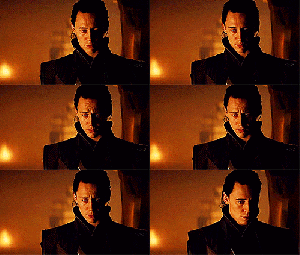
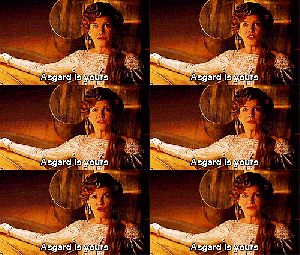
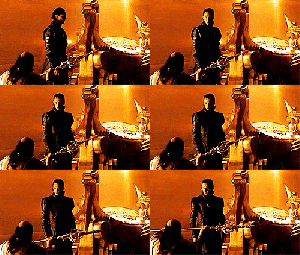
Okay this face makes me want to rant. People joke constantly about how Loki was lying to Thor about everything, even the fact that he loves his brother, because he always thirsted for the throne. Aside the fact that he SAID “I never wanted the throne, I only ever wanted to be your equal" to Thor in the heat of candid emotion, look at this face.
He makes this face WHEN NO ONE IS LOOKING.
WHEN NO ONE IS LOOKING.
WHEN NO ONE IS LOOKING.
It is in EARNEST. When the audience sees Loki making faces in moments like THIS, be they evil faces or sad faces, the writer and director are using a rhetorical device called DRAMATIC IRONY: the audience has insight into character feelings, motives, and actions that no other character has. There are three moments of Dramatic Irony in Thor:
1) When Loki facepalms at Thor wanting to go to Jotunheim and succeeding in convincing the Warriors 3 to join him.
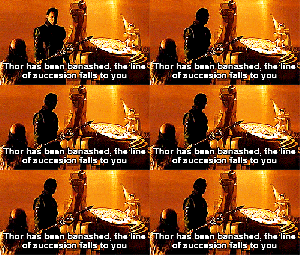
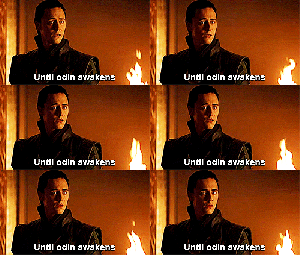
2) THIS moment, in this gif, and also when Thor is cast out and Loki reacts behind Odin’s back in shock and hurt—as well as in nervous vigilance when Mjolnir is cast out as well.
3) Much later, after things have escalated, when Loki lies to Thor that Odin is dead, turns away, and we see him smirking triumphantly that Thor has bought the lie.
ERGO:
—Loki did not plan for it to go this far.
—Loki is contrite that it went this far.
—Loki is also unwilling to stop its trajectory (although he DOES try once, before Odin silences him).
Almost anything else about events leading up to this is arguable, except that Loki a) loves Thor, b) is jealous of Thor, c) is conflicted about his own role in the family dynamic. And he did NOT want Thor banished. And he DID NOT anticipate that Odin would banish Thor. He just wanted Thor DISCREDITED as a leader to Odin so that Loki would have the time to prove HIMSELF a worthy heir (even though, as he himself SAID, it wasn’t even a title he ultimately wanted).
I find that people constantly argue that Loki planned for everything that happened to Thor in the first half of the movie. I deeply believe that this is inaccurate. I believe that Loki was an excellent deceiver but that his Achilles’s Heel has ALWAYS been to get in over his head. He thought the three Jotun guards would mess up Thor’s coronation. He thought Thor and Odin would argue and Odin would berate Thor for being “arrogant and reckless" (Loki’s words). He did not care about Aesir collateral, although he didn’t anticipate that either (because he thought Odin would get there faster, and didn’t realize Odin was tired and headed for an Odinsleep). And that’s it. He DIDN’T expect Thor to ever REACH Jotunheim (again, he overestimated Odin’s capacity to come stop them when he tipped off the guard), and I even argue he didn’t want Thor to even TRY (because he already got what he wanted, Odin is already furious at Thor, and also, because Loki facepalms, again, when NO ONE IS LOOKING, in EXASPERATION, he doesn’t triumphantly smirk the way he does after he’s lied to Thor that Odin is dead). And when they got there, and battled, and Fandral was wounded, and Odin took them all home, he DIDN’T expect Odin to banish Thor OR to cast Mjolnir out with him. THEN it happened. THEN the confession of Loki’s Jotun heritage happened. THEN Loki decided he’d go after Mjolnir and keep Thor exiled indefinitely. THEN Sif and the W3 disobeyed his mandate. THEN Loki panicked and sent the Destroyer to kill Thor. You see how things were not entirely planned out to the last detail, or rather they were, but anytime something on the chessboard shifted, so did Loki? Things snowballed.
People need to remember two facts:
a) Loki gets in over his head, because he’s playful and likes the thrill of danger.
b) Loki changes his plans 180 degrees with every new contingency. He is resourceful and capricious.
He establishes boundaries for himself to avoid what he sees as a manipulative, hopeless family member (doesn’t visit Loki in prison, doesn’t mourn Frigga with him, etc.).
He forgives Loki only after Loki displays behavior that to Thor indicates the potential for, if not a willingness to, change.
Yes, Thor loves Loki. Yes, he protects Loki even when he’s upset with him. But he’s never more lenient and forgiving and protective of Loki than I’d expect any loving family member to be (I hope it goes without saying that we’re dealing with a whole different scale when talking about movie villains and Asgardians). His willingness to accept that Loki can be rehabilitated, rather than punished, is indicative of his goodness, but I don’t think it’s something that applies only to Loki. Thor has to believe in the idea that people can right the wrongs they’ve committed and become better because Thor himself has a past.
Thor is a good brother. Not perfect, but he tries (and would do very well if the two of them had any ability to communicate healthily).
Yeah, Thor 100% has the capacity to understand Loki’s grievances, he just didn’t get a chance to because he wasn’t even in Ragnarok, Thor* was. Heimdall might not be a saint, but I think it’s wrong to assume he saw Loki with Thanos. It seems unlikely he would have mentioned none of that. As for Loki pulling a double-cross… while I get the appeal of this, it seems like such an unrealistic culmination of Loki’s arc even ignoring Ragnarok.
I’m not sure I think it would have been Whedon’s angle.
I mean, I know that Thanos behaves kind of stupid in GotG, but I feel like having him accept Loki as his ally with all that happens… would have undermined him as a villain.
Right… I wasn’t completely on board with all of @juliabohemian‘s analysis on my other post. She and I seem to fundamentally disagree about Thor’s moral character and disposition toward Loki as shown in previous films: I think the character called “Thor” in Ragnarok is a radical departure from Thor as we’ve seen him in previous movies, which is why I refer to him as Thor*; she, and many other non-Thorki-shipping Loki fans, think that Ragnarok amplifies Thor’s previous tendencies toward self-absorption and insensitivity, but is not completely discontinuous with the character. I don’t see us coming to full agreement on that issue anytime soon, and that’s fine.
As to the issue of the double-cross being “an unrealistic culmination of Loki’s arc”… I actually disagree with you there. If you just mean it would have been unrealistic for Thanos to accept Loki as his ally, I do see where you’re coming from there, but there are ways around it. The idea of having Thanos take Thor as a hostage is one way. That way Thanos wouldn’t have to trust Loki; he would just have to trust Loki’s unwillingness to allow harm to come to Thor, which given what Thanos knows about him he absolutely would and should. I think that would appeal to Thanos for a couple of reasons:
(1) Good old-fashioned sadism. Whedon’s Thanos clearly wasn’t into any of that pseudo-benevolent Malthusian bullshit; the reference to “courting death” in the Avengers tag scene indicated that Whedon was picturing a Thanos obsessed with Lady Death like he is in the comics. No attempt would have been made to make that Thanos sympathetic. That Thanos is a creepy fucker who would have gotten a kick out of torturing Thor physically (just a little) and torturing Loki psychologically with the knowledge that a step out of line would mean pain and/or permanent damage to Thor. Ooh, maybe he would have cut off a finger or a toe when Loki made a decision to undermine Thanos that he was just barely able to pass off as an incompetent fuck-up. And Loki would have known that… and wouldn’t have hesitated to trade his own pain, but when it’s Thor’s it’s so much worse. (Should I be worried about myself, coming up with this shit?)
(2) It would mean that Loki wasn’t a completely wasted investment. If Thanos were a good economist (which clearly he isn’t…), he wouldn’t buy into the sunk costs fallacy, and he’d be perfectly happy cutting his losses and cutting Loki loose… but I think he’s into narrative neatness (OK, this is just “Abyss” Thanos now, never mind what Whedon would have done) and he would like the idea of making Loki useful after all. Plus, there must have been a reason he thought it was a good idea to trust Loki with the Tesseract retrieval mission – and the Mind Stone! – in the first place; he must think he’s good at some stuff.
If by “unrealistic culmination of Loki’s arc,” you mean it wouldn’t be a realistic place for Loki’s character progression to go, then I definitely disagree. Part of what was so objectionable about Thor*’s treatment of Loki in Ragnarok was that he was effectively demanding that Loki become a different person as a condition of maintaining a relationship with Thor* (classic sign of an abusive relationship, btw). Of course, that demand was also based on the faulty premise, assumed by Ragnarok but by none of the previous films, that Loki’s basic nature or “essence” was the “god of mischief” who betrays people out of hedonistic self-interest or just because he thinks it’s fun. I mean, it’s not unreasonable for Thor to demand that Loki stop betraying him, but when you’re working on the assumption that that’s what Loki has been doing their whole lives, instead of just for the past 6 really shitty years out of 1000+, and that it’s just in his nature to do that, then you’ve really gotta wonder why Thor put up with it for as long as he did… and also you don’t give an abusive “change fundamentally or I’m leaving” ultimatum; you just fucking leave.
One of the best parts of TDW, which totally got me the first time I watched it, was when Loki makes a show of betraying Thor to trick Malekith into drawing the Aether from Jane. That was absolutely brilliant because it was Thor and Loki, together, taking advantage of some of Loki’s most distinctive features – illusion magic, acting ability, and a reputation for treachery – to achieve a good aim they shared. Having Loki pull a long con on Thanos would be that gambit writ large. And ideally, this time – in order for it to represent a progression from the incident in TDW rather than just a replay – Thor would not be on on the plan… but he would indicate, perhaps while conversing in a dungeon with one of Thanos’s other unfortunate prisoners, that he believes Loki is still on his side and is planning to double-cross Thanos in the end. He doesn’t know; he harbors some doubts; but he believes. That would represent character growth for both Thor and Loki: Thor is forced to trust Loki for a long period of uncertainty; and Loki is, on some level, trusting Thor to trust him. That, too, would be a source of anguish for Loki – wondering whether Thor thinks that Loki has betrayed him again, more grievously than ever – but he hopes, and maybe even believes (William James will-to-believe style, because it helps), that Thor believes Loki is doing the right thing, in his indirect, strategic way.
@fuckyeahrichardiii, @illwynd, @incredifishface, @seidrade, I’m bringing y’all in on my harebrained IW do-over ideas because I’m curious to know what you think. (I’m never writing this as a fic, because I’m not that good at plot details, but just the outline.)
[…. “When I’m king, I’ll hunt the monsters down and slay them all. Just as you did, father.” Child!Thor in Thor 2011, starting 6 minutes and 51 secs and ending at 6 minutes and 59 seconds.
And later, as an adult, “Father! We’ll finish them together!” Adult!Thor in Thor 2011 at 26 minutes and 19 seconds.
It is true that Thor also spoke of ‘breaking the Jotuns spirits’ so they would ‘never dare threaten’ Asgard again, but that does not sound too pleasant either, does it?
So, I am afraid your memory isn’t quite on point with this. So yes, Thor was on a similar tract with Hela, but in a different fashion driven more by hubris and power and arrogance, and he did think wiping out all the Jotun was just A okay. So it isn’t much wonder A. Loki felt he was a monster when he discovered he was the same race that his brother literally wanted to slaughter and B. he did not think wiping them out was much of a problem either.]
Apparently people are trying to say that we shouldn’t take what Child!Thor says seriously because he’s changed between that scene and when we see him again as a young man… a few seconds later in movie time. That argument makes no damn sense because the entire point of that scene with Thor and Loki as children is to establish (1) the way Odin fosters competition between them and (2) the basic character traits and dynamic that will continue into their adulthood. And that is, in fact, what we see: Thor remains outspoken and belligerent; Loki follows his lead, but is more hesitant and reserved, and seems always to be playing catch-up. It would be pointless and misleading to introduce them as kids if they’re going to be importantly different at the age when most of the movie takes place.
Also, how does “Father! We’ll finish them together!” NOT sound like suggesting genocide?
P.S. I want to make clear that I do not hate Thor and I do not think he is morally worse than Loki. I do think we should acknowledge that he has done some things that are comparable in severity to Loki’s worst crimes. If we are good readers, we will not take this to be a problem; Thor 1 makes it pretty clear, for those who are paying attention, that its hero is flawed and its villain is sympathetic. What makes Thor the “hero” and Loki the “villain” is primarily the direction of their change: Thor improves while Loki deteriorates. The fact that we’re watching Thor’s ascent makes him functionally the protagonist, and the fact that Loki ends up in conflict with Thor as they try to achieve their respective goals makes him functionally the antagonist. Wherever people got the idea that “hero/protagonist” necessarily means “morally blameless” while “villain/antagonist” necessarily means “morally worthless,” they need to drop that right now. (Although interestingly, I haven’t seen people have as much of a problem with this regarding Black Panther… which might just be because I’m not in a fandom specific to that movie, just indirectly through the MCU, so I see a lot less commentary on it in general.)
Literally everything Thor does in this movie is condescending and uncaring toward Loki. He’s not even remotely nice to him. His brother who said “Sometimes I’m envious of you, but never doubt my love” “I didn’t do it for him.” This entire movie was just a stage for Thor to be “awesome God of Thunder” and to put Loki in some sort of sideshow space.
Exactly where he started in the first film.
He’s back to just having to go along with Thor regardless of how he feels about the matter “let’s do get help, you love it.” “I hate it, it’s embarrassing” “we’re doing it”
Loki literally tells Thor he finds that modus operandi degrading and Thor essentially replies “I don’t give a flying fuck what you think, we’re doing it because I want to, so deal.” and Loki, of course, does exactly that.
Because that’s how it’s been with Thor for all their adult lives.
“know your place, brother.”
“Enough.”
TR took Thor back to square one. He’s not the mature, thoughtful king-in-training he was in TDW (I will ALWAYS prefer that version of him; it was true to his character arc). He’s gone back to the selfish, arrogant “it’s all about me” outlook. He doesn’t care about Loki, doesn’t ask his opinion– unlike the carefully executed plan of TDW where Loki gets to use his skills equally alongside Thor’s brawn.
But the one thing that really gets me about that comment above is this part: “while Loki thought it was an affectionate pat”
What. The. Hell?!?!?! God forbid Loki actually receive some real, genuine affection from Thor because he’s just a trickster, so he doesn’t really matter. That was beaten in our faces OVER AND OVER AND OVER by Taika Waititi–
Loki is just a dumb trickster who has no motive and no life-plan.
Loki just wants to drink margaritas and watch bad theater about himself because he’s a glorified narcissist.
Loki just wants to fuck the Grandmaster (or at least the GM wants to fuck him).
Loki and all of his past issues were non-issues, so stop feeling sorry for him.
Oh, and my favorite, though I don’t think I can contribute this to TW, but rather whoever wrote the script:
“You’ll always be the God of Mischief, but you could be something more.”
We’re supposed to admire Thor’s cleverness and kingly wisdom in this scene, when actually all this is doing is subtly reinforcing the fact that Loki’s been treated as the punching bag, the jokes-on-legs, the “if we have no SMART ideas I’ll just throw my LITTLE brother at the bad guys”.
What.
The.
FUCK.
I thought Thor was pretty cleverly executed given that he’s tried dealing with Loki in failure after failure to bridge that gap. The unconditional love of Thor 1 didn’t help, the attempt to regain common ground and offer a hand in Thor 2 ended in Loki faking his own death and usurping Asgard.
The problem was that Thor was enabling him rather than helping him. By Ragnarok he’s mature enough to guess how Loki is going to act, and he helps Loki help himself. Stepping back from the relationship logically, Thor’s love and trust has been abused time and time again and I don’t blame him from stepping back from it when he’s stuck in the same old loop of enabling Loki into the next fresh batch of bullshit.
I’ll preface the next statement by saying that I love Loki in all his incarnations dearly but it’s not as though he’s NOT guilty of some pretty despicable shit that Thor has been more than patient over (I’m talking about the entirety of The Avengers) so I think Thor is pretty validated in his suspicion and distance.
For what it’s worth, it DOES work and we see Loki in a better place at the end of TR and I suspect he needed someone he loves and respects to be sick of his bullshit in a dismissive way or he was never going to change. Which is reminiscent of what happened to his character arc in the comics but that’s a whole different thing. Loki’s been through a lot of writers in the MCU with varying quality and difference of characterization but personally I still think the biggest injustice is what happened in Infinity War.
Regarding the claim that Thor was “enabling” Loki by continuing to reach out to him, I would encourage you to read this post, because I really can’t say it any better. It was written by someone who liked Ragnarok for several months until having a conversation that led to the realizations described in the post.
The only reason “it DOES work and we see Loki in a better place at the end of TR” is because the same writer(s) who wrote that gambit ensured that it would work. (People who have read the novelization and said the betrayal-electrocution sequence wasn’t in there lead me to believe we have Taika himself, not Eric Pearson, to thank for that little bit of amateur relationship counseling.) It’s not like they tested it out on an actual person with the same complex of mental illnesses as Loki, as seen in previous movies. It’s not clear what he has (depression? bipolar? BPD?), but it should be clear to anyone that he’s unwell; he doesn’t just betray people for shits and giggles. And it’s debatable whether Loki is really in a “better place” at the end of TR. He’s been cowed into submission; he’s accepted a place as Thor’s inferior.
It also doesn’t make a whole lot of sense to say that Loki abused Thor’s love and trust in TDW, except given the assumptions about what happened that TR wants to push on us. It tells us again and again that Loki “faked his death” – but a more plausible reading, considering that Loki’s illusions aren’t tangible, is that Loki actually was impaled, thought he was going to die, and took advantage of the situation when he unexpectedly woke up. And considering that Thor told him he would just put him back in prison after they finished avenging Frigga (“Vengeance. And afterward this cell”), can you completely blame Loki for doing what he did? Can you completely blame him for exiling Odin, after all the shit Odin has pulled? TR totally ignores all the intelligible reasons Loki had for doing what he did: avoiding getting thrown in solitary confinement for life, with no Frigga to visit him – or worse (remember, “Frigga is the only reason you’re still alive”?); getting back at Odin for his lies and rejection (and for locking him away without actually asking why he invaded Midgard…); putting himself in a position of safety and power from which he could hide from Thanos and make efforts to thwart him (remember, it was Loki who sent Sif and Volstagg to store the Aether with the Collector). None of that is even mentioned; it’s just because Loki is such an incorrigible trickster and wants to lounge around in his bathrobe eating grapes and watching self-glorifying plays. That’s never who Loki has been in the MCU. He always has comprehensible, psychologically compelling reasons for his misdeeds: envy, resentment, the need for his father’s approval, internalized racism, vengefulness, threats and coercion from Thanos. Naked hedonistic self-interest has never been a significant part of his motivation. It’s only by completely reframing everything he’s ever done that TR makes it remotely plausible that Loki needs this kind of “tough love” to just “get over himself” and start being a good guy. What he needs is for someone to really listen, which Thor, even with all his pleas for him to come home, has never done.
reading an article about child psychology & favouritism and
One child grows up feeling powerful, believing they can do or accomplish anything while the other child grows up feeling defeated with low expectations of getting what they want.
honestly, in my opinion, the dynamic between loki and thor is fundamentally very unhealthy, on both sides, and the reason for this is because neither of them knows how to really listen to the other, and neither knows how to communicate with the other.
loki:
thinks that he knows thor better than thor knows himself
loki is very unstable, and his perception of how thor feels is heavily affected by his own self esteem at the time
even if thor is literally saying the opposite, loki will convince himself he knows what thor Really Means
loki fundamentally thinks thor is better than him and more important than him, and that means he will automatically put thor’s needs and desires (or perceived needs and desires) above his own
loki is frightened that if he disagrees with or openly disobeys thor (esp pre-thor 2011), that thor will withhold affection and love in the same way that odin will
often avoids questions, both as a defensive mechanism and to protect thor’s feelings
loki is hyperaware of the fact that people love thor, and hate loki, and that that is the natural scheme of things.
he is uncomfortable when thor acts like people should like loki, because it usually means – from loki’s perspective – that they will pretend to like him in order to please thor.
thor:
is quite arrogant, and does think that loki should obey thor’s orders.
does not take into account that loki might actually feel inferior to him, and genuinely does respect and love loki. he just settles naturally into his role as leader, and thinks loki should respect thor’s authority to some extent.
fundamentally thinks that a lot of the issues loki faces with strangers (before he does anything terrible) are bc loki doesn’t try hard enough to be likable.
he does not take into account how it might feel to be in loki’s position, and constantly be compared (and found lacking in comparison to) thor.
thinks that loki just shouldn’t get upset when people call him ergi, and would tell loki to just ignore it before he ever told somebody else to stop saying it in the first place.
becomes confused, upset, and defensive when loki deceives him instead of disagreeing to his face. he assumes that loki’s deception is inherently malicious, rather than a fear of confrontation.
often talks over loki and disagrees with him before he’s finished explaining something, especially if he doesn’t like loki’s tone.
literally loves loki more than anything else in the universe, and tends to change the subject when people say they hate him. he will always defend loki’s good intentions, and will normally prevent people from being straight up nasty to loki’s face.
doesn’t really occur to him that once thor leaves the room, that faux-nicety will fade
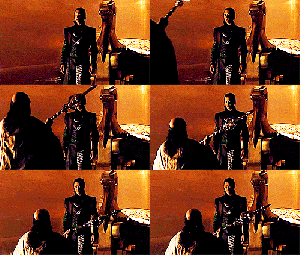
I love this scene too. It’s such a shame it was cut from the final film. I wish Marvel did extended edition dvds. When I saw it, it put Loki’s comment about having been king in a different light. And it also gives the following scene with the Warriors Three a different tone, more nuanced, less outright lying villan.
This is relevant to a recent discussion about that scene in the throne room with Sif and the Warriors Three. I think we’re supposed to think that they mistrust and dislike him more than his previous actions actually warrant; they turn out to be correct that he is up to no good, but they have no way of knowing that or the actual reason for it (i.e., the shattering revelation of his identity). We’re also supposed to think they have some reason for mistrusting him (“Loki’s always been one for mischief”), but not as much as they do: they seem to think that he’s usurped the throne (and maybe deliberately harmed Odin?!), but we know that the inheritance was completely legitimate and Frigga-approved.
From the deleted Thor & Loki scene where Thor says “Some do battle, others just do tricks,” the servant laughs, and Loki scares him by turning wine into snakes, I got the impression that Asgardians are simultaneously disdainful and suspicious of sorcery, especially when used by men and/or on the battlefield. That’s perfectly in keeping with the actual attitude toward the practice of seidr in ancient Norse culture: men who practice it were tarred with ergi,“unmanliness” (the major implication being that they bottom during sex with men). You see a similar attitude toward a man’s use of anything considered a “woman’s weapon,” such as poison: it’s considered cowardly, underhanded, dishonorable; but it’s also especially frightening because it’s hard to see coming and defend against. Asgardians expect Loki to be sneaky, not least because he’s a sorcerer. This may be a stretch, but it seemed to me that Hogun’s accusation drew attention to this connection: “A master of magic could bring three Jotuns into Asgard.” On the surface, he’s just saying that Loki had the capability to do it; but more implicitly he’s also suggesting that Loki is the type of person who would do it.
I suspect there’s something distinctively Shakespearean going on here: the villain who becomes a villain in part because everyone expects him to be one. One notable example is Richard III, who implies that he chose to become a monster in part because his deformity makes people see him as a monster already: “Deformed, unfinish’d, sent before my time / Into this breathing world, scarce half made up, / And that so lamely and unfashionable / That dogs bark at me as I halt by them… And therefore, since I cannot prove a lover, / To entertain these fair well-spoken days, / I am determined to prove a villain…” Another example is Shylock, who pursues the forfeit of a pound of flesh because Antonio has consistently spat on him and insulted him and his people. He puts the point elegantly: “Thou call’dst me dog before thou hadst a cause; / But, since I am a dog, beware my fangs!” I think both of these examples are instructive in Loki’s case. Loki accuses Odin of wanting to “protect him from the truth” of his origin “because I am the monster parents tell their children about at night”; and I have a variety of reasons for connecting Loki with Shylock.
sb: thor isn’t made of sunshine and rainbows, and is actually a complicated guy who’s done some bad shit, and shouldn’t be treated as an innocent teddy bear
thor stans: is this character hate?
thor stans: thor isn’t perfect but he’s not malicious and sure as shit didn’t try to commit genocide
sb: wow such a flat outlook on character. thor stans just can’t see thor as anything but perfect. sad.
As a fan of both Loki and Thor who finds Loki more interesting as a character but certainly does not deny that he has more moral problems than Thor, I have to point out that that’s a peculiarly bad example. Kid Thor saying “When I’m king, I’ll hunt the monsters down and slay them all” can be dismissed as little-boy careless bravado. Young man Thor, after starting a destructive battle on Jotunheim, shouting “Father! We’ll finish them together!”… harder to dismiss. Maybe he just means “defeat them definitively”; maybe it’s just the rage of battle talking. Or maybe he meant what he said when he was a kid.
Loki certainly has a more effective plan to commit genocide, and probably comes closer to succeeding. It’s indirect and technological rather than direct and warrior-like; that’s part of the difference between their characters. Loki’s attempt also has the complexity of being undertaken after finding out that he’s a member of the group he’s trying to wipe out. Does that make it morally better? Not exactly, but it does add an element of twisted pathos. In both cases, Odin’s miseducation deserves a large share of the blame.
exactly, they both have done wrong things, Thor changed and realised genocide isn’t the answer while Loki went the other way. And yet….they were both raised by a conqueror, someone who taught them their history in which it obviously shows that wiping out entire civilizations was alright cause they were inferior.
Thor says that you can’t kill an entire race while Loki answers: Why not? And what is this newfound love for the frost giants?You, could have killed them all with your bare hands!
It did surprise me that when Loki had the throne, he chose to stay put, and only care for Asgard, the Loki in Thor and Avengers would’ve turned into Hela, and he knows it.
Problem is, Thor is always painted as the Hero™ and that means that he can do or has done nothing wrong, and is not that simple.
Egh, I actually don’t agree that Loki really hated the Frost Giants and wanted to kill them. I think that was a panicked response to a situation he’d already escalated to fuck, and was very much prompted by self-loathing – barely ten minutes after attacking the Jötnar he tried to kill HIMSELF, and I think it was all to do with his hatred of himself that he wanted to attack Jötunheimr. A mix of hating himself and wanting desperately to make Odin proud.
Attempted Genocide round two. The invasion of Muspelhiem, the assassination of Surtr. The slaughter of its people. Thor was under the evil influence of Thanos after being tortured by him, wait that was wrong. Thor had just found out that he was a fire giant and his father told him his destiny was to die, and his brother had just gone off and tried to kill all the fire giants. No wait that’s wrong too. Umm.. Three fire giants sneaked into Asgard and tried to steal the cask of summer?? No.. Oh I remember. Thor was attacked by the Scarlet Witch and she had him hallucinate about Ragnarok. He became so obsessed by his hallucination, even though every other hero had experienced a similar attack he decided to drop all his obligations and race off across the nine realms trying to stop his hallucination from becoming reality. That was his reasoning. Sorry dude I’ve dropped acid in my time. I don’t go around cutting down trees because of the one bad trip where I hallucinated a tree was following me around all night, to eat me. You only had a 20 minute spell. I call bullshit on his heroism.
Ok so I wasn’t gonna get into this because I haven’t seen the first movie in awhile and I’m not even in the headspace to discuss character motivations right now, but I think I’m gonna have a go.
The problem with this whole thing, in my opinion, is that- to most normal audience members who aren’t obsessed with all the intricacies of these films (*cough* not nerds)- it seems that Thor is constantly in the right, not because he’s never tried to commit genocide or expressed disturbing bigoted ideals and flawed morals, but because every time he has done these things, the film makers have made it out to seem like he’s doing them for all the right reasons.
It’s like: He hates jotuns and sees them as nothing more than monsters to be slain? Well that’s just because they attacked Midgard long ago, so technically he’s right. Oh, he wants to kill all of the jotuns? Well, they did ruin his coronation and they do seem like cold cruel people, so he’s just doing the universe a favor, probably.
More examples: What, Thor chooses to strangle Tony instead of talking like a civilized individual? Well, Tony did just accidentally create a murder robot so he deserves to be physically threatened by a being much stronger than him. Oh, Thor runs off to assuage his paranoia over the hallucinations instead of staying and protecting Midgard (like he said he’d do) or returning and checking on Asgard? Well, it ultimately led him back to Asgard, so it’s cool.
I have a ton more examples, but I can’t add them right now because I’m posting this on my phone and mobile gets glitchy once you’ve typed so much.
But yeah, the issue isn’t that people don’t acknowledge his wrongdoings. It’s that they brush them aside simply because Thor is made out to be this heroic honorable awesome Good Guy, and they assume that means every single one of his dick moves are justified.
And it’s not just Thor. Almost every single one of the Avenegers gets the same hypocritical treatment from fans. Steve started an entire war and was a complete arrogant fuckface while doing it? Oh, he was protecting his friend so we can argue that all of that was the right move and even congratulate him for it. Natasha, Clint, Tony, and Bruce all killed lots of people in their pasts? It’s fine, they’re heroes now. Wanda literally messed with everyone’s minds and she and Pietro fought against the Avengers to achieve the goals of their evil leader? It’s ok, he manipulated them and they were heroes in the end so it’s totally fine.
I mean, I love all of the people I just mentioned. They’re great and they absolutely are heroes, but it’s extremely irritating when people don’t hold them accountable for their past actions simply because they “meant well” or because “they’re heroes now”. Because how much do you wanna bet that those fans are the same ones shitting on Loki and Odin and others for their flaws and mistakes and refusing to acknowledge their heroic traits.
I think @musclesandhammering is quite right about the interpretive pattern. Framing is powerful, and framing certain characters as “heroes” (i.e., we root for these ones) and others as “villains” (we boo them) primes us to read their actions in predetermined ways.
Unpopular opinion: the movie with the best characterization of a mature Thor is Avengers: Age of Ultron.
The opinions on quality of Thor’s maturity and growth across films will always be subjective, I believe, but Thor in Age of Ultron is underrated in this regard. I think it’s the first movie where we see Thor not necessarily in the process of becoming more mature, but being mature. It’s the first film where Thor isn’t just actively trying to overcome the mistakes of his youth, trying to find his own way in the universe, and/or fighting with sentimental emotions to do what’s right.
I don’t think this opinion is unpopular simply because many people think that it is completely not true, but rather because this film is unpopular. It’s easy not to pay attention to Thor’s characterization when it’s not a fan favorite for a lot of people. From what I can remember, parts of the fandom were fizzling out and the excitement of the first Avengers film was wearing off. However, what I also remember was the overwhelmingly positive reaction to Thor despite it all.
I believe that was in part because Thor was the mature one. Thor was the wise one. Thor was the patient one. Thor was willing to face many unknowns in order to make the right decisions. Thor embodied qualities that people wished were present amongst all the other heroes. Of course, this was all made possible by Thor’s growth over the previous films. Thor was relatively sheltered from consequence for a long time as a prince, but was forced to mature.
Thor was more somber in Age of Ultron, due to the loss of his mother and his brother. While this could have made him self-destruct and I would not blame him for it, he chose to turn his mourning into something productive. He was shaken by the visions he was given, and chose to go out to find answers despite how frightening those answers may be. Furthermore, while his anger often gets the best of him, he only lost control on Tony Stark.
Why? …because he actually understood the gravity of Stark’s choices. Thor wasn’t having a tantrum. He wasn’t aggravated because he was prevented from doing something he wanted or needed to do. He wasn’t being impatient. He was angry because no one seems to be taking the situation as seriously as they should and if they are they’re wallowing in despair, while Thor has been working tirelessly to find solutions to a situation that could have been prevented.
Thor was the mature one in that film, because he had to be. To me, that doesn’t mean that Thor needs to maintain a serious outlook and attitude across the films moving forward. Thor continues to make difficult decisions despite the amount of pain and loss it brings him, and he’s been able to do so with a serious attitude and with a sunny optimistic disposition as well. Age of Ultron Thor embodies maturity in a lot of ways, though, in a manner that stands out.
It’s just unfortunate that the movie does not equally stand out.
Unpopular opinion #2: AOU is underrated, largely because people have the knee-jerk impulse to demonstrate their moral purity by hating on Joss Whedon for everything he does – not just his characterization of women, which does have some issues, but also his storytelling and characterization abilities more broadly. Plot-wise, AOU is no messier than Civil War; in terms of character arcs and philosophical depth, it’s in a different league entirely.
Unpopular opinion #3: Ragnarok does not show a mature Thor but “with a sunny optimistic disposition” instead of a serious one; it does not depict Thor at all. Infinity War attempts to get back to mature Thor, but is hampered by the need for some kind of continuity with Ragnarok (which showed no such consideration for its predecessors) and the fact that character was taking a backseat to a contrived plot throughout IW.
Unpopular opinion #1b: Thor in AOU is exactly what “funny Thor” should look like. His sense of humor is subtle and deadpan; he occasionally veers into the undignified, but never comes off as a buffoon.
For further clarification, I’m not stating whether I like or dislike any of the films or their creators, nor am I measuring the films against each other in quality. Age of Ultronisone of the least well received movies in the MCU thus far, and the fandom didn’t respond as strongly to it as they did to the previous Avengers film for various reasons that I’m not going to get into because this was about Thor. Not the quality of the film. Civil War also hadn’t been out yet to make any comparison, but that movie also didn’t get the best reception.
So, as I was saying, the movie does not stand out by comparison even though Thor definitely stood out to fans of the character. This isn’t based on my opinion of the movie, but rather critical reception of the film and lack of fandom interest compared to the previous Avengers. Furthermore, despite my disagreements with your opinion re: #3, I never mentioned Ragnarok or Infinity War.
I stated the following:
“Thor continues to make difficult decisions despite the amount of pain and loss it brings him, and he’s been able to do so with a serious attitude and with a sunny optimistic disposition as well.”
…because it is something that I have noticed applies to multiple works across mediums wherein Thor appears. I don’t want to limit Thor’s characterization to very serious or overly optimistic when I have seen both from Thor whilst dealing with making mature decisions. However, that wasn’t why I responded in the first place. It was to further discuss how Thor is noticeably mature in Age of Ultron, which fans responded positively to despite the comparative lack of success of the film.
So, you’re projecting your negative attitudes about Ragnarok onto my own observations of his character even though I was making a general statement about Thor and the mature decisions he has made, perhaps just because I don’t see Thor as a vapid representation of himself in Ragnarok like you do (which, I see no point arguing. People seem pretty adamant about where they stand with this film and it’s not my job to force people to like something that I like.)
I don’t agree with your last point either, but I’m not going to argue against it because it’s all based on subjective likes or dislikes regarding Thor and humor. Again, I’ve seen creators use a wide range of it across mediums as well. So, I really see no point arguing which one is the most “correct.” I’m also not going to argue against it because I don’t see how it’s relevant to Thor’s maturity in Age of Ultron. I don’t see how 99% of this response to me was relevant. Instead, it just reads as completely passive aggressive and hostile towards me for no particular reason other than you don’t like Ragnarok.
I agree with most of what you said about Thor in Age of Ultron, including the bit about why he lost his temper with Tony. I do think he still has some anger management issues, and sometimes forgets how much more fragile humans are, but only when the stakes are very, very high.
You said that AOU was “not a fan favorite for a lot of people” and “did not equally stand out” as a whole; I offered an explanation. I think people have trouble acknowledging any of its virtues, including Thor’s characterization, because of the Whedon-hate.
As to Ragnarok, I read between the lines of the statement “that doesn’t mean that Thor needs to maintain a serious outlook and attitude across the films moving forward. Thor continues to make difficult decisions despite the amount of pain and loss it brings him, and he’s been able to do so with a serious attitude and with a sunny optimistic disposition as well.” That seemed to be referring to the “lightening” of his character in TR and consequently in IW. I was registering my disagreement with the apparent claim that Thor in Ragnarok represents a continuation of the maturity he had achieved by AOU, just with a change in his level of cheerfulness or optimism. Because you said “across the films moving forward,” I assumed you were talking about the MCU rather than the comics, with which I admit to being less familiar. So yes, my response was relevant to something you said, albeit something said indirectly or by implication rather than explicitly.
Finally, I disagree with your claim that judgments about Thor’s characterization in AOU vs. Ragnarok are “all based on subjective likes or dislikes regarding Thor and humor.” Like many people who work on the philosophy of art (not that I’ve worked on it much, but I hope to in the future), I hold that judgments about the quality of works of art are neither wholly objective nor wholly subjective. There is no one single interpretation that is authoritative, but there can be better and worse interpretations, which often entail or at least suggest a certain range of evaluative judgments about the quality of the work. And if anyone is tempted to say “They’re just popcorn movies, why are you taking them so seriously”… Athenian tragedies and Shakespeare’s plays were the popcorn movies of their day. My dissertation advisor writes papers about “The Sopranos” and “Breaking Bad.” I’m not saying the MCU will survive as this age’s great art, but the fact that it’s pop culture doesn’t mean it’s not worth thinking seriously about.






 Loki is the Philosopher King