I hate that during this scene the warriors 3 are basically trying to bully Loki, the current King of Asgard, into doing what they want him to do as always. They had clearly been nothing but disrespectful to him his entire life and I honestly wonder why Loki put up with it so long. Like, fuck them. And Loki baby, I am so glad you treated them in the most King-like fashion, never lowering to their level, and maintaining that poise and elegance that trademarks you as royalty and superior. Yet, I am proud of you for putting them in their place💚
“We’re done.” 👏🏼👏🏼👏🏼
Nothing but respect for my King 👑
<3<3<3<3<3
So something I’ve been wondering about ever since I saw the deleted scene where Loki is legitimately made king, is what did Sif and the Warriors Three think? Did they think, like the audience was meant to think, that Loki had seen his chance and just taken power and locked his mother away with Odin? Or do you think they believed what he said? If they thought he had stolen power unjustly and had hurt Odin and Frigga then their behaviour is more understandable. But if not then they were just being spoilt children.
I firmly believe that they thought Loki was a usurper. That Loki saw his chance and seized it. It looks to an outsider that all of the events of this movie were a carefully planned coup to get rid of Thor, when all it was was a bad prank gone awry and Loki adapting to it in a way that protected him. (I’m not defending his bad choices, don’t get me wrong.) Loki had no idea Odin would go into his Odinsleep. Loki didn’t know Odin would banish Thor for attacking Jotunheim. Thor was constantly reminding Loki of his “place” – Loki felt as though he had extremely limited influence on any situation that involved his brother and would do anything for Thor’s approval, so he went along. Frigga knew who and what Loki was, and still gave him Gungnir and the throne. Loki was king by his own right, and not a usurper.
…bullying him???
*facepalm*
Well, maybe not “bullying”. But disrespect him as new king, like it was all a joke. Sif was about to slap him if I’m not mistaken. And that laugh from Volstagg when he says the word “king” is mockery. Maybe that’s a better word…
it’s a vastly different thing, and something tells me they would have taken the mickey out of Thor too if it had been him. Those looks at Thor’s coronation are the kind that promise the King of Asgard is going to be put in his place by his mates after the coronation, lest he should forget he’s still just Thor.
As for Loki, finding HIM on the throne comes to them as a total shock, but when they realize it’s serious, they do the kneeling and “my kinging” thing as due, if unsettled by the new turn of affairs. No disrespect at all once they are convinced is not a joke. Then of course they are further unsettled when they request Loki to allow Thor to return and Loki gives an answer that disturbs them and furthers their notion that something is very wrong here, which it absolutely is.
As for Volstagg specifically, the man laughs at everything, and he also says the “silver tongue turned to lead” quip, but he was the first to jump to Loki’s defense when Hogunn suggested he might be the one behind the frost giants in the throne room. No, wait, I think Fandral is the first.
Sif doesn’t like Loki and he doesn’t trust him, and the roots for that animosity can be argued to come directly from myth, but personally from sir Ken’s editing choices I think there’s a huge element of jealousy there i wonder why , and Hogun I have no idea but in any case his suggestion that Loki might be behind the frost giant thing is 100% right, so you can argue this is a case of prejudice against Loki, that Hogunn is always ready to think the worst about him (but we don’t have ANY other indication about that in the MCU, not a lot of interactions between Hogun and anyone to be able to tell), but you could just as well argue this is… intelligence, insight, the ability to read a person beyond the screens he hides behind.
I insist the whole notion that Loki is bullied by Asgard, Sif and the Warriors 3 is not a fair assessment of the situation as described.
I think Loki does feel like nobody likes him and that he doesn’t fit, and he’ll find confirmation of that wherever he likes, because that’s what his type of mentality breeds. But that’s on Loki and his mental problems.
what I see in that throne room is the very disturbing notion of all that power suddenly bestowed on a highly perturbed man who’s just discovered a terrible truth about himself, and hasn’t told anyone about it, on the back of a serious upheaval in his family. I see a tyrant in the making, uptight as fuck, on the defensive from the first moment bc he’s ready to be confronted (rightly so, his hold on power is extremely weak, and he must be feeling guilty af about what happened to his father, not to mention the Jotun thing), and he acts in a way that is making everybody very fucking nervous. That scene is meant to describe precisely that. The Villain is in Power, the Good Guys are in Danger. The Warriors 3 and Sif are very fucking right in feeling suspicious and concerned about Thor’s fate, and their own. There’s something fishy there, and Loki is not to be trusted, but feared, with power already gone to his head. Not ideal in a new king.
ABSOLUTELY 100% FUCKING RIGHT.
no bullying anywhere.
I think the interpretation of the scene varies if there are different headcanons involved. I like that about the MCU – the films are made in a way that is ambiguous and open to interpretation. If you include the myth or not, if you have some simliar experiences yourself or not, defines what you see and the scene is open enough for all those perspectives. This is the source of all those glorious fanfiction 🙂
What I’m trying to say is, that it is totaly valid to see Loki as harrased, bullied or else here if you depicture the relationship between him and the warrior’s three/sif until now as a Thor-centric where Loki has always been the loser who is just allowed because he happened to be Thors brother. But your points are totaly valid and interesting too 🙂
you’re right. the way I put it, it sounds as if I think there’s no room for interpretation, and of course there is. Having said that, there is a place for headcanon and interpretation, but canon is also there. You can’t claim black was white and say that white is canon. You have to substantiate your interpretation on something that other people can see too, or you’re just making things up, and we’re playing a different game. In other words, you’re free to make up a verse in which Loki was a perfectly wholesome and adjusted boy who was bullied and mistreated so much by Thor and the Warriors 3 that he ended up suffering a complete breakdown and so became a genocidal maniac, but that’s not canonverse as we are shown it.
And I certainly cannot share the view that what we are shown in that scene amounts to any form of bullying. Not the way I understand the word, anyway. As for disrespecting the king, I disagree entirely too. The jokes end very quickly, the moment they realize that Loki somehow is truly officially king, and that it’s not a prank. They request respectfully in respectful words and tone that he let Thor return. Whether or not that respect is heartfelt is another thing.
Personally, I think it is. Among other things, because respect is something you earn, and Loki doesn’t start on the right foot, making suspicious things more suspicious with his decision to keep his brother away (a cruel punishment according to all of them, Loki included) which is indeed very very suspicious if Loki loves his brother as much as he claims, and if Loki’s place on the throne is as clear and strong as he makes it to be, in which case he should have nothing to fear from Thor’s return (and indeed when Loki goes to see Thor on Earth, Thor humbly accepts his removal from the throne and Loki’s rule and just asks to come home). Their friends know them both. If things were all right, if Loki was not up to something, he could easily let Thor return, no problems. Any of the warriors 3 or Sif in Loki’s place would do it, and the reason Loki gives for not doing would always sit wrong with them, first because it’s a big fat lie, and second because among their group, politics shouldn’t go above friendship. For some reason, Loki’s keeping his brother away, and they won’t stand for that. Which is what heroes do, even if you love Loki very very much and feel for him a lot. Fair is fair.
…and maybe I should leave this here? I ramble.
FWIW, I think we are intended to read Loki’s treatment by Thor, the W3, and other Asgardians as (not entirely deserved) bullying. It’s most obvious in the deleted scene, when Thor says “Some do battle, others just do tricks” and the servant laughs: even the lowest-status Asgardians look down on Loki’s magic and think he’s not a “real” warrior. Loki’s reaction is petty and might be construed as bullying itself, since he’s in a position of power over the servant, but that’s character-appropriate: Loki is not one to turn the other cheek, and there’s a satisfying irony in seeing the person who laughed at how pathetic his “tricks” are unnerved by those same tricks. No one is behaving well here, but you can see how the constant grating of underestimation and quiet snickering behind his back would fray Loki’s nerves and push him into occasional cruelty. Not to mention that in a hierarchical society like theirs, it’s extremely inappropriate and galling for a servant to mock a prince.
I also think we’re supposed to interpret the “Silver tongue turned to lead?” comment as unkind. I got that impression just from the actors’ performances – there’s something cold in the delivery of the line, and Loki’s (Tom’s) facial expression and body language in response to it is pained – but there’s also evidence in the script: the direction before the line is “Volstagg walks beside the frustrated Loki, needles him.” My sense of the word “to needle” (reinforced by checking some online dictionaries) is that it’s not friendly teasing. Now, in the online script, Volstagg’s remark is followed by a nasty retort from Loki – “Get me off this bridge before it cracks under your girth” – and “Volstagg and Fandral share a laugh.” I’m not sure how to interpret that (Loki can dish it out but can’t take it?), but I think there’s a good reason that response was cut. Well, two good reasons: one is that it’s unnecessary fat-shaming; but I suspect the other reason is that we’re supposed to get the sense that Loki doesn’t quite fit in with Thor’s group of friends, and it would be less clear if we saw him giving as good as he gets.
The overall impression I got is that Thor’s friends, and often Thor himself, think of Loki as Thor’s weird tag-along little brother and kind of tolerate his presence without actually liking him. Part of that might be because they’ve been the targets of the “mischief” we’re told about, but the conclusion I drew from the “some do battle, others just do tricks” bit was that they also don’t entirely respect or trust him because of his use of magic. He’s not the prototypically macho Asgardian warrior; he’s a little effeminate, he’s a nerd where Thor & co. are jocks. And we see that Thor & friends aren’t always nice to him, which includes Volstagg’s comment and the way Thor cuts him off when he’s trying to negotiate with Heimdall and snaps “Know your place, brother” when Loki tries to talk sense into him in Jotunheim. I also inferred from the staging and the body language that this isn’t unusual: the way Loki tends to stand a little apart from Thor’s friends and hold himself slightly stiff; the way he looks down and his mouth tightens when Thor interrupts him on the bridge, keeps standing there looking humiliated as Thor et al. walk past him and Heimdall, looks hurt when Volstagg makes his snide remark and continues to hang back.
So I think everyone is getting something right and missing something about what happens in the throne room. Yes, Sif and the W3 are disrespectful; they don’t seem to believe that Loki inherited legitimately, Sif says “my King” in a defiant and mocking way, Volstagg is laughing half-nervously and half-disbelievingly when he starts making an obsequious plea for Loki to “reconsider.” Their mistrust and disdain aren’t completely unjustified, but I think Loki’s previous behavior doesn’t warrant it to that extent. Loki is also acting suspicious, saying some weird authoritarian bullshit about “continuity,” and enjoying his new power over the people who always looked down on him. Part of the reason Loki is “a tyrant in the making, uptight as fuck, on the defensive from the first moment bc he’s ready to be confronted” is because he’s used to being disrespected; it’s no wonder that, especially given the recent upheaval in his life and family, the power starts going dangerously to his head. No one is completely in the right or completely in the wrong – which is what makes this movie so complex and interesting: its villain is sympathetic and understandable, its heroes are flawed.
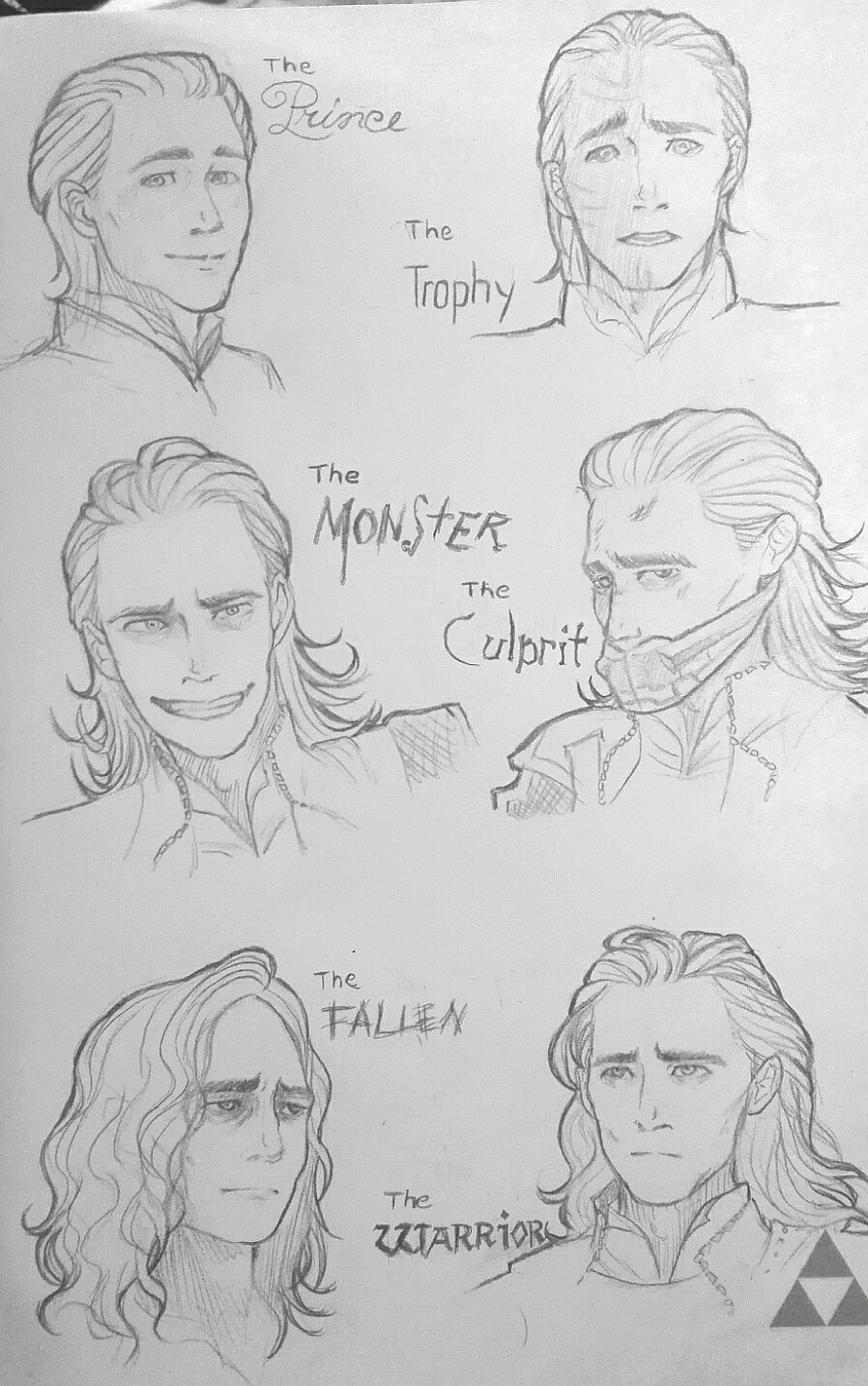
Well, I tried to picture his emotions through the movies and I came to think that I really don’t like his prince appearance at all because he lacked of character in that time. (Or maybe I just drew him bad)
I think Prince!Loki was very good at keeping his emotions under wraps, which is why his face appears so neutral, even bland. Then after what happened in Jotunheim, his facade pretty decisively cracked (along with some other things).
“This is the moment where the thin steel rod that’s been holding your brain together snaps.“ – Kenneth Branagh directing Tom Hiddleston in 2011′s Thor.
For the people who seem to think this was just a bid to “get out of hot water” rather than a suicide attempt… the director disagrees.
This reminds me of a little fic I wrote about that scene (on Tumblr; on AO3).
Thank you, Tom, for reminding us of Loki’s emotional complexity. And pointing out that the fact that he was lied to all his life and found out a world-shattering truth in an abrupt, traumatic fashion does still make a difference in the way he behaves.
That’s a nice change from CH and TW going “pfffft Shakespeare’s stoopid, why you take this so serious Tom, what we need is more anus jokes”. I love that RDJ specifically told Tom what a great job he did in the more Shakespearean version of MCU.
Lets be honest, Loki would bust out laughing when he hears Jane asked Thor to explain the bifrost and Yggdrasil and the nine realms. Because, he knows he can give a much better explanation and answer on all three and more.
Maybe he wouldn’t laugh that she asked, but he’d probably laugh at the answer.
i think about this a lot but how much better would thor 1 be if we got to see thor react to the fact that his beloved brother was a race that he grew up wanting to slaughter?? like was that not an important plot point?? THAT’S a better way for thor to realize that killing just to conquer is wrong, that’s how he should have realized the error of his ways, not just meeting mortals and wanting to protect them, but by hurting someone that he loved because of his arrogant ignorance and prejudice
It makes Thor and Loki’s relationship the most important in the movie since it’s the relationship impacting Thor’s character arc, and that’s how it should be in a Thor movie.
The people Thor wants to conquer are Frost Giants, not humans. Asgard’s opinion of Midgard is in no way comparable to its opinion of Jotunheim. Learning how nice and cool humans are shouldn’t impact how he feels about Jotunheim. This is why I explain his change of heart in other ways.
The trouble is, I think a small change like, for instance, Thor noticing Loki turning blue when the Frost Giant touches him would change the plot entirely. If Thor had noticed that, he’d have grabbed Loki and noped the fuck out of the battle on Jotunheim. The conversation between him and Odin would have been entirely different. He probably wouldn’t have been banished, which means Loki wouldn’t have been regent.
There’s an interesting fanfic in that idea. (Obviously there are already works that have Thor find out Loki’s a Frost Giant and never get banished, but most of the ones I’ve read are pro-Odin, pro-Asgard, and anti-Jotunheim, and that’s just not my cup of tea.)
Oddly enough, I strongly disagree, because that change would make the movie *less* about their relationship and less compelling as a narrative. This isn’t to say I don’t want it to be addressed (wow, do I ever want a scene where they actually confront that particular revelation between them), but having that take place in Thor 1 would have dramatically weakened the story as a whole.
First, it wouldn’t make sense in terms of Thor’s character as it had been portrayed up till that point (and forward as well). This a character who is extremely kind and generous and good-hearted but also prone to taking too much for granted when things seem fine and whose arrogant streak makes him a bit blind to the perspectives of others. The growth that needs to occur in the first movie is not “learning that killing to conquer is wrong,” even though it takes place in that context. The way Thor needs to grow is to have his perspective get a shaking. He gets knocked down a peg, has to accept help from people he would have considered weaker, finds himself in a situation where all the things he counted on–his own position, his expected trajectory in life, the people he loved and trusted–are gone and he has to figure out who he is in this new situation and reevaluate the choices that got him there. He would not learn those lessons from finding out that Loki was an abandoned Jotun baby that Odin took in after the war. But moreover, the person Thor is at the beginning of the movie has not yet had the growth necessary to respond in any useful way to that revelation. The Thor who yells back at Odin that he’s a old fool for not waging preemptive war on Jotunheim for the vault incident would not have come quickly enough to the right understanding if he had seen Loki’s hand turn blue. He’d have suspected a trick or a curse (as Loki did also), and if those were disproved and he actually learned the truth at that point? Does anyone actually believe this would not have been disastrous? He’d have handled it so badly, and while there could certainly have been an interesting story there (quite a few fics’ worth), it would have very likely been an uglier one and one less focused on their brotherly relationship.
The reason the actual movie was in fact entirely focused on their relationship even though they spent half the movie not even on the same realm is that everything that happens to Thor–from deciding to go to Jotunheim to being banished to (nearly) dying at the hand of the Destroyer–was brought into motion by Loki, and we as the audience are aware of this but, crucially, Thor is not. It is their relationship playing out in shadows and reflections. We can see and understand Loki’s conflict and Loki’s resentment and Loki’s turmoil and the context for it. And at the same time we can see Thor’s growth as he deals with the shock of his changed circumstances. We can see Thor’s better traits shining through in his own trials. And we can see Thor’s blindness to what’s happening with Loki (and Loki’s awareness of Thor’s blindness) and how that mirrors the things that grew Loki’s resentment over the years. We’re able to see both of their stories unfolding at the same time and how completely connected these are even though they are not taking place in the same physical space. And then when they are in the same space–first, Loki visiting Thor on Midgard to lie to him, and then after Thor regains Mjolnir and returns to Asgard–we can watch as their relationship evolves as Thor grows and Loki cracks. Thor pleading with Loki, looking to him as a lifeline, as the most trusted person in Thor’s old life, and Loki turning him away because he can’t, things can’t go back to how they were, and Loki doesn’t trust Thor with this knowledge. And then Thor’s return, grown and changed and having to deal with knowing that something has gone very wrong with Loki but he lacks an understanding of what; in this he is still having to face the ripples of his old arrogance and ignorance, the problems that he had not even been aware of in his relationship with his brother.
And this conflict unfolding at this point, after Thor has had the shakeup of being banished, and after Loki has had time to dig himself well into a violent breakdown–Thor has had the necessary growth to deal with this situation better, but the stakes have gotten higher and the situation has gotten worse and all our hearts break because their goals are fundamentally in conflict so someone has to lose–and we have seen through both their eyes and we know how important their relationship is to both of them, so that means there can be no real winning, either.
I don’t think you’d get that same effect if you formulated the story so that it dealt with that relationship and Loki’s origins head-on.
If the story had been centered on Thor learning a lesson about not killing Jotnar because Loki was one, it would have been very likely to become an after-school special on prejudice.
Dealing with it obliquely, with their relationship reflected in and infused through everything that happens–that makes the story so much more.
I happen to agree with a lot of what you said @illwynd, which is why I specified that I think it would make for an interesting fic. I love the idea of Loki’s heritage being dealt with head-on, but I prefer for the sake of the overall relationship arc between Thor and Loki in the MCU that Thor retain its structure (not least because we have the option to explore these canon divergent AUs, but also diverge from canon in completely different ways at completely different points). That said, I’d still have preferred if they left in the scenes that hinted at Thor’s vulnerability. I think it helps to explain why three days in an insecure position is enough to sober Thor up sufficiently.
Yeah, I guessed that we were at least somewhat on the same page! I was mainly disagreeing with the idea expressed in the OP that Thor 1 would have been a better movie by dealing with that aspect explicitly, and I wanted to go into why I thought so, because there is a bit of a trend lately to discuss Thor 1 (and Avengers and TDW) in what are actually pretty inaccurate ways and I wanted to make sure to give adequate context.
If you mean the deleted scenes, yes, at least most of those I wish they had kept in as well! One of my favorite scenes in the whole damn thing is the deleted/extended version of Loki goading Thor into going to Jotunheim. There’s just so much going on in it, so much hinted history between them. 😀
After reading @illwynd‘s lovely essay above, I completely agree; I didn’t think it all the way through before sharing the original post. The fact that so much of the plot turns on incomplete information and misunderstandings can make it infuriating to watch but also very Shakespearean. Or Attic-tragedian, even. And I absolutely know what you mean about people discussing the previous movies in inaccurate ways: they’ve been reading the Ragnarok retconning of their characters back into previous movies – most notably, by portraying all of Loki’s actions as completely unmotivated and unintelligible, the way they’re framed in Ragnarok; claiming that everything he does, from letting the Jotnar in to disrupt Thor’s coronation to attempting to destroy Jotunheim, was done just because he’s “the god of mischief” and likes to fuck shit up for no reason.
The important thing about Thor’s banishment to Earth is that it represents the “high brought low” trope (an expression that my English prof pal @fuckyeahrichardiii taught me; a literary education is never complete). I came across a strange reblog chain once where people were describing Thor 1 as a case of “meeting the savages,” where Thor’s sojourn on Earth, among people he considered his racial inferiors, was supposed to teach him to respect the Jotnar… I think in general (sorry, @foundlingmother) that there’s been a bit too much reading present concerns about racism and colonialism into the Thor movies; Asgard is a premodern pagan society, and I suspect they really don’t think about other races and cultures the way we do now. It used to be completely normal to utterly crush your enemies (hence the thing in the Old Testament about eradicating the Amalekites, down to their sheep and cattle) and even make their land uninhabitable so they wouldn’t be able to rise up and pose a threat any time soon (hence the custom of sowing fields with salt, as the Romans did to the Carthaginians). Not that any of this is good, just that it seems a little strange to me to approach Asgard with modern critiques of colonialism, which presuppose that the conquerors themselves espouse a basically Christian, post-Enlightenment moral worldview.
The point of Thor’s banishment, from Odin’s POV as well as that of the film, was to humble him by making him helpless and forcing him to rely on the hospitality of others (and so much the better if they’re weaker and beneath him in station!), not to teach him respect for other cultures (clearly, as we see in TDW, Odin doesn’t care about that). Thor’s practical humility, so to speak, does come along with a measure of epistemic humility: he learns to question the things he used to take for granted, to question his own perspective, and therefore to give more consideration to the perspectives of others. Importantly, he learns to question what he’d always believed (indeed, been taught by Odin to believe) about his own worth relative to others, including Midgardians, Loki, and (to some degree) Frost Giants.
I thought this part of illwynd’s commentary was especially insightful (and heartbreaking):
And then when they are in the same space – first, Loki visiting Thor on Midgard to lie to him, and then after Thor regains Mjolnir and returns to Asgard – we can watch as their relationship evolves as Thor grows and Loki cracks. Thor pleading with Loki, looking to him as a lifeline, as the most trusted person in Thor’s old life, and Loki turning him away because he can’t, things can’t go back to how they were, and Loki doesn’t trust Thor with this knowledge. And then Thor’s return, grown and changed and having to deal with knowing that something has gone very wrong with Loki but he lacks an understanding of what; in this he is still having to face the ripples of his old arrogance and ignorance, the problems that he had not even been aware of in his relationship with his brother.
What’s so heartbreaking is that Loki, at this point, has no reason to trust Thor with the terrible secret of his birth, no reason to trust that he’s changed and become more open-minded and sensitive to Loki’s feelings and perspective. I’ve remarked before on how Thor’s apology to Loki after he sends the Destroyer to Midgard – “Brother, whatever I have done to wrong you, whatever I have done to lead you to do this, I am truly sorry” – is kind of a non-apology, because it’s hard to truly repent (which is to say, rethink, reevaluate) something you don’t know you did. So you can’t entirely blame Loki for not trusting that apology or taking it seriously; but at this point you also can’t entirely blame newly matured Thor for not knowing what immature arrogant Thor did, because immature Thor was too blind and self-centered to really be aware of the ways he was neglecting and belittling Loki and how much it hurt him, and mature Thor doesn’t really have any more information, just a new willingness to listen. So their confrontation has the kind of inevitability you want from a good Shakespearean tragedy: just one little bit of information shared at the right time could avert the whole thing (I’ve even written some little AU vignettes along those lines), but the urgency of the situation and the heightened emotions means there’s no real opportunity for that information to be exchanged.
Definitely planning to write fic where Thor and Loki actually discuss the Jotun heritage thing… but set after Thor’s long trajectory of maturation (and ignoring TR’s reversal of that trajectory, while accepting the broad outlines of the plot as canon).






 Loki is the Philosopher King