Sorry for not answering this sooner, I had to think about it, haha. I really enjoy the concept of pre-Thor Loki because there is just so much we don’t know about who Loki was before everything went to shit. We have a basic idea of his general personality, of course – the envious younger brother, the mischief-maker, the less-favored prince. Even despite these attributes, though, Loki clearly holds Thor in high regard (”sometimes I’m envious, but never doubt I love you”) and never meant for things to go as far as they did.
When I think about pre-Thor Loki, the quote I always come back to is when Kenneth Branagh states (in his commentary on the Vault scene): “This is the moment where the thin steel rod that’s been holding your brain together snaps.” Truly, this moment is life-altering and devastating for Loki, but Branagh implies that Loki’s mind was fractured to begin with. We don’t generally think of healthy brains as being “held together with thin steel rods,” and it begs the question, why was Loki so unstable in the first place? Certainly as a result of his upbringing, as far as I can guess. (Whether or not mental illness is inherent in his brain chemistry is a different question, but it bears mentioning that mental illness includes conditions like anxiety, depression, etc, and that these conditions can be a result of one’s upbringing.)
I (like so many others) take such issue with Thor calling Loki’s grievances imagined slights because they are very much not imagined and, if anything, they are the worst kind of slights because by nature they are designed to break a person down steadily over time. If you tell a dog it’s bad enough times, the dog will eventually believe it. In the first twenty or thirty minutes of Thor, if we include deleted scenes, we see Loki being openly laughed at by a servant (!!), admitting he’s envious but telling Thor he loves him anyway, only to get a “Thank you” in response (without any reassurance of Thor’s feelings in return), a nasty comment from Volstagg on the rainbow bridge about Loki’s silver tongue, and Thor snapping for Loki to “know your place” when Loki tries to talk Thor down from literally starting an intergalactic incident.
Furthermore, after Thor’s banishment, Loki admits that he told the guard of their plans. It’s important to note that he’s not being sneaky or underhanded – he straight up admitted, “yeah, I told them we were going, and I’m not sorry because Thor is out of control and his idea was fucking stupid.” And what’s his payback? As soon as he leaves, the Warriors 4 talk about him behind his back, say he’s always been jealous of Thor, and wonder out loud if Loki is the traitor Laufey spoke of. Why would they immediately assume that Loki is a traitor to his family and his kingdom? Like, that escalated really fucking quickly.
All of these things show us that Loki is treated as less than, for no real reason other than he’s very different from Thor. Different, in Asgard, seems to mean, not as good as. The narrative tells us we should just accept this treatment of Loki because he turns out to be the villain (although the argument has been made, many times, that his actions weren’t villanous at this point – but, I digress) so one can assume that the same is true of Asgard – everyone should just accept that this is how Loki is treated, everyone is used to Loki being the punching bag, and no one should feel badly about it.
I don’t even think I’m answering your question right, I’m sorry, but what I’m trying to get at is, if this is the sort of treatment we see Loki getting just in the beginning of the movie, imagine a (very, very long) lifetime of the same sort of treatment. Imagine how broken down someone would have to be after that. Even if Loki’s upbringing wasn’t bad, in that he was privileged with wealth and title and family and all of that, it was definitely emotionally abusive. And I think that it’s very possible to feel like you have a nice life, to feel like other people have it worse than you, to feel like you deserve all of the imagined slights heaped upon you, until you snap. This is why Loki was hanging onto mental stability by a thread. This is why he suffers a complete mental breakdown – because, in addition to this toxic environment and mindset he’s been conditioned into, now he learns that he is something he’s been taught to believe is savage and disgusting and inferior. He loses all hope of ever being worthy, which makes him double down on his efforts to attain that worthiness. In his heart, maybe he knows it’s a lost cause, and maybe that’s why he fights so hard for it, anyway.
So, did he have safe havens? Probably. He probably holed up in the library with his books and scrolls, or maybe he had a favorite reading spot in the gardens, or maybe he liked to lay in the grass and watch the stars. Did he have secrets, things that were only his? Most definitely, as Loki in general (I think) is a private person who wants things to keep for his own, things that he doesn’t have to share with Thor. Did he hang out with Thor’s friends for obligation? No, I think that at first, he really wanted to be a part of their group. They’re all shown to be so close in age and class (except Volstagg, who seems older) that it seems like these are the people he should be friends with, and would be friends with, were he just more like Thor. I’m sure, eventually, he realized that they didn’t like him (and he didn’t really like them, either) but it was probably also a situation where Loki didn’t have any other friends, so he might as well hang out with the ones who tolerated him, sometimes, sort of.
Sorry for babbling at you and I don’t know if that answered your question or not, but I have a lot of Feels about Loki’s treatment in the first movie, and also the implications it has on his life beforehand. Thank you for the ask!
These assumptions came after TR tried to retcon everything about Thor franchise and characterizations. It came from the snake story which was improvise by CH just for jokes, and no one cared to remind him that Thor and Loki aren’t the same age, since Odin declared Thor his firstborn in Thor 1. These assumption came from TW who didn’t understand Loki at all despite enough material in other movies:
“someone who tries so hard to embody this idea of the tortured artist, this tortured, gothy orphan”
“…this little emo goth hanging out by himself. He was like the kid in Harry Potter [Malfoy].”
has been trying to kill Thor his entire life
None of these conclusions are true. Loki was pretty loyal to Thor his entire life. Even disrupting the coronation wasn’t a betrayal to Thor.
“You are my brother and my friend. Sometimes I’m envious, but never doubt I love you.”
“I love Thor more dearly than any of you, but you know what he is. He’s arrogant. He’s reckless. He’s dangerous. You saw how he was today. Is this what Asgard needs from its king?”
He knew Thor wasn’t ready and he also wanted a chance to prove to his father that he is worthy too, since that was the impression both Thor and Loki got from Odin, that the better son get to be the king.
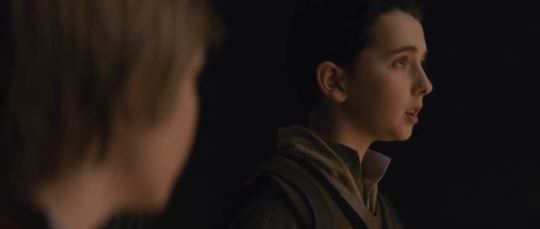
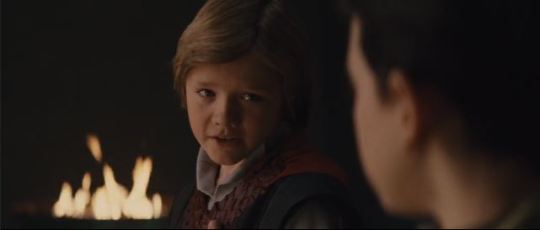
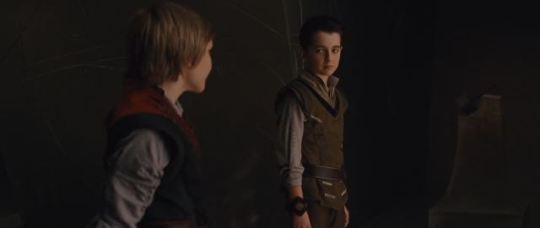
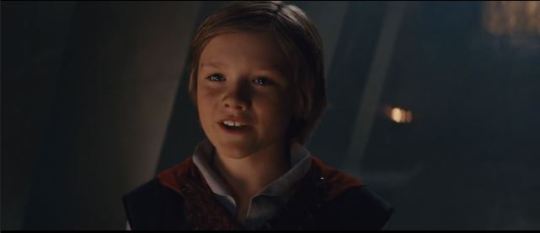
We got to see Thor and Loki as children in Thor 1. Let’s see what can be understood from their scene as children.
The scene starts when Odin finishing his tale about the war with Jotunheim and shows his children the war prize he got from them, the Casket of Ancient Winters to stop them to cause further harm. His tale portrays Jotuns as villains who attacked Earth with no reason and Asgardians as heroes. He speaks of a long and bloody war with an enemy that is very strong. As all children, Thor and Loki see their father as a hero and invincible, but in their case even more so, because Odin calls himself the protector of the nine realms. But this enemy even took their father’s eye. They must be very strong and scary. They must be monsters. Notice that Odin calls Jotuns, “Frost Giants”, a word that can inflicts fear and has a negative effect. Odin finishes his tale with:
“But the day will come when one of you will have to defend that peace.”
And starts the idea of brother’s competition for the throne right there.
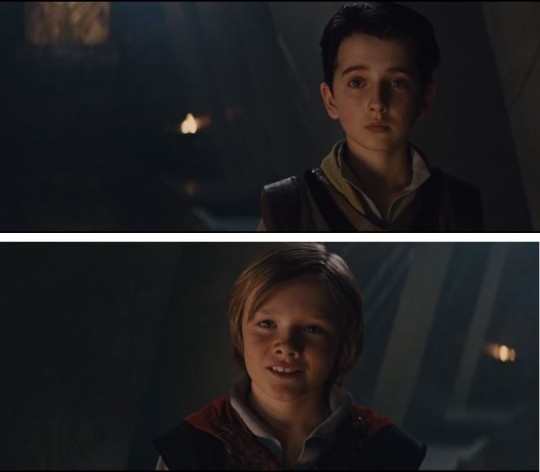
The camera zooms on Thor and Loki’s faces individually.
Loki:
“Do the Frost Giants still live?”
Loki’s face and question shows that he is analyzing this information. His expression and tone also shows caution and that he’s scared(of his own race). this can be an indication that he’s a sensitive kid. He has just heard a tale of war and death and it doesn’t interest him. Although he’s scared, he is still curious and wants to know more.
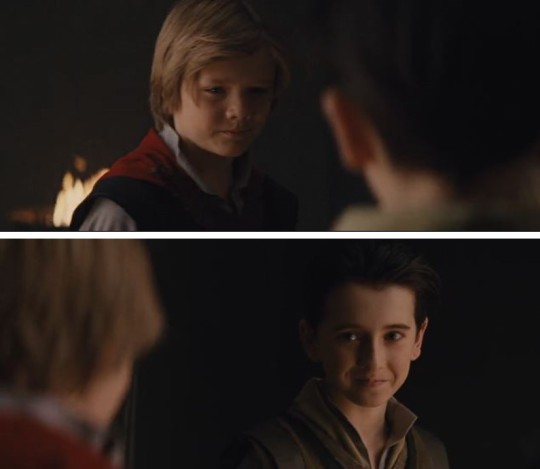
Before Odin has a chance to answer, Thor confidently declares:
Thor: “When I’m king, I’ll hunt the monsters down and slay them all!”
The camera cuts to Loki..
The way Loki looks at him after this, is very telling. There’s a bit exasperation and annoyance in his expression. As if he’s thinking “why are you
like this?” and “why do you think it’s you who’s going to be king”. There’s also embarrassment because Thor’s reaction made him look
weak, and envy because he thinks he isn’t as brave as his brother.
Thor continues,
full of excitement and admiration for his father, his hero: “Just as you did, Father”
This whole part shows that Thor is completely sure and confident that he is the one who is going to be the king. That it doesn’t matter to him if there are any monsters. He is going to kill them all. He is going to be like his father.
The next moment is very important in the movie. Both kids are looking to their father and waiting for his answer. Which one of them get his acknowledgment and approval? Does he think it’s better to know about the Frost Giants or just kill them all?
Loki’s face shows insecurity while Thor’s shows confidence. And both of them are longing to be validated by their father.
Odin knows this damn well. He looks at both of his sons and choose to answer them indirectly:
“A wise king never seeks out war but he must always be ready for it.”
Translation: It doesn’t matter to know about the Frost Giants more than it’s needed to defeat them. You must always be ready for war but don’t seek it.
He answers both of them with that. But in doing so he also confirms what Thor said, that Frost Giants are monsters. And the only information you need to know about them is how to beat them. There it is. Odin validating racism for his sons, knowing one of them is from the same race he just covertly confirmed to be monsters.
I was so shocked by this moment the very first time I watched this movie. I expected for Odin to tell Thor that they are not monsters. But instead Odin answered like that and it made me sure that this moment will come back to bite them(and us).
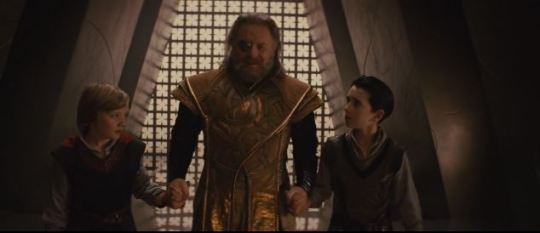
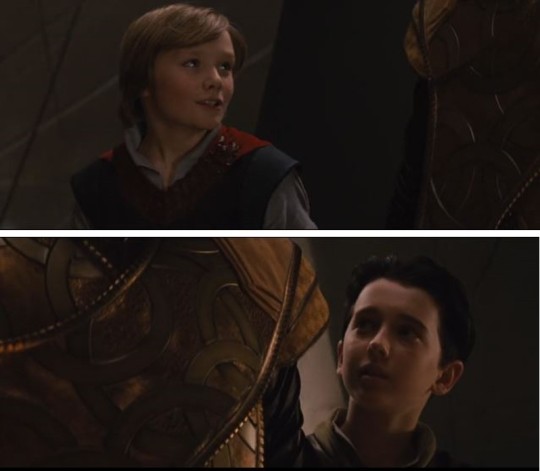
As Odin walks away from the children, Thor and Loki look at each other. There is love, excitement and innocence in their faces. And then they both run to reach to their father and grab his hands.
Thor states with confidence and determination while looking at Odin:
“I’m ready Father!”
Loki grabs Odin’s other hand and with desperation and insecurity tells Odin:
“So am I!”
Thor looks at Loki irritated. Loki looks at Odin, desperate to be acknowledged. Odin says:
“Only one of you can ascend to the throne. But both of you were born to be kings.”
Thor’s confidence returns and Loki’s face turns hopeful.
What Odin did here is pitting the two brothers against each other. His answer implies that only one of them, the better son can be king. This will make them compete against each other. This will make them seek Odin’s approval all the time which makes it easy for Odin to control them.
The way this scene plays out is very clever. The brothers look at each other with love but then run to Odin. Odin comes between them, literally and figuratively. The compete to gain his approval and as Loki’s insecurity here shows and later we find out, favoring Thor are the reasons that truly set the brothers apart.
So what can be concluded from this analysis? That neither Thor, nor Loki were malicious and definitely not towards each other. They got annoyed or irritated with each other but their reactions are as normal and childlike as any other child. Loki shows envy towards Thor, but the love in his eyes surpasses it far more(“sometimes I’m envious but never doubt I love you”). Besides his main concern is getting Odin’s approval. So a sensitive, curious, cautious child who is get upset and scared by the story of war and monsters, whose love for his brother is far more than his envy, isn’t capable of going around stabbing his brother. Also from a more logical point of view, he is intelligent, he knows stabbing his brother, the favorite son I might add, would never help him to gain his father’s approval which is his main goal. This also confirms what Loki later says to Thor:
“I never wanted the throne. I only ever wanted to be your equal!”
He wasn’t after the throne. Getting the throne was the proof that Odin saw him worthy. It was what Odin planted in their mind when they were children.
Kid Thor also isn’t malicious. He’s just a child who admires his father very much and wants to be like him. A child that his mistakes aren’t corrected but enabled and he is treated more favorably and better than his brother. So he learns that he’s better than Loki and learns to treat him the same way as he sees while they grow up. So the assumption that he was a sensitive kid(he was the one who got excited by stories of war and killing monsters) who was bullied by his broody evil brother can’t be correct.
Loki was never as evil and wrong as TR portrayed him. Neither Thor was like a saint and always right. Their relationship is far more complicated than good Thor vs. evil Loki. I don’t accept TR retconning their characteristics like this. Especially when there’s proof that TR’s interpretation of them is wrong.
The thing that really strikes me about this picture is how it’s similar to this one:
Right before Thor’s coronation.
Odin used his own daughter as no more than a weapon for his bloody wars. He was the mastermind, the brain, and Hela was the brawn. And he brought up his two sons to fit this exact image. Thor was supposed to be the symbol of Asgard’s physical power and Loki the advisor, the strategist. Thor was the brawn and Loki was the brain. It’s interesting how Hela and Thor, who were the muscles, both hold Mjolnir, a hammer. Odin holds Gungnir, a scepter and we know one of Loki’s preferred weapons is a scepter.
The kings wear red, the weapons wear green.
The weapons are on the right side of the kings.
The kings have wings on their helmet, the weapons only have horns.(Another interesting detail is how Odin’s helmet is the combination of Thor and Loki’s. He gave his wings to Thor and his horns to Loki)
It’s also another parallel that when the weapons get out of the kings’ control, they were cast out.
(As a side note I think I should mention that when I say Thor and Hela are the brawn I don’t mean they are stupid. They both are quite intelligent. I mean they are the stronger fire power and physical fights are what they are best at. Odin and Loki are both physically strong too but they are best at mind games and planning. Remember Hela told Loki “You sound like him?”. Because he does. He learned those skills from Odin)
Jumping on because I can’t resist over thinking this with you. I wholeheartedly agree with everything you wrote, and wanted to comment on the unspoken layer beneath all of this. Because as much as Loki’s trying to prove himself and make his father proud (as Frigga tells him to do), there’s the the constant undercurrent of Loki trying to grapple with what he is. Yes, he is trying to prove himself as the second son now that he’s out of that shadow, but he’s also trying that he is capable as King despite his Jotun nature.
Because no matter how much you claim to love me,
you could never have a Frost Giant, sitting on the Throne of Asgard!
Loki believes that Odin only saw him as a tool and never intended–never saw him capable–of sitting on the throne. No amount of Frigga’s words of support and love are able to negate this, so Loki needs to prove that Odin is wrong. That he can do this–can destroy Laufey and the Frost Giants and prove his worth as a son of Odin. I think up until the moment he Gungnir in his hand, Loki is floundering–unable to process what he’s learned and unsure of how he will cope–but when he is named king, he suddenly realize that he can do it. He can make Odin proud despite ‘what’ he is.
Father! We’ll finish them together.
Loki knows what Thor will do if he returns. Thor will wage war against Jotunheim. Thor will lead them into battle and get the credit for saving the realm. He will be the golden son that he always is. Why else would Loki have ended Thor’s banishment unless Loki needed Thor to rule because he couldn’t do himself? Why else would the Warriors Four be questioning his reign, if they too didn’t seem him as incapable? But, as you note, if Thor stays on Midgard, then Loki will be the victor–he will be the worthy one. No one will see him as the weak second son (or the monster he now knows he is). He will prove he can rule–that he can save Asgard–despite not being Thor (and despite what he his).
There will be no kingdom to protect if you’re afraid to act! The Jotuns must learn to fear me, just as they
once feared you.
And finally’s there’s this. Loki has heard Thor say such things since they were boys–I’m sure Loki, himself, said such things. As much as Frigga says he’s their son and that they love him, he fears Thor’s reaction. I don’t think this alone is enough to make him strike first, but he is guarding himself against it. Then the Warriors Four doubt and betray him purely because he is Loki. If they can turn on him so easily now, Loki doesn’t even need to question how they–let alone the rest of Asgard (or Thor)–would react if they knew what he was. They would string him up before he could even blink. But if he can just destroy Jotunheim (something that is better than Thor just making the Jotuns fear him), then there is no reason for any of them to doubt him. The only way to disprove what he is, is to be the hero. And the only way to be Asgard’s savior is to keep Thor on Midgard (by any means necessary).
Ugh this is all so, so true and an excellent point/addition. Especially this:
I don’t know that Loki immediately began plotting to make it a more permanent position out of corruption, though. I think that he began plotting to do as much as he could while he had the position to clean up Thor’s mess with Jotunheim and make himself the hero who killed Laufey, slaughtered the Frost Giants (which Thor wanted to do) and saved Asgard. In my opinion, Loki’s intentions were never evil or corrupt; he acted out of a desperate need to prove his worth – to prove himself equal to Thor, or maybe even better than Thor.
It really makes me wonder how things might have turned out had Sif and the W3 not intervened – because, really, all Loki was trying to do was keep Thor away from Asgard until he had time to carry out his plan and come out the other side, victorious. I think eventually, he probably would have let Thor come back. But once the W4 went against Loki’s orders to bring Thor back, that’s when Loki got desperate and things fell apart.
I don’t think Loki ever thought he’d have the kingship permanently. If nothing else, Odin was going to wake up eventually, at which point he’d be king again. Loki just saw an opportunity to prove himself, while taking Thor down a few pegs, and pounced. Idk, it’s all very interesting because there’s just so much complexity going on between the characters in this movie and a million different ways things could have all turned out.
If they can turn on him so easily now, Loki doesn’t even need to question how they–let alone the rest of Asgard (or Thor)–would react if they knew what he was. They would string him up before he could even blink.
God, poor Loki. The saddest part is that this is absolutely true, Loki doesn’t have to do anything untrustworthy to be considered untrustworthy, so if they knew what he really was, that dynamic increases tenfold. Additionally, it’s almost like it gives them validation in their mistrust of him. See? He’s a frost giant. We knew he was up to no good. We were right not to trust him. Incidentally, I kind of headcanon that Heimdall does feel this way toward Loki – that he inherently distrusts him because he’s Jotun and is just waiting for an excuse to be proven right. This is why Heimdall turns on him in the blink of an eye. Like, that escalated pretty quickly for someone supposedly so loyal to the throne. But I digress.
Yeah, I’ve had that thought about Heimdall, too.
I’ve definitely had similar thoughts about Heimdall! After all, Loki doesn’t ever mean for him, Thor and the W4 to get to Jotunheim; he wants them to be stopped, either by the guard he notified or by Heimdall. He had two failsafes in place.
My headcanon is that Loki offers to speak to Heimdall because he already knows from years of prior experience that Heimdall doesn’t trust him— not knowing exactly why, of course— and he doesn’t try very hard to disguise their mission. He assumes Heimdall will just shut him down and not let them pass, because no way will Heimdall go against Odin’s orders and allow Thor to start a war. Odin will show up and Thor will get in trouble and look like an immature boy, which is all Loki really wants at this point.
But Heimdall shuts Loki down (obviously suspecting him of letting the frost giants into the vault, partly because he has to know who Loki really is) and his line to the group, “you’re not dressed warmly enough,” becomes hugely ironic if you assume he knows that Loki is Jotun and won’t be cold.
I imagine in letting them pass that Heimdall is hoping Loki will be outed as the original culprit, or discovered to be Jotun, which would amount to much the same thing. It’s a potential way of getting around Odin’s order not to share Loki’s heritage with anyone (an order which Heimdall does seem oddly inclined to obey) while revealing Loki as a traitor. I suppose to Heimdall, it’s a necessary risk to take.
Loki obviously figures this all out at some point— once he knows his heritage, it’s only a matter of time before he has that moment of clarity. He’s probably furious at the thought that Heimdall would risk an all-out war with Jotunheim—knowing Thor’s lack of diplomatic finesse— and potentially the deaths of their group (despite their skill, they’re vastly outnumbered in harsh enemy territory and are only saved by Odin at the last moment) just in order to confirm his suspicions about Loki, who only intended to demonstrate how unfit Thor currently was to rule, even if his methods were pretty desperate and over the top. (I can understand that Heimdall sees Loki as a liability/threat that needs to be revealed and probably has confidence in his abilities to get the group out of Jotunheim before any serious catastrophe befalls them, but obviously there are injuries sustained and many Jotnar die… there’s a reason Odin was sensible for once and didn’t want Thor to go charging in.)
I think this all adds very some necessary subtext to Loki’s later encounters with Heimdall once he’s king, especially when Loki freezes Heimdall with the Casket.
He could have possibly subdued Heimdall in other ways, but I think part of Loki wants some poetic justice. In Loki’s mind, Heimdall not only betrayed him by being privy to the secret of his origins, but also in allowing Loki to go to Jotunheim, knowing full well that Loki might be exposed— never mind that Loki manipulated Thor into going, he never meant for his bluff to be called because Heimdall had information he didn’t. (And from Laufey’s dialogue, we know that Loki had taken precautions to disguise his identity when he first arranged to show the frost giants into the Asgardian vault.)
As king, Loki wants Heimdall to know that he’s figured it all out, that he can evade his watch, that he won’t be stopped and won’t tolerate Heimdall’s resistance and treason. He wants Heimdall to know that he was defeated by a Frost Giant— one who sits upon the Asgardian throne despite Heimdall’s best efforts to prevent it. Loki doesn’t have any pride in his heritage at this point— I think he only uses the Casket to rub Heimdall’s impotence in his face. He sees Heimdall as one more huge roadblock on his quest to prove his worth. It must have been a strange sense of relief/near satisfaction for a moment before the crushing sense of what he’s doing sets in— Heimdall must be something of a father figure for him and Thor. It must hurt to see this evidence come to light that like Odin, Heimdall never trusted him, never gave him a chance. I don’t think this act of vengeance against Heimdall appeases Loki’s heartbreak or rage in the slightest. Underneath it all, he’s still scared shitless.
But he has a mission and it’s too late to turn back now. If he can show himself to be a hero worthy of his realm and his family’s love, worthy of the crown, while simultaneously showing Heimdall to be a traitor, so much the better. (Of course, we know how it actually goes. Loki often gets in way too deep, ensnared in his own traps because his chess pieces are individuals with their own motivations he doesn’t always foresee and information he isn’t always privy to… sigh.)
It’s no great surprise Loki later banishes Heimdall when acting as Fauxdin. Even if it leaves him vulnerable to say, Thor arriving without warning, or other more hostile visitors…
Anyway, a very long digression, but it ties back into the sentiment of the original posts, which are all absolutely excellent, so I figured I’d keep it in the thread…
Oh, damn. You make a lot of really good points here. Heimdall even says that the reason he’s letting them go to Jotunheim is that he wants to find out how the Frost Giants got in on his watch. Later, Heimdall accuses Loki of having let them in without any evidence beyond his ability to conceal his presence and move between realms using means other than the Bifrost. Is he justified in concluding that Loki is the *only* person with those abilities? Or did Heimdall suspect him beforehand – partly because he has a reputation for being a sneaky mischief-maker (which is probably related to his use of magic, especially as a male), and partly because Heimdall knows he’s a Jotun and Jotnar aren’t to be trusted? Did Heimdall know that Loki didn’t know his own origin? Or did he think that maybe Loki did know, which was why he might have been helping Jotunheim all along? (Boy, am I getting Dreyfus Affair feels right now.)
The more I think about it, the more of an asshole Heimdall starts to look like. And a *racist* asshole, too, which is ironic given the casting choice. I’ve seen people complain about the fact that the anti-Inhuman senator character on “Agents of S.H.I.E.L.D.” is a South Asian woman (played by the magnificent Parminder Nagra) rather than a white person, considering that anti-Inhuman prejudice could be construed as an allegory about race. I can see where the complaint is coming from, but I think it’s misguided.
First of all, Inhumans, like mutants (for whom they are basically stand-ins in the Marvel TV Universe, because Marvel Studios/TV didn’t own the rights to the X-Men), could be an allegory about race… or about disability, or about sexual orientation or gender identity. So then the objection goes that making the bigoted character a person of color perpetuates the stereotype that non-White/European cultures are more intolerant about things like disability and sexual orientation. And yeah, I see where that’s coming from too. But there’s this overcorrecting tendency on the (Tumblr) Left to act as if it’s only White people who are “problematic” in other ways, only White men who feel entitled to women’s bodies, as if the experience of being oppressed on the basis of race automatically gives you full empathetic understanding of all other forms of oppression… when the fact is that it doesn’t, any more than being oppressed on the basis of gender or sexual orientation gives an empathetic understanding of racial oppression – something we’re reminded of every day by the news of White women calling the police on Black people (and by the barrage of Tumblr posts about White feminism, White gays, etc.). And then there’s the fact that there isn’t consistent solidarity among groups that are oppressed on the basis of race. I’ve been seeing a lot of attention called recently to the anti-Blackness within other communities of color (Asian, Middle Eastern, Latinx, etc.), which may be a case of following the same script as various European ethnic groups that were eventually, grudgingly, accepted into Whiteness (Irish, Polish, Ashkenazi Jews): distance yourself from Blackness, the permanent Other of the American racial landscape, and you have a better chance of being accepted. Even if they’re near the bottom of the ladder, everyone likes having someone lower than them that they can still look down on. And when there’s a new Other, people who had been divided by racial lines can find themselves allied; the foreignness of Russian and Chinese immigrants suddenly made the Irish look very American indeed. And that’s what the Inhumans are: a new, very strange and threatening Other that might just make the last wave of human immigrants seem to fit right in.
So what about Heimdall? Why have a Black Asgardian show racist suspicion toward a Jotun who, in Aesir form, otherwise looks White? I think that’s actually a pretty good way of demonstrating that skin color differences among the Aesir don’t matter any more than hair or eye color (within a certain range) among White people. And I’m not sure Heimdall’s attitudes are any more racist than those of Thor and his friends; he’s just in a position to display more subtle forms of racism, since (we have to assume) he knows Loki’s true origin. Why the race-blind casting for Heimdall as opposed to, say, Fandral or Sif? I dunno, they could have done both… but when you’ve got Idris Elba, give him a role with gravitas.
Jumping on because I can’t resist over thinking this with you. I wholeheartedly agree with everything you wrote, and wanted to comment on the unspoken layer beneath all of this. Because as much as Loki’s trying to prove himself and make his father proud (as Frigga tells him to do), there’s the the constant undercurrent of Loki trying to grapple with what he is. Yes, he is trying to prove himself as the second son now that he’s out of that shadow, but he’s also trying that he is capable as King despite his Jotun nature.
Because no matter how much you claim to love me,
you could never have a Frost Giant, sitting on the Throne of Asgard!
Loki believes that Odin only saw him as a tool and never intended–never saw him capable–of sitting on the throne. No amount of Frigga’s words of support and love are able to negate this, so Loki needs to prove that Odin is wrong. That he can do this–can destroy Laufey and the Frost Giants and prove his worth as a son of Odin. I think up until the moment he Gungnir in his hand, Loki is floundering–unable to process what he’s learned and unsure of how he will cope–but when he is named king, he suddenly realize that he can do it. He can make Odin proud despite ‘what’ he is.
Father! We’ll finish them together.
Loki knows what Thor will do if he returns. Thor will wage war against Jotunheim. Thor will lead them into battle and get the credit for saving the realm. He will be the golden son that he always is. Why else would Loki have ended Thor’s banishment unless Loki needed Thor to rule because he couldn’t do himself? Why else would the Warriors Four be questioning his reign, if they too didn’t seem him as incapable? But, as you note, if Thor stays on Midgard, then Loki will be the victor–he will be the worthy one. No one will see him as the weak second son (or the monster he now knows he is). He will prove he can rule–that he can save Asgard–despite not being Thor (and despite what he his).
There will be no kingdom to protect if you’re afraid to act! The Jotuns must learn to fear me, just as they
once feared you.
And finally’s there’s this. Loki has heard Thor say such things since they were boys–I’m sure Loki, himself, said such things. As much as Frigga says he’s their son and that they love him, he fears Thor’s reaction. I don’t think this alone is enough to make him strike first, but he is guarding himself against it. Then the Warriors Four doubt and betray him purely because he is Loki. If they can turn on him so easily now, Loki doesn’t even need to question how they–let alone the rest of Asgard (or Thor)–would react if they knew what he was. They would string him up before he could even blink. But if he can just destroy Jotunheim (something that is better than Thor just making the Jotuns fear him), then there is no reason for any of them to doubt him. The only way to disprove what he is, is to be the hero. And the only way to be Asgard’s savior is to keep Thor on Midgard (by any means necessary).
Ugh this is all so, so true and an excellent point/addition. Especially this:
I don’t know that Loki immediately began plotting to make it a more permanent position out of corruption, though. I think that he began plotting to do as much as he could while he had the position to clean up Thor’s mess with Jotunheim and make himself the hero who killed Laufey, slaughtered the Frost Giants (which Thor wanted to do) and saved Asgard. In my opinion, Loki’s intentions were never evil or corrupt; he acted out of a desperate need to prove his worth – to prove himself equal to Thor, or maybe even better than Thor.
It really makes me wonder how things might have turned out had Sif and the W3 not intervened – because, really, all Loki was trying to do was keep Thor away from Asgard until he had time to carry out his plan and come out the other side, victorious. I think eventually, he probably would have let Thor come back. But once the W4 went against Loki’s orders to bring Thor back, that’s when Loki got desperate and things fell apart.
I don’t think Loki ever thought he’d have the kingship permanently. If nothing else, Odin was going to wake up eventually, at which point he’d be king again. Loki just saw an opportunity to prove himself, while taking Thor down a few pegs, and pounced. Idk, it’s all very interesting because there’s just so much complexity going on between the characters in this movie and a million different ways things could have all turned out.
If they can turn on him so easily now, Loki doesn’t even need to question how they–let alone the rest of Asgard (or Thor)–would react if they knew what he was. They would string him up before he could even blink.
God, poor Loki. The saddest part is that this is absolutely true, Loki doesn’t have to do anything untrustworthy to be considered untrustworthy, so if they knew what he really was, that dynamic increases tenfold. Additionally, it’s almost like it gives them validation in their mistrust of him. See? He’s a frost giant. We knew he was up to no good. We were right not to trust him. Incidentally, I kind of headcanon that Heimdall does feel this way toward Loki – that he inherently distrusts him because he’s Jotun and is just waiting for an excuse to be proven right. This is why Heimdall turns on him in the blink of an eye. Like, that escalated pretty quickly for someone supposedly so loyal to the throne. But I digress.
Okay this face makes me want to rant. People joke constantly about how Loki was lying to Thor about everything, even the fact that he loves his brother, because he always thirsted for the throne. Aside the fact that he SAID “I never wanted the throne, I only ever wanted to be your equal" to Thor in the heat of candid emotion, look at this face.
He makes this face WHEN NO ONE IS LOOKING.
WHEN NO ONE IS LOOKING.
WHEN NO ONE IS LOOKING.
It is in EARNEST. When the audience sees Loki making faces in moments like THIS, be they evil faces or sad faces, the writer and director are using a rhetorical device called DRAMATIC IRONY: the audience has insight into character feelings, motives, and actions that no other character has. There are three moments of Dramatic Irony in Thor:
1) When Loki facepalms at Thor wanting to go to Jotunheim and succeeding in convincing the Warriors 3 to join him.
2) THIS moment, in this gif, and also when Thor is cast out and Loki reacts behind Odin’s back in shock and hurt—as well as in nervous vigilance when Mjolnir is cast out as well.
3) Much later, after things have escalated, when Loki lies to Thor that Odin is dead, turns away, and we see him smirking triumphantly that Thor has bought the lie.
ERGO:
—Loki did not plan for it to go this far.
—Loki is contrite that it went this far.
—Loki is also unwilling to stop its trajectory (although he DOES try once, before Odin silences him).
Almost anything else about events leading up to this is arguable, except that Loki a) loves Thor, b) is jealous of Thor, c) is conflicted about his own role in the family dynamic. And he did NOT want Thor banished. And he DID NOT anticipate that Odin would banish Thor. He just wanted Thor DISCREDITED as a leader to Odin so that Loki would have the time to prove HIMSELF a worthy heir (even though, as he himself SAID, it wasn’t even a title he ultimately wanted).
I find that people constantly argue that Loki planned for everything that happened to Thor in the first half of the movie. I deeply believe that this is inaccurate. I believe that Loki was an excellent deceiver but that his Achilles’s Heel has ALWAYS been to get in over his head. He thought the three Jotun guards would mess up Thor’s coronation. He thought Thor and Odin would argue and Odin would berate Thor for being “arrogant and reckless" (Loki’s words). He did not care about Aesir collateral, although he didn’t anticipate that either (because he thought Odin would get there faster, and didn’t realize Odin was tired and headed for an Odinsleep). And that’s it. He DIDN’T expect Thor to ever REACH Jotunheim (again, he overestimated Odin’s capacity to come stop them when he tipped off the guard), and I even argue he didn’t want Thor to even TRY (because he already got what he wanted, Odin is already furious at Thor, and also, because Loki facepalms, again, when NO ONE IS LOOKING, in EXASPERATION, he doesn’t triumphantly smirk the way he does after he’s lied to Thor that Odin is dead). And when they got there, and battled, and Fandral was wounded, and Odin took them all home, he DIDN’T expect Odin to banish Thor OR to cast Mjolnir out with him. THEN it happened. THEN the confession of Loki’s Jotun heritage happened. THEN Loki decided he’d go after Mjolnir and keep Thor exiled indefinitely. THEN Sif and the W3 disobeyed his mandate. THEN Loki panicked and sent the Destroyer to kill Thor. You see how things were not entirely planned out to the last detail, or rather they were, but anytime something on the chessboard shifted, so did Loki? Things snowballed.
People need to remember two facts:
a) Loki gets in over his head, because he’s playful and likes the thrill of danger.
b) Loki changes his plans 180 degrees with every new contingency. He is resourceful and capricious.
Like goddamn I really made myself upset thinking about how the entire trajectory of Loki’s arc could have been altered if Odin and Frigga had been slightly more comfortable expressing verbal and physical affection? As in, expressing it at all?
NOT GOOD ENOUGH PLS TRY AGAIN
God look at his face, this is the face of someone who is confident that he is loved by his family. A+ parenting, no hugs required.
*kicks down door of my own post*
AND ANOTHER THING.
God just. Look at how blank his face is. How he’s hiding all the fear and turmoil and anger he unleashed on Odin. He doesn’t trust her anymore, after such a huge betrayal. How can he? But he’s also probably afraid of pushing her away by being angry at her, so he just shoves it all down. What the fuck kind of damage does it do to be betrayed by someone so close to you, but they’re still basically the entirety of your emotional support system? Ugh still crying about Thor 2k18.
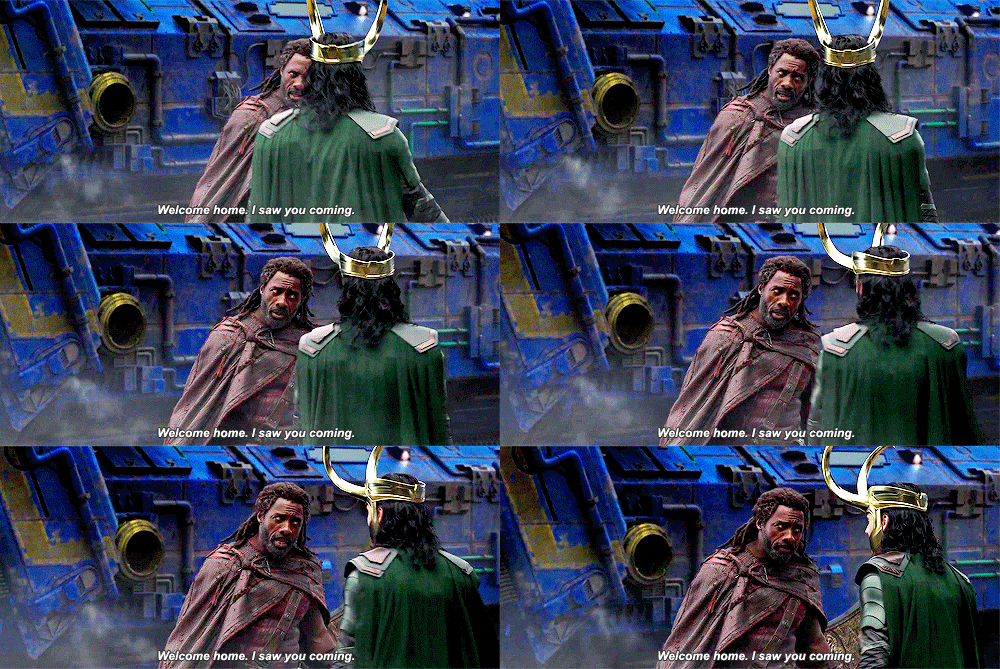
Imagine being Heimdall and having a spirit so generous that you could sincerely say “welcome home” to the individual who once turned you into an icicle and is now showing up 15 minutes late without Starbucks to the apocalypse that he sort of started.
That’s because Heimdall knows that he himself was a traitor and deserved it. He also sees that Loki is more loyal than he has to be. Oh yeah, and his brother Thor was the one that told him to go start Ragnarok in the first place.
Heimdall commited treasons TWO times. The second time Loki-as-Odin pardoned him. Heimdall still was the gatekeeper in Avengers: AoU (2015).
OP is so willingly blind and petty? Loki showed up with an evacuation vessel to help a place he didn’t own any loyalty or debt to. As for “icicling” Heimdall, lol Loki would have been in his right to kill him if he wanted, seeing as he was King at the time.
Also? Heimdall only saw Loki cause Loki allowed him to, so guess who was being magnanimous in that scene? Yep, Loki.
And let’s not forget that Heimdall went for the kill, and Loki in response just froze him.
Yeah, that was a weird bit of writing in Thor 1, which is in most respects a very well-crafted movie. Why did Heimdall (apparently) attempt to kill Loki after Loki pronounced a banishment sentence? Was it revenge for having let the Frost Giants into Asgard, resulting in the deaths of two Einherjar? Did he believe Loki posed an immediate threat to the safety of Asgard? Also, why did Loki let Heimdall see him coming back from Jotunheim previously, and why did he admit to letting the Jotnar in before Thor’s coronation? He still had plausible deniability at that point.
I certainly don’t hate Heimdall, but he does seem inordinately hostile to Loki in Thor 1, and is suspicious of him – to the point of disobeying both Loki’s orders and Odin’s by sending the W4 to Asgard to retrieve Thor – before he has any good reason to be. I wonder if Heimdall’s hostility to Loki is a subtle allusion to the fact that in myth, they’re prophesied to kill each other at Ragnarok
Interesting point about Heimdall still being gatekeeper in AOU – that hadn’t occurred to me. So Loki must have banished him later… maybe it took him a while to figure out that it was Loki in disguise? If so, that’s a really impressive masquerade on Loki’s part; he must have been wearing the Odin glamour at virtually every moment, even when alone and/or asleep. Alternatively, Heimdall might have been aware but kept it to himself because after TDW, he knew that Odin wasn’t a fit ruler anymore. But then he might have threatened to reveal Loki’s identity because Loki did something he didn’t approve of, whereupon Loki banished him.
We first see Heimdall in Thor 1 when Thor and his merry band are approaching Heimdall for travel to Jotunheim. Loki speaks first and Heimdall cuts him off & harshly tells him “Enough.” Just another example of an Asgardian commoner treating an Asgardian Prince with disdain. Moments later, as “the Team” heads inside for transport, Volstagg walks past Loki and insults him saying, “what’s the matter, Silver Tongue turn to lead?” No one, at this point, knows that Loki gave info to Laufey that allowed a few Frost Giants to enter the Weapons Vault during Thor’s coronation. I’ve always been angered at the lack of respect Loki received at the hands of non-royal Asgardians from the beginning of the film.
Actually, Heimdall interrupts to say “You’re not dressed warmly enough,” Loki starts to say “I don’t know what you mean,” and Thor cuts him off with “Enough.” The upshot is that non-royals don’t show him deference and Thor reinforces that behavior rather than discouraging it. The deleted scene in which the servant laughs at Thor’s “Some do battle, others just do tricks” quip both establishes that dynamic and provides a presumed explanation: Loki’s use of magic is disdained, in keeping with the attitude in historical Norse culture that male practitioners of seidr are shamefully unmanly.
@tracheometry First, Loki didn’t think the Jotuns were his people because: 1. Odin brainwashed him to believe Jotuns are a race of despicable monsters. 2. Odin told him he was abandoned to die by the Jotuns when he was a baby. (It probably was a lie but that’s another topic.)
Second, Heimdall not only welcomed Thor back but even committed treason to bring him back. And Thor at that time was a murderer for hundreds of lives, who would have committed genocide if his daddy had not arrived and stopped him in time.
Third, in fact after Ragnarok Loki wanted to reconcile with Heimdall and explain everything to him, but Heimdall was unmoved and uninterested. From Avengers Infinity War prelude novel:
Bold of you to assume that people who comment on a post that we’re “delusional” are actually open to entertaining evidence or arguments to the contrary. Or trying to understand the nuance of a villain who is presented as sympathetic, not because his actions are supposed to be justified or excusable, but because we can understand the circumstances and the troubled mindset that led him to commit them. The contempt and mistrust Loki receives from other Asgardians feed into the insecurity, self-loathing, and hunger for approval that eventually push him into attempting genocide. He desperately feels he needs to prove what a good, loyal Asgardian he is not only because he’s found out he isn’t one by birth, but because his valor and masculinity – which Asgard prizes above all – are constantly being questioned, and he wonders whether his biological heritage is part of the reason he’s never seemed good enough.
The excerpt from the prelude novel paints a curious picture. Heimdall doesn’t hold Loki’s actions against him – but he still refuses to reconcile or establish friendly relations. I guess he has reason not to trust Loki, but if he really doesn’t still blame him, it’s not clear why he’s being so dickish.
Imagine being Heimdall and having a spirit so generous that you could sincerely say “welcome home” to the individual who once turned you into an icicle and is now showing up 15 minutes late without Starbucks to the apocalypse that he sort of started.
That’s because Heimdall knows that he himself was a traitor and deserved it. He also sees that Loki is more loyal than he has to be. Oh yeah, and his brother Thor was the one that told him to go start Ragnarok in the first place.
Heimdall commited treasons TWO times. The second time Loki-as-Odin pardoned him. Heimdall still was the gatekeeper in Avengers: AoU (2015).
OP is so willingly blind and petty? Loki showed up with an evacuation vessel to help a place he didn’t own any loyalty or debt to. As for “icicling” Heimdall, lol Loki would have been in his right to kill him if he wanted, seeing as he was King at the time.
Also? Heimdall only saw Loki cause Loki allowed him to, so guess who was being magnanimous in that scene? Yep, Loki.
And let’s not forget that Heimdall went for the kill, and Loki in response just froze him.
Yeah, that was a weird bit of writing in Thor 1, which is in most respects a very well-crafted movie. Why did Heimdall (apparently) attempt to kill Loki after Loki pronounced a banishment sentence? Was it revenge for having let the Frost Giants into Asgard, resulting in the deaths of two Einherjar? Did he believe Loki posed an immediate threat to the safety of Asgard? Also, why did Loki let Heimdall see him coming back from Jotunheim previously, and why did he admit to letting the Jotnar in before Thor’s coronation? He still had plausible deniability at that point.
I certainly don’t hate Heimdall, but he does seem inordinately hostile to Loki in Thor 1, and is suspicious of him – to the point of disobeying both Loki’s orders and Odin’s by sending the W4 to Asgard to retrieve Thor – before he has any good reason to be. I wonder if Heimdall’s hostility to Loki is a subtle allusion to the fact that in myth, they’re prophesied to kill each other at Ragnarok
Interesting point about Heimdall still being gatekeeper in AOU – that hadn’t occurred to me. So Loki must have banished him later… maybe it took him a while to figure out that it was Loki in disguise? If so, that’s a really impressive masquerade on Loki’s part; he must have been wearing the Odin glamour at virtually every moment, even when alone and/or asleep. Alternatively, Heimdall might have been aware but kept it to himself because after TDW, he knew that Odin wasn’t a fit ruler anymore. But then he might have threatened to reveal Loki’s identity because Loki did something he didn’t approve of, whereupon Loki banished him.
We first see Heimdall in Thor 1 when Thor and his merry band are approaching Heimdall for travel to Jotunheim. Loki speaks first and Heimdall cuts him off & harshly tells him “Enough.” Just another example of an Asgardian commoner treating an Asgardian Prince with disdain. Moments later, as “the Team” heads inside for transport, Volstagg walks past Loki and insults him saying, “what’s the matter, Silver Tongue turn to lead?” No one, at this point, knows that Loki gave info to Laufey that allowed a few Frost Giants to enter the Weapons Vault during Thor’s coronation. I’ve always been angered at the lack of respect Loki received at the hands of non-royal Asgardians from the beginning of the film.
Actually, Heimdall interrupts to say “You’re not dressed warmly enough,” Loki starts to say “I don’t know what you mean,” and Thor cuts him off with “Enough.” The upshot is that non-royals don’t show him deference and Thor reinforces that behavior rather than discouraging it. The deleted scene in which the servant laughs at Thor’s “Some do battle, others just do tricks” quip both establishes that dynamic and provides a presumed explanation: Loki’s use of magic is disdained, in keeping with the attitude in historical Norse culture that male practitioners of seidr are shamefully unmanly.
[…. “When I’m king, I’ll hunt the monsters down and slay them all. Just as you did, father.” Child!Thor in Thor 2011, starting 6 minutes and 51 secs and ending at 6 minutes and 59 seconds.
And later, as an adult, “Father! We’ll finish them together!” Adult!Thor in Thor 2011 at 26 minutes and 19 seconds.
It is true that Thor also spoke of ‘breaking the Jotuns spirits’ so they would ‘never dare threaten’ Asgard again, but that does not sound too pleasant either, does it?
So, I am afraid your memory isn’t quite on point with this. So yes, Thor was on a similar tract with Hela, but in a different fashion driven more by hubris and power and arrogance, and he did think wiping out all the Jotun was just A okay. So it isn’t much wonder A. Loki felt he was a monster when he discovered he was the same race that his brother literally wanted to slaughter and B. he did not think wiping them out was much of a problem either.]
Apparently people are trying to say that we shouldn’t take what Child!Thor says seriously because he’s changed between that scene and when we see him again as a young man… a few seconds later in movie time. That argument makes no damn sense because the entire point of that scene with Thor and Loki as children is to establish (1) the way Odin fosters competition between them and (2) the basic character traits and dynamic that will continue into their adulthood. And that is, in fact, what we see: Thor remains outspoken and belligerent; Loki follows his lead, but is more hesitant and reserved, and seems always to be playing catch-up. It would be pointless and misleading to introduce them as kids if they’re going to be importantly different at the age when most of the movie takes place.
Also, how does “Father! We’ll finish them together!” NOT sound like suggesting genocide?
P.S. I want to make clear that I do not hate Thor and I do not think he is morally worse than Loki. I do think we should acknowledge that he has done some things that are comparable in severity to Loki’s worst crimes. If we are good readers, we will not take this to be a problem; Thor 1 makes it pretty clear, for those who are paying attention, that its hero is flawed and its villain is sympathetic. What makes Thor the “hero” and Loki the “villain” is primarily the direction of their change: Thor improves while Loki deteriorates. The fact that we’re watching Thor’s ascent makes him functionally the protagonist, and the fact that Loki ends up in conflict with Thor as they try to achieve their respective goals makes him functionally the antagonist. Wherever people got the idea that “hero/protagonist” necessarily means “morally blameless” while “villain/antagonist” necessarily means “morally worthless,” they need to drop that right now. (Although interestingly, I haven’t seen people have as much of a problem with this regarding Black Panther… which might just be because I’m not in a fandom specific to that movie, just indirectly through the MCU, so I see a lot less commentary on it in general.)





 Loki is the Philosopher King