“Loki is often the voice of reason to Thor’s impulsiveness and is usually relied on to talk his older brother out of sticky situation. ”
“As Odin’s younger son, Loki has always known the throne of Asgard will never belong to him. He has, however, tried his best to be a good brother to Thor and a son Odin could be proud of.”
BONUS:
Interesting.
Teleport is canon!
This irritates me…… a lot.
He can teleport.
Why the hell wasn’t this used in any of the other movies?
This is so important.
The argument could be made that he did teleport in the first Avengers. Loki cast an illusion of himself/became invisible and teleported behind Coulson to stab him with his staff.
Also he may have teleported himself into the room Thor was being kept in by S.H.I.E.L.D. in the first Thor movie and we just didn’t get to see it.
Honestly, I just ignore the teleportation thing in my fic writing. There’s a lot of stuff in canon that wouldn’t make sense if he could teleport.
The fact that Loki can teleport makes a LOT of canon stuff make no sense. The first 5 minutes of Infinity War especially.
Loki’s teleporting is definitely worth discussing, but can we talk about what they listed as Frigga’s “abilities”? Like … what even lol.
I should clarify: by “canon” (involving Loki) I mean Thor (2011), The Avengers (2012), and Thor: The Dark World (2013).
Yeah, they kind of forgot about Frigga’s illusion magic and swordfighting skills… or maybe they didn’t decide to put those in until TDW.
Re: @angryowlet‘s speculation, I don’t think any teleportation was involved in killing Coulson. I think Loki made two illusory copies of himself: one to lure Thor into the cage, and one to taunt Thor while the actual Loki was off retrieving the scepter.
The main reason I think teleportation would mess with canon logic is that Thor probably would have known that Loki could teleport, and that would be an extremely clear indication that he had gotten himself captured on purpose in The Avengers. He also could have teleported away to keep himself from being apprehended and imprisoned at the end, though I suppose he might have had reasons to want to place himself under Asgardian protection. Also (and this is mostly kind of silly), he wouldn’t have needed to ride a horse from the palace to the Bifrost observatory toward the end of Thor.
“Loki is often the voice of reason to Thor’s impulsiveness and is usually relied on to talk his older brother out of sticky situation. ”
“As Odin’s younger son, Loki has always known the throne of Asgard will never belong to him. He has, however, tried his best to be a good brother to Thor and a son Odin could be proud of.”
BONUS:
Interesting.
Teleport is canon!
This irritates me…… a lot.
He can teleport.
Why the hell wasn’t this used in any of the other movies?
This is so important.
The argument could be made that he did teleport in the first Avengers. Loki cast an illusion of himself/became invisible and teleported behind Coulson to stab him with his staff.
Also he may have teleported himself into the room Thor was being kept in by S.H.I.E.L.D. in the first Thor movie and we just didn’t get to see it.
Honestly, I just ignore the teleportation thing in my fic writing. There’s a lot of stuff in canon that wouldn’t make sense if he could teleport.
Sorry for not answering this sooner, I had to think about it, haha. I really enjoy the concept of pre-Thor Loki because there is just so much we don’t know about who Loki was before everything went to shit. We have a basic idea of his general personality, of course – the envious younger brother, the mischief-maker, the less-favored prince. Even despite these attributes, though, Loki clearly holds Thor in high regard (”sometimes I’m envious, but never doubt I love you”) and never meant for things to go as far as they did.
When I think about pre-Thor Loki, the quote I always come back to is when Kenneth Branagh states (in his commentary on the Vault scene): “This is the moment where the thin steel rod that’s been holding your brain together snaps.” Truly, this moment is life-altering and devastating for Loki, but Branagh implies that Loki’s mind was fractured to begin with. We don’t generally think of healthy brains as being “held together with thin steel rods,” and it begs the question, why was Loki so unstable in the first place? Certainly as a result of his upbringing, as far as I can guess. (Whether or not mental illness is inherent in his brain chemistry is a different question, but it bears mentioning that mental illness includes conditions like anxiety, depression, etc, and that these conditions can be a result of one’s upbringing.)
I (like so many others) take such issue with Thor calling Loki’s grievances imagined slights because they are very much not imagined and, if anything, they are the worst kind of slights because by nature they are designed to break a person down steadily over time. If you tell a dog it’s bad enough times, the dog will eventually believe it. In the first twenty or thirty minutes of Thor, if we include deleted scenes, we see Loki being openly laughed at by a servant (!!), admitting he’s envious but telling Thor he loves him anyway, only to get a “Thank you” in response (without any reassurance of Thor’s feelings in return), a nasty comment from Volstagg on the rainbow bridge about Loki’s silver tongue, and Thor snapping for Loki to “know your place” when Loki tries to talk Thor down from literally starting an intergalactic incident.
Furthermore, after Thor’s banishment, Loki admits that he told the guard of their plans. It’s important to note that he’s not being sneaky or underhanded – he straight up admitted, “yeah, I told them we were going, and I’m not sorry because Thor is out of control and his idea was fucking stupid.” And what’s his payback? As soon as he leaves, the Warriors 4 talk about him behind his back, say he’s always been jealous of Thor, and wonder out loud if Loki is the traitor Laufey spoke of. Why would they immediately assume that Loki is a traitor to his family and his kingdom? Like, that escalated really fucking quickly.
All of these things show us that Loki is treated as less than, for no real reason other than he’s very different from Thor. Different, in Asgard, seems to mean, not as good as. The narrative tells us we should just accept this treatment of Loki because he turns out to be the villain (although the argument has been made, many times, that his actions weren’t villanous at this point – but, I digress) so one can assume that the same is true of Asgard – everyone should just accept that this is how Loki is treated, everyone is used to Loki being the punching bag, and no one should feel badly about it.
I don’t even think I’m answering your question right, I’m sorry, but what I’m trying to get at is, if this is the sort of treatment we see Loki getting just in the beginning of the movie, imagine a (very, very long) lifetime of the same sort of treatment. Imagine how broken down someone would have to be after that. Even if Loki’s upbringing wasn’t bad, in that he was privileged with wealth and title and family and all of that, it was definitely emotionally abusive. And I think that it’s very possible to feel like you have a nice life, to feel like other people have it worse than you, to feel like you deserve all of the imagined slights heaped upon you, until you snap. This is why Loki was hanging onto mental stability by a thread. This is why he suffers a complete mental breakdown – because, in addition to this toxic environment and mindset he’s been conditioned into, now he learns that he is something he’s been taught to believe is savage and disgusting and inferior. He loses all hope of ever being worthy, which makes him double down on his efforts to attain that worthiness. In his heart, maybe he knows it’s a lost cause, and maybe that’s why he fights so hard for it, anyway.
So, did he have safe havens? Probably. He probably holed up in the library with his books and scrolls, or maybe he had a favorite reading spot in the gardens, or maybe he liked to lay in the grass and watch the stars. Did he have secrets, things that were only his? Most definitely, as Loki in general (I think) is a private person who wants things to keep for his own, things that he doesn’t have to share with Thor. Did he hang out with Thor’s friends for obligation? No, I think that at first, he really wanted to be a part of their group. They’re all shown to be so close in age and class (except Volstagg, who seems older) that it seems like these are the people he should be friends with, and would be friends with, were he just more like Thor. I’m sure, eventually, he realized that they didn’t like him (and he didn’t really like them, either) but it was probably also a situation where Loki didn’t have any other friends, so he might as well hang out with the ones who tolerated him, sometimes, sort of.
Sorry for babbling at you and I don’t know if that answered your question or not, but I have a lot of Feels about Loki’s treatment in the first movie, and also the implications it has on his life beforehand. Thank you for the ask!
These assumptions came after TR tried to retcon everything about Thor franchise and characterizations. It came from the snake story which was improvise by CH just for jokes, and no one cared to remind him that Thor and Loki aren’t the same age, since Odin declared Thor his firstborn in Thor 1. These assumption came from TW who didn’t understand Loki at all despite enough material in other movies:
“someone who tries so hard to embody this idea of the tortured artist, this tortured, gothy orphan”
“…this little emo goth hanging out by himself. He was like the kid in Harry Potter [Malfoy].”
has been trying to kill Thor his entire life
None of these conclusions are true. Loki was pretty loyal to Thor his entire life. Even disrupting the coronation wasn’t a betrayal to Thor.
“You are my brother and my friend. Sometimes I’m envious, but never doubt I love you.”
“I love Thor more dearly than any of you, but you know what he is. He’s arrogant. He’s reckless. He’s dangerous. You saw how he was today. Is this what Asgard needs from its king?”
He knew Thor wasn’t ready and he also wanted a chance to prove to his father that he is worthy too, since that was the impression both Thor and Loki got from Odin, that the better son get to be the king.
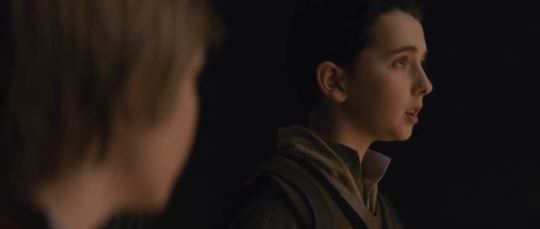
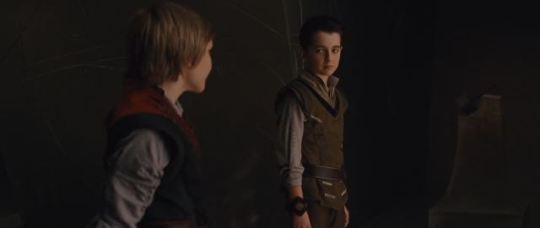
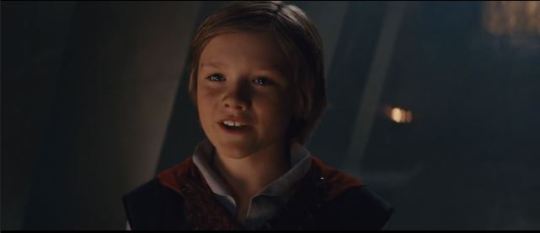
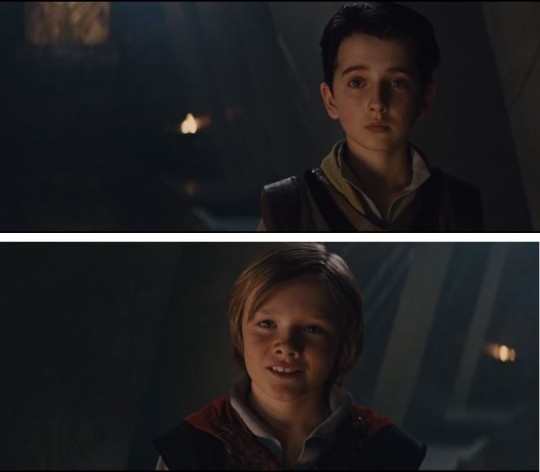
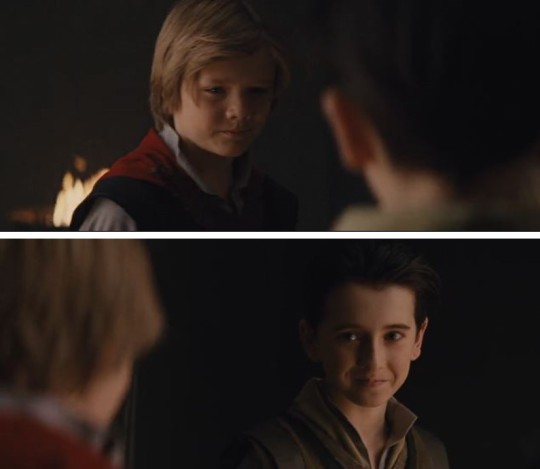
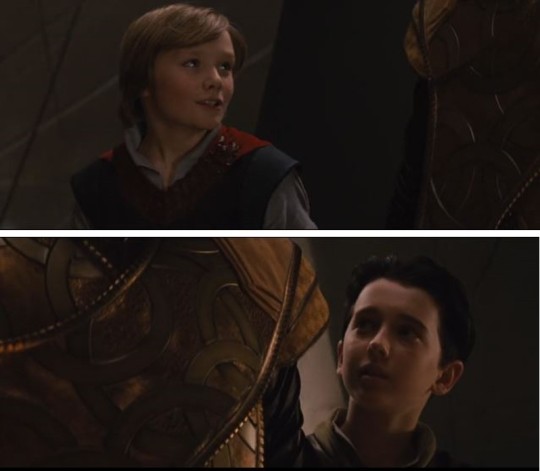
We got to see Thor and Loki as children in Thor 1. Let’s see what can be understood from their scene as children.
The scene starts when Odin finishing his tale about the war with Jotunheim and shows his children the war prize he got from them, the Casket of Ancient Winters to stop them to cause further harm. His tale portrays Jotuns as villains who attacked Earth with no reason and Asgardians as heroes. He speaks of a long and bloody war with an enemy that is very strong. As all children, Thor and Loki see their father as a hero and invincible, but in their case even more so, because Odin calls himself the protector of the nine realms. But this enemy even took their father’s eye. They must be very strong and scary. They must be monsters. Notice that Odin calls Jotuns, “Frost Giants”, a word that can inflicts fear and has a negative effect. Odin finishes his tale with:
“But the day will come when one of you will have to defend that peace.”
And starts the idea of brother’s competition for the throne right there.
The camera zooms on Thor and Loki’s faces individually.
Loki:
“Do the Frost Giants still live?”
Loki’s face and question shows that he is analyzing this information. His expression and tone also shows caution and that he’s scared(of his own race). this can be an indication that he’s a sensitive kid. He has just heard a tale of war and death and it doesn’t interest him. Although he’s scared, he is still curious and wants to know more.
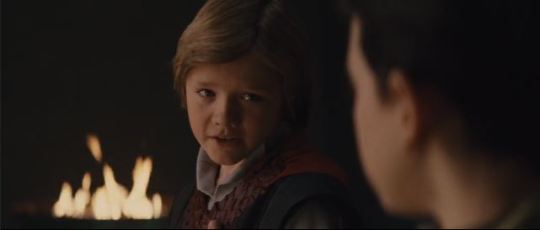
Before Odin has a chance to answer, Thor confidently declares:
Thor: “When I’m king, I’ll hunt the monsters down and slay them all!”
The camera cuts to Loki..
The way Loki looks at him after this, is very telling. There’s a bit exasperation and annoyance in his expression. As if he’s thinking “why are you
like this?” and “why do you think it’s you who’s going to be king”. There’s also embarrassment because Thor’s reaction made him look
weak, and envy because he thinks he isn’t as brave as his brother.
Thor continues,
full of excitement and admiration for his father, his hero: “Just as you did, Father”
This whole part shows that Thor is completely sure and confident that he is the one who is going to be the king. That it doesn’t matter to him if there are any monsters. He is going to kill them all. He is going to be like his father.
The next moment is very important in the movie. Both kids are looking to their father and waiting for his answer. Which one of them get his acknowledgment and approval? Does he think it’s better to know about the Frost Giants or just kill them all?
Loki’s face shows insecurity while Thor’s shows confidence. And both of them are longing to be validated by their father.
Odin knows this damn well. He looks at both of his sons and choose to answer them indirectly:
“A wise king never seeks out war but he must always be ready for it.”
Translation: It doesn’t matter to know about the Frost Giants more than it’s needed to defeat them. You must always be ready for war but don’t seek it.
He answers both of them with that. But in doing so he also confirms what Thor said, that Frost Giants are monsters. And the only information you need to know about them is how to beat them. There it is. Odin validating racism for his sons, knowing one of them is from the same race he just covertly confirmed to be monsters.
I was so shocked by this moment the very first time I watched this movie. I expected for Odin to tell Thor that they are not monsters. But instead Odin answered like that and it made me sure that this moment will come back to bite them(and us).
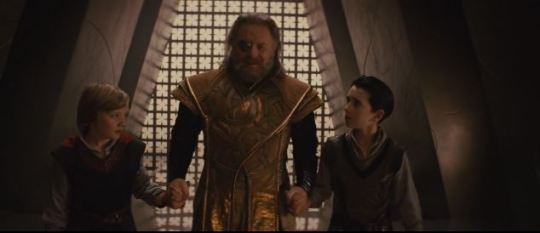
As Odin walks away from the children, Thor and Loki look at each other. There is love, excitement and innocence in their faces. And then they both run to reach to their father and grab his hands.
Thor states with confidence and determination while looking at Odin:
“I’m ready Father!”
Loki grabs Odin’s other hand and with desperation and insecurity tells Odin:
“So am I!”
Thor looks at Loki irritated. Loki looks at Odin, desperate to be acknowledged. Odin says:
“Only one of you can ascend to the throne. But both of you were born to be kings.”
Thor’s confidence returns and Loki’s face turns hopeful.
What Odin did here is pitting the two brothers against each other. His answer implies that only one of them, the better son can be king. This will make them compete against each other. This will make them seek Odin’s approval all the time which makes it easy for Odin to control them.
The way this scene plays out is very clever. The brothers look at each other with love but then run to Odin. Odin comes between them, literally and figuratively. The compete to gain his approval and as Loki’s insecurity here shows and later we find out, favoring Thor are the reasons that truly set the brothers apart.
So what can be concluded from this analysis? That neither Thor, nor Loki were malicious and definitely not towards each other. They got annoyed or irritated with each other but their reactions are as normal and childlike as any other child. Loki shows envy towards Thor, but the love in his eyes surpasses it far more(“sometimes I’m envious but never doubt I love you”). Besides his main concern is getting Odin’s approval. So a sensitive, curious, cautious child who is get upset and scared by the story of war and monsters, whose love for his brother is far more than his envy, isn’t capable of going around stabbing his brother. Also from a more logical point of view, he is intelligent, he knows stabbing his brother, the favorite son I might add, would never help him to gain his father’s approval which is his main goal. This also confirms what Loki later says to Thor:
“I never wanted the throne. I only ever wanted to be your equal!”
He wasn’t after the throne. Getting the throne was the proof that Odin saw him worthy. It was what Odin planted in their mind when they were children.
Kid Thor also isn’t malicious. He’s just a child who admires his father very much and wants to be like him. A child that his mistakes aren’t corrected but enabled and he is treated more favorably and better than his brother. So he learns that he’s better than Loki and learns to treat him the same way as he sees while they grow up. So the assumption that he was a sensitive kid(he was the one who got excited by stories of war and killing monsters) who was bullied by his broody evil brother can’t be correct.
Loki was never as evil and wrong as TR portrayed him. Neither Thor was like a saint and always right. Their relationship is far more complicated than good Thor vs. evil Loki. I don’t accept TR retconning their characteristics like this. Especially when there’s proof that TR’s interpretation of them is wrong.
No, I don’t
agree with it. This is the trope that TR was trying to maintain by retconning
all the previous canon in the franchise. Thor has never been a love martyr(except maybe once)
because:
1. Thor is
not the perfect and blameless angel who loves his completely evil brother. Thor
and Loki are both flawed characters and their relationship has been on the rocks because they both hurt each other and never actually talked about it.
2. Unlike
what Thor thinks, most of Loki’s horrible actions wasn’t about hurting Thor.
3. It didn’t
take a long time until Ragnarok for Thor to give up on Loki. Thor gave up on him
in Avengers.
Let’s discuss
these points in more details:
Thor starts
his journey as an arrogant warmonger prince. He is the golden child of his
realm and Loki is his shadow. No one respects Loki or take him seriously the
way they respect Thor. Not guards, not Heimdall, not Thors’ friends and not
even servants. The way Thor treated Loki certainly had an effect on Loki’s
situation(aside from other cultural aspects). Thor doesn’t respect Loki: “Enough!”,
“Know your place brother!”, “Some do battles, other do tricks”.
He doesn’t even look at Loki, when Loki speaks with him. The way Loki reacts
after these mistreatments doesn’t show his surprise, it shows that he’s used to
them. Despite all of this, Loki still cares about Thor and Loves him: “You are
my brother and my friend. Sometimes I’m envious but never doubt that I love you”.
Sabotaging
Thor’s coronation was not a betrayal to Thor. Loki knew that Thor wasn’t fit to be a king yet, and
he tried to stop it. Just like Thor tried to take the throne from Hela, who was
the rightful heir, because she wasn’t suitable for the job.
I always
think the worst thing that Loki has ever done to Thor is lying to him when Thor
was in SHIELD when he was already down after failing to lift Mjolnir. Thor’s “Can
I come home?” and his tears always break my heart.
Now the
paragraph says that Loki tried to kill Thor at least twice! No, Loki almost
killed him once with the destroyer. But that was it. In their fight on the
Bifrost he only tried to stop Thor and stall him so he can destroy Jotunheim.
After that Loki never tried to kill Thor. He dropped Thor in the Hellicarrier
because he knew if Mjolnir could crack that glass, it could also break it. He
was never surprised that Thor showed up later. And don’t tell me him stabbing
Thor with that tiny dagger was an attempt on Thor’s life.
Loki trying
to commit genocide on Jotunhim wasn’t about hurting Thor, it was about proving
his worthiness to Odin. Loki killed Coulson mostly because he was in his way
and he was threatening Loki with a destroyer gun. But faking his death to usurp Odin? Really?
*sighs* Loki’s illusions are not solid unless it’s on the person. So Loki
getting stabbed by Kursed wasn’t an illusion. He was really stabbed through
the chest to save Thor. He had no way of knowing what would happen when he attacked
Kursed. This wasn’t planned. And he couldn’t know that he would survive it. So
after he survived he didn’t tell Thor because Thor promised he would return
Loki to his cell. Usurping the throne from Odin had nothing to do with Thor.
Again it wasn’t about hurting Thor. It was about getting his revenge on Odin
for sentencing him to solitary confinement for life and all the other awful
things he’d done. Then Loki as Odin offered the throne to Thor. Loki even asked him to confirm
that it was really what Thor wanted and wasn’t Jane’s wish. None of the things
that the paragraph mentioned was an act of betrayal against Thor. So the line
that Thor says in TR: “I trust you, you betray me. Round and round in
circles we go” is not true.
Now let’s
talk about Thor giving up on Loki and the only situation that love martyr trope can be applied to him. When he found Loki on Earth, first he asked
about Tesseract, then he said Loki’s grievances were imagined slights and then threatened
him. He once again tried to reason with Loki on the Stark Tower and was stabbed
for it. That was the last time Thor ever tried to talk to Loki. That was when
he gave up on Loki. It was obvious that Thor had forgiven Loki after everything Loki did to him in the first Thor movie and still wanted Loki to go home. He made mistakes when he was talking to Loki, but imo forgiving Loki after the way he lied to him and almost killed him was a big deal and that makes Thor a love martyr. But then Thor gives up on Loki after he is stabbed. And that’s the end of him being in the love martyr trope. He never visited Loki when Loki was imprisoned. Not even to
tell him that their mother was dead. Even when he went to Loki for help, Thor
treated Loki like a stolen relic(“locked away here until you may have use of
me”): “I did not come here to share our grief” “I grant it to
you, vengeance, and after this cell”.
Thor and
Loki both loved and cared about each other despite the fact that the other one
hurt them. But Thor is not a love martyr. He never tried to talk to Loki and
understand him about his just grievances. He never asked Loki what happened to
him after he let go. He also made mistakes. He is not blameless in all of this.
And I just talked about the Thor we saw in every movie except TR. Because TR
Thor is very ooc and he constantly dismisses Loki and his pain. In other movies Thor simply doesn’t understand Loki. In TR he just doesn’t care to understand despite Loki trying to explain to him and trying to find a common ground with Thor. What Thor does in TR is a disgusting reverse psychology method, not giving up on Loki. Because “you’re late” implies that Thor knew Loki would come. So imo that paragraph in TV tropes page got it all wrong.
None of the things you mentioned can be considered as torture. Loki dropped Thor with the glass cage right after he saw that Mjolnir could crack the glass. The reason Thor stopped attempting to break the glass wasn’t because the glass was unbreakable, but because the cage would fall if he continued. So Loki knewThor could free himself before the cage hit the ground. Yes, Loki lied to Thor about Odin’s death and he almost killed him with that backhand and IMO these are very horrible and
the worst things he ever did to Thor. Still they are not torture. He broke Thor with his lies but those lies showed Thor that the consequences of his actions can be very grave. Also an argument can be made that if Loki really wanted Thor dead, he would incinerate him with the destroyer not backhand him. The only time Loki really stabbed Thor was in The Avengers. They were fighting, and it was a stab to the gut not the chest and it was with a really small blade that didn’t harm Thor that much. The stab in TDW was an illusion(again that was a stab to the gut), because when he lifted the illusion Thor’s armor was intact while in The Avengers, Thor’s armor remained torn after the stab.
No one said Thor shouldn’t have stopped Loki from betraying him. But Thor could simply make Loki unconscious with the obedience disk(I explained in this post that the device has two settings). That would be acceptable. But Thor chose to leave Loki in constant pain with the device on for an infinite amount of time. Yes, Thor and Loki are called gods and they are more durable. But just because they can tolerate more pain, it doesn’t make it ok to inflict pain on them. It’s still pain and the obedience disc is a torture device. And no Thor had no way of knowing that Loki could get out of it. In fact he knew Loki couldn’t free himself. Thor with all his power, was paralyzed by the obedience disc. Even his lightning couldn’t get him free from it. Only the control device could free Loki. And he was unable to move.
What is torture?
“The action or practice of inflicting severe pain on someone as a punishment or to force them to do or say something, or for the pleasure
of the person inflicting the pain.”
Thor didn’t just stopped Loki’s betrayal. He inflicted severe pain on him for an infinite amount of time
as punishment for his betrayal and then had the audacity to gleefully preach Loki about growth and change and laugh at his pain.
What Thor did in TR was torture and that makes him so much ooc that I don’t consider TR Thor, the real Thor.
I think it would be appropriate to reiterate what I said in the last post linked in the above (the one arguing that the obedience disc is a torture device), so here it is again for people who don’t bother to follow links:
< I’ve been seeing a lot of people try to justify Thor* by pointing out that Loki has done worse things to him; most commonly they will cite the incident in The Avengers where Loki drops Thor out of the Helicarrier in the Hulk cage. (This is such a common move that I feel like it’s got to be in some Thor* stan/ Ragnarok defense playbook.) Here is why that comparison doesn’t accomplish what they want it to accomplish:
It was entirely reasonable for Loki to think he was not endangering Thor’s life. He knew Thor could get out of the cage because he had Mjolnir with him. As far as we can tell, in Ragnarok, Thor* had no way of knowing that the first people who would happen along were Korg & co. as opposed to, e.g., Topaz, who probably would have just killed Loki while he was incapacitated. Maybe he did have some way of knowing, but this was not made at all clear in the film. So even if he didn’t think he was endangering Loki’s life, he was being culpably negligent.
In The Avengers, Loki was acting as an adversary, and everyone was completely aware of that. He was trying to hamper his opponents by scattering them, and possibly to demoralize Thor by showing that he wasn’t going to get his brother back. In Ragnarok, Thor* presented what he did as some kind of “tough love” – punishing Loki “for his own good,” with the aim of getting Loki back on his side rather than (as Loki was doing in The Avengers) turning him decisively against him. If you can’t see why that’s kind of fucked up, well…
Loki is clearly aware that what he’s doing in The Avengers is wrong. He hesitates before he hits the button to drop the cage, and hesitates again (with tears in his eyes, FFS!) before he stabs Thor later. He’s conflicted, and it’s not unreasonable to think he regrets hurting Thor when he’s no longer under direct threat from Thanos (his attempts at self-justification in TDW have a defensive air that make me think the lady doth protest too much). In Ragnarok, Thor* just looks smug and self-righteous about the electrocution thing, even though he’s very aware that Loki is in severe pain. >
And I’m sure I’ve said it somewhere else, but again, it doesn’t really make sense to compare the electrocution in Ragnarok to the things Loki did to Thor in Thor 1 and The Avengers because in both of the latter cases, it’s made pretty clear that Loki isn’t in his right mind. In Thor 1, Loki has pretty clearly been profoundly disturbed by the revelation that he actually belongs to a race that he has been taught all his life to hate and fear (and that Thor has twice vowed to “finish”). He is convinced that the reason Odin always favored Thor is because Loki is really Jotun, not Asgardian, so he’s desperate to prove how very Asgardian and not Jotun he really is. I agree that it’s not clear whether Loki meant to kill Thor with the Destroyer; he must have known that killing Odin’s other son wouldn’t be a great way of earning his favor. (Maybe he had it backhand rather than incinerate him so he could pass it off as an accident… or maybe he lacked commitment there too.) At any rate, he is very obviously emotionally and psychologically unwell for… over half of the movie, tbh, but it becomes increasingly obvious in the last third.
In The Avengers, Loki shows up looking like shit; his eyes are wild and hollow and he’s saying some really weird stuff. When they communicate through the scepter, the Other threatens him and he looks terrified. No, Loki wasn’t completely under Thanos’s control and maybe he bears some responsibility for getting himself into that position… but again, he’s clearly been through some shit and is under severe duress. And, as noted above, he’s conflicted about hurting Thor.
Thor* has no such excuse or explanation in Ragnarok. On the contrary; he’s presented as being fully in control, cool-headed, rational, oh-so-cleverly out-thinking his clever brother. He even thought up this scheme in advance, because he predicted that Loki would betray him (for no good reason other than it was needed as set-up for the “trickster tricked” scenario where Loki gets his painful, humiliating comeuppance). Thor*’s action is more blameworthy than anything Loki has done to him because he does it while in full possession of his faculties and shows sadistic glee at making Loki suffer.
And no, Loki has not been stabbing Thor or “trying to kill him” since they were children. Taika Waititi pulled that out of his ass. It should be obvious from Thor 1 that Thor trusts Loki, that they’ve been comrades in arms for centuries, and that Loki’s betrayal and his demand that Thor fight him come as an incredible shock. If you want to accept the stabbing-since-childhood BS as canon, then you’d better stop citing anything Loki does in Thor 1, including telling Thor their father is dead and striking him with the Destroyer, because clearly you’re ignoring what that movie established as the longtime dynamic between them. You want to pretend previous canon doesn’t exist? Then at least do it consistently.









 Loki is the Philosopher King