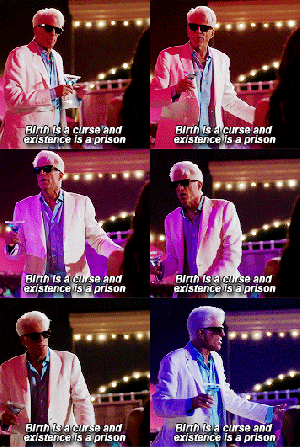
I’m watching season 3 of “The Good Place” and Chidi just quoted Gay Science 125 (the God is dead one). I don’t think he’s ever quoted Nietzsche before.
It was kind of a joke but also kind of not. The idea – which I admit may be a little far-fetched – is that The Good Place is a fictionalization of an idea from Kant’s so-called rational theology (his attempts to provide a basis in rational argument for certain religious principles). The idea in question is an argument for the immortality of the soul (or “noumenal subject,” in Kant-speak) based on the demandingness of the moral law and the fact of human imperfection. The argument basically goes like this: we all find ourselves with the call to be good (he considers this just a given), but also with a whole lot of selfish, hedonistic, or just contrarian impulses that make it very difficult to consistently heed that call. It is impossible for any human being to be completely good all the time. And even if you’re acting in accordance with the moral law, you might still be doing it from self-interested motives rather than the motive of duty, in which case the action still has no real moral worth. People can get morally better over time, but it would take an infinite amount of time to become completely morally good.
So, why does this prove that the soul is immortal and we therefore have the infinite amount of time we need to become morally good rather than that we’re all fucked? Well, he’s already argued that we’re practically justified in faith in God (this is not supposed to be a Descartes-style theoretical argument) because we can only be rationally motivated to pursue the aim of morality – which, Kant says, is the “highest good,” the apportionment of happiness in accordance with virtue (i.e., good people are happy, the best people are the happiest; bad people are unhappy, the worst people are the most miserable) – if we believe there is a possibility that it will be achieved. But given what we know about this crapsack world, we would only be justified in believing that the highest good is achievable if we believed there was an omnipotent, benevolent being who guaranteed its achievement, and that’s God. God has not decreed or commanded the moral law, because the moral law is supposed to be justified by rationality itself; but God is its guarantor, so to speak.
So, why does God not just apportion happiness after death to the level of virtue achieved during life? Put simply, because that would make God a real dick. And that’s kind of what we see in The Good Place: all of our heroes died young, before they had a chance to turn their lives around. But what we see in their afterlife is that they all have the capability to turn their lives around, given the right opportunity and motivation. So Kant’s idea is that after (well, the “after” is vague, because noumenal existence is outside of time… there are some parts of this argument where you have to squint) our embodied selves die, the rational subject lives on, interacting with other rational subjects in some way that I’m not completely clear on because none of them have bodies. But they become happier and happier as they become morally better. That, I submit, is what The Good Place dramatizes: continuing moral improvement after death, via interaction with other people who are also morally improving.
Does this mean that everyone ends up perfect and perfectly happy? Or, put differently, is Kant the pseudo-secular version of a universal salvationist? (There are some Christian theologians who believe that Jesus’s sacrifice saved literally everybody, even Hitler.) No, it does not. Kant thinks that everybody makes a fundamental choice either to try to be good or not to, and this choice is expressed over time in the direction that a life takes. It might seem a little implausible that Eleanor and Jason, especially, made a fundamental choice to try to be good, considering how they lived their earthly lives… but the fact that they’re susceptible to moral improvement after death means that they must have.
In the Tao Te Ching, Lao Tzu wrote, “Knowing others is wisdom, but knowing the self is enlightenment.”
False: Kant does in fact talk about masturbation. He says it is a violation of the categorical imperative because you are using yourself as a mere means to your own pleasure.
throwback to that time in my existentialism class where the professor asked ‘who thinks hell is other people’ and half the class slowly and meekly put their hand up
then the prof was like ‘…i mean who originally said it’
there are some posts that sound utterly made up for the joke or for the notes, but this one I whole heartedly believe
Sounds right to me…
That quote is amazing to me in that it’s quoted completely accurately and yet in a way that means something completely different from what it meant in context.
(Sartre was claiming that Hell was other people. He was not claiming that other people were hell.)
…I can’t actually tell what distinction you’re drawing there. Can you expand?
The line comes from No Exit, which is set in Hell. Spoilers for No Exit follow
In particular, three people who have been condemned to hell are trapped eternally in a room together. And at first they think they got off easy without any pitchforks or fiery lakes or anything. But over the course of the play they discover that they have been chosen very specifically to have neuroses and character flaws that interact with and torment each other.
Each one needs the approval of a second in an unstable RPS cycle so that any time one of them might be satisfied by a second, the third swoops in and ruins it.
And when they figure this out, one of the characters expresses his understanding, that hell isn’t physical torture. “Hell is just—other people.”
So the point isn’t that other people, generically, are hellish; it’s rather that you can build a hell out of other people.
But when I hear people quote it, it’s usually sort of an introvert-pride thing. “Other people are hell; you should spend time alone.” And that’s not the point at all. It’s a statement about how bad unhealthy relationships can be, not a statement about how all relationships are unhealthy!
“hell is other people” has always been misunderstood. It has been thought that what I meant by that was that our relations with other people are always poisoned, that they are invariably hellish relations. But what I really mean is something totally different. I mean that if relations with someone else are twisted, vitiated, then that other person can only be hell.
Reblogging for the original post which was hilarious and also for that explanation which is beautiful























 Loki is the Philosopher King