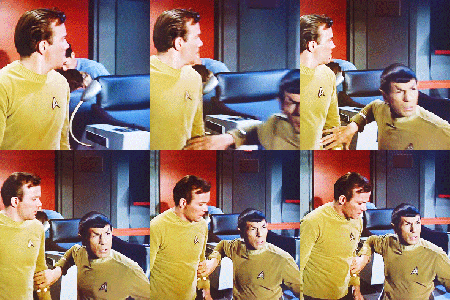
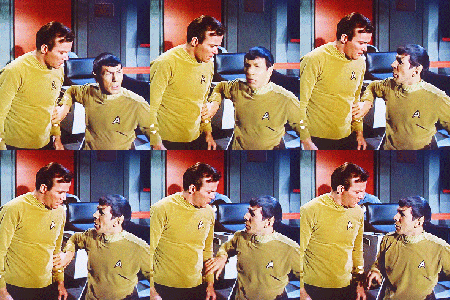
(Image description: Spock, wearing the same wtf yellow/green sweater that Jim is wearing, grabs Jim by the arm. Jim, who is visibly Shook, looks down at Spock’s hand like it is the greatest treasure he has been searching for in deep space. Spock, on the other hand, keeps talking as if he didn’t just rock his Captain’s works with one touch)
So people make fun of the Kirk shirt rip in Shore Leave because it is so blatantly independent of the fight with Finnegan
See:
then:
But what most people fail to acknowledge is that the Shore Leave planet is there to suddenly create things you are thinking about, rather than obey the laws of reality.
Which means that Kirk was thinking about fighting Finnegan, so he appeared:
Which also means, in the middle of the fight, Kirk must have thought: “Man, it would be so cool if my shirt ripped off right now,” leading to the inevitable:
So since we’re fairly certain now exactly what Kirk thinks about during fights, we can continue to laugh at his shirt rip in Shore Leave, but make sure it’s for the right reasons: not so much continuity error, more actually being Exactly In Character.
I really hope most people are aware of why Amok Time was made in the first place
I should start off by saying that Star Trek was made with a female audience in mind. It’s why Captain Kirk’s shirt rips and why he’s shirtless a lot, since the makers of the show were expecting to draw in a female audience with the good looks of William Shatner. Star Trek was even considered fake sci fi for girls by most male sci fi fans.
I have to mention that first because the show was banking on the female audience to fawn over Captain Kirk, and many of the women watching did, but they soon realized that even more women were fawning over Spock. When the show got renewed for a second season, they wanted to make sure they could retain the same female audience, most importantly the Spock fangirls, so they decided to treat their female audience with Amok Time.
Every single decision involved in the plot of the episode was made with “how do we give these ladies what they want without hurting his likability?”. Pon Farr was made up so Spock would have a reason to act super horny while still being the same alien everyone knew and love, T’Pring leaving Spock while Spock was planning on being loyal to her to show off how loyal he is to romantic partners, and his Pon Farr being cured without actually having sex was to keep him single.
TL;DR Amok Time was made for straight girl wank bank but instead they created the K/S community
I don’t think it was inadvertent at all – Theodore Sturgeon, the writer of Amok Time, was openly gay and was known for constantly trying to slip gay shit past the censors. He also wrote the backrub scene and lots of other k/s moments. Lgbt people in the 60s wanted to see themselves represented in media just as much as we do, but because of censorship laws it all had to be subtextual.
I’d like to look at this from another angle, because I think there’s more to it than Sturgeon was gay, therefore the gay subtext.
At the time Trek was airing, CBS thought of it as a kids’ show and boys were assumed to be the primary audience of Sci-Fi. In 1967 – 1969 girls were not thought of as being interested in Sci-Fi for its own sake (no matter how wrong media producers were about that). Girls were the half of the demographic that had to be brought in by “girl things”, e.g., fashion and romance and cute (non-threateningly good looking) male characters. An example would be the inclusion of Chekov with his Monkees haircut during the second season.
So yes, when it was discovered that there was actually a female demographic gravitating to the show on its own, for its own reasons (e.g., Spock, the dynamic between Spock & Kirk), then Roddenberry, a very clever man, decided to exploit these things for all they were worth.
One of the best and most time-honored ways of doing this is through the “Are They Or Aren’t They (Lovers)?” question (aka the Bromance), primarily of interest (so it is assumed) to the female audience. What makes the question work is that it’s always hinted at but never, ever answered. If you answer the question, you resolve the undercurrent of sexual tension and you kill the show (or it must become another kind of show).
It is also something that Theodore Sturgeon, a well-established science fiction writer at the time “Amok Time” was written, would have known. He would also have known where to look for a story idea that would really grab the audience, not with fistfights, rubber monsters or planet-devouring robots, but with the question: What do I (and the rest of the audience) most want to see? The answer is always the forbidden, the thing held back, kept under wraps.
“Amok Time” and Pon Farr is one of the best examples of “Are They Or Aren’t They?” because the engine that drives the story is that strong undercurrent of unresolved sexual tension (aka gay subtext). At the time the show aired, few in the audience would have spotted that subtext, which was how they got away with it, but the female and gay contingent would certainly have felt its effects. When a show brushes close to your half-conscious fantasies, it is absolutely electrifying, though you may not be able to explain exactly why.
Sturgeon headed straight for the forbidden: to strip Spock emotionally naked. Pon Farr was the vehicle with which to do it. Show after show (and Nimoy himself, as he developed the character) gave the female audience teasing little hints at the inner Spock, the smouldering interior landscape, the potentially barbaric sexual and emotional inner being he was keeping hold of with an iron fist. “Amok Time” is an emotional striptease that pays off by symbolically answering Are They Or Aren’t They?
In writing, and this includes television writing, when you have written a fight scene, particularly one that is cathartic, you should examine it with the same critical eye as you would a sex scene. This is because in terms of character development, fight scenes and sex scenes do the same thing: they strip the character bare by showing you their “inner animal”, their deepest needs, desires and fears. This is something else Sturgeon would have known. It is the reason Pon Farr is structured to only have two possible resolutions: sex or a fight (or denied either, death). So when Spock finally does explode, how does it happen? A fight to the death not with Stonn, his actual rival for T’Pring, but with Kirk (with the acknowledgment that Spock didn’t choose Kirk for this purpose, but Sturgeon, the writer did).
On an emotional and symbolic level, the answer to Are They Or Aren’t They is a resounding YES, THEY ARE. On a conscious, visual level, the answer remains ambiguous, a hint, subtext, thus keeping the unresolved sexual tension intact. However physical the fight, the consummation remains emotional only, and thus the show, and the chemistry between Kirk & Spock, goes on. It’s an elegant solution to a big problem: How can you give the audience what it wants, without really giving them what they want and destroying the show (as it would have been at that time)?
So IMO, Pon Farr was not quite so deliberately created to give Trek a hefty dose of gay subtext, nor is that subtext just an accidental byproduct. It’s a great writer weaving all of that together to make a very compelling story.
damn….
Just one last thing, Sturgeon won a “Gaylactic Spectrum Award” (given to LGBT+ science fiction/fantasy novels and short stories) for a piece he wrote called The World Well Lost. It’s about humans who discover a pair of male aliens who are deeply, intrinsically in love, kinda like Spock and Jim ☺️
(Also, I don’t believe Sturgeon was gay, I believe he was actually bisexual or sexually fluid, but I’ll have to check because I don’t know for sure.)
my absolute favourite thing about all the old star trek series is when the ship unexpectedly collides with something and, due to the lack of sophisticated special effects available at the time, everyone just throws themselves across the set as dramatically as possible
Wait, isn’t there stabilised gifs of these shots floating around?
I FOUND SOME!!!
Is Uhura just like grinning like a dork in the last one?
Tag yourself, I’m Spock reaching out to tip over a chair in the first gif







 Loki is the Philosopher King