ppl who dont even like shakespeare: WOW how DARE you alter the original text these are CLASSICS have you no RESPECT, going around DESECRATING these sacred texts in the name of POLITICAL CORRECTNESS!!!!!!!!!
people who love shakespeare: im going to stage a production of hamlet where all the actors are dogs
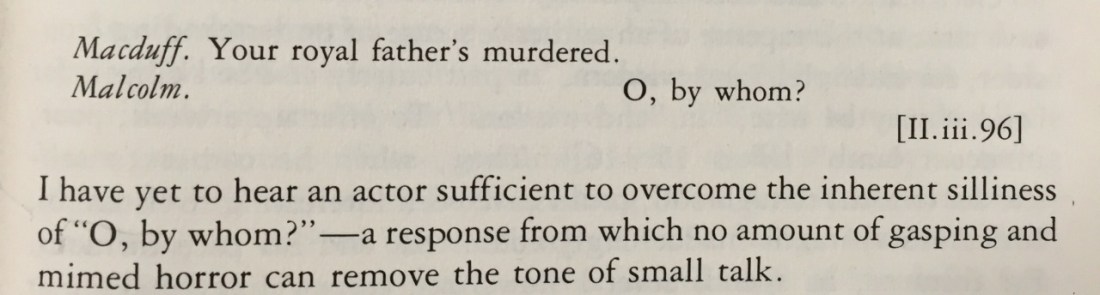
I’m in rehearsals for Macbeth right now and this line is always hilariously underwhelming.
Oh, but this is exactly the kind of thing I love as an actor! If nothing can “remove the tone of small talk”, then let the line be small talk. Does he think it’s a joke, and he’s playing along? Is he clamping down on his emotions? Does he just not know what to say, and this is the only thing that comes out of his mouth? If “gasping and mimed horror” don’t do the trick, stop doing it. Let the line be what it’s trying to be, and find the truth and the weight in that.
I find a big stumbling block that comes with teaching Romeo and Juliet is explaining Juliet’s age. Juliet is 13 – more precisely, she’s just on the cusp of turning 14. Though it’s not stated explicitly, Romeo is implied to be a teenager just a few years older than her – perhaps 15 or 16. Most people dismiss Juliet’s age by saying “that was normal back then” or “that’s just how it was.” This is fundamentally untrue, and I will explain why.
In Elizabethan England, girls could legally marry at 12 (boys at 14) but only with their father’s permission. However, it was normal for girls to marry after 18 (more commonly in early to mid twenties) and for boys to marry after 21 (more commonly in mid to late twenties). But at 14, a girl could legally marry without papa’s consent. Of course, in doing so she ran the risk of being disowned and left destitute, which is why it was so critical for a young man to obtain the father’s goodwill and permission first. Therein lies the reason why we are repeatedly told that Juliet is about to turn 14 in under 2 weeks. This was a critical turning point in her life.
In modern terms, this would be the equivalent of the law in many countries which states children can marry at 16 with their parents’ permission, or at 18 to whomever they choose – but we see it as pretty weird if someone marries at 16. They’re still a kid, we think to ourselves – why would their parents agree to this?
This is exactly the attitude we should take when we look at Romeo and Juliet’s clandestine marriage. Today it would be like two 16 year olds marrying in secret. This is NOT normal and would NOT have been received without a raised eyebrow from the audience. Modern audiences AND Elizabethan audiences both look at this and think THEY. ARE. KIDS.
Critically, it is also not normal for fathers to force daughters into marriage at this time. Lord Capulet initially makes a point of telling Juliet’s suitor Paris that “my will to her consent is but a part.” He tells Paris he wants to wait a few years before he lets Juliet marry, and informs him to woo her in the meantime. Obtaining the lady’s consent was of CRITICAL importance. It’s why so many of Shakespeare’s plays have such dazzling, well-matched lovers in them, and why men who try to force daughters to marry against their will seldom prosper. You had to let the lady make her own choice. Why?
Put simply, for her health. It was considered a scientific fact that a woman’s health was largely, if not solely, dependant on her womb. Once she reached menarche in her teenage years, it was important to see her fitted with a compatible sexual partner. (For aristocratic girls, who were healthier and enjoyed better diets, menarche generally occurred in the early teens rather than the later teens, as was more normal at the time). The womb was thought to need heat, pleasure, and conception if the woman was to flourish. Catholics might consider virginity a fit state for women, but the reformed English church thought it was borderline unhealthy – sex and marriage was sometimes even prescribed as a medical treatment. A neglected wife or widow could become sick from lack of (pleasurable) sex. Marrying an unfit sexual partner or an older man threatened to put a girl’s health at risk. An unsatisfied woman, made ill by her womb as a result – was a threat to the family unit and the stability of society as a whole. A satisfying sex life with a good husband meant a womb that had the heat it needed to thrive, and by extension a happy and healthy woman.
In Shakespeare’s plays, sexual compatibility between lovers manifests on the stage in wordplay. In Much Ado About Nothing, sparks fly as Benedick and Beatrice quarrel and banter, in comparison to the silence that pervades the relationship between Hero and Claudio, which sours very quickly. Compare to R+J – Lord Capulet tells Paris to woo Juliet, but the two do not communicate. But when Romeo and Juliet meet, their first speech takes the form of a sonnet. They might be young and foolish, but they are in love. Their speech betrays it.
Juliet, on the cusp of 14, would have been recognised as a girl who had reached a legal and biological turning point. Her sexual awakening was upon her, though she cares very little about marriage until she meets the man she loves. They talk, and he wins her wholehearted, unambiguous and enthusiastic consent – all excellent grounds for a relationship, if only she weren’t so young.
When Tybalt dies and Romeo is banished, Lord Capulet undergoes a monstrous change from doting father to tyrannical patriarch. Juilet’s consent has to take a back seat to the issue of securing the Capulet house. He needs to win back the prince’s favour and stabilise his family after the murder of his nephew. Juliet’s marriage to Paris is the best way to make that happen. Fathers didn’t ordinarily throw their daughters around the room to make them marry. Among the nobility, it was sometimes a sad fact that girls were simply expected to agree with their fathers’ choices. They might be coerced with threats of being disowned. But for the VAST majority of people in England – basically everyone non-aristocratic – the idea of forcing a daughter that young to marry would have been received with disgust. And even among the nobility it was only used as a last resort, when the welfare of the family was at stake. Note that aristocratic boys were often in the same position, and would also be coerced into advantageous marriages for the good of the family.
tl;dr:
Q. Was it normal for girls to marry at 13?
A. Hell no!
Q. Was it legal for girls to marry at 13?
A. Not without dad’s consent – Friar Lawrence performs this dodgy ceremony only because he believes it might bring peace between the houses.
Q. Was it normal for fathers to force girls into marriage?
A. Not at this time in England. In noble families, daughters were expected to conform to their parents wishes, but a girl’s consent was encouraged, and the importance of compatibility was recognised.
Q. How should we explain Juliet’s age in modern terms?
A. A modern Juliet would be a 17 year old girl who’s close to turning 18. We all agree that girls should marry whomever they love, but not at 17, right? We’d say she’s still a kid and needs to wait a bit before rushing into this marriage. We acknowledge that she’d be experiencing her sexual awakening, but marrying at this age is odd – she’s still a child and legally neither her nor Romeo should be marrying without parental permission.
Q. Would Elizabethans have seen Juliet as a child?
A. YES. The force of this tragedy comes from the youth of the lovers. The Montagues and Capulets have created such a hateful, violent and dangerous world for their kids to grow up in that the pangs of teenage passion are enough to destroy the future of their houses. Something as simple as two kids falling in love is enough to lead to tragedy. That is the crux of the story and it should not be glossed over – Shakespeare made Juliet 13 going on 14 for a reason.
shakespeare’s character descriptions/stage directions/contexts are so vague it makes me so happy. wanna make Laertes hamlet’s ex boyfriend? doesn’t say HE’S NOT. wanna make juliet a trans girl? WHERE IN THE SCIRPT DOES IT SAY SHE ISN’T??? fucking put King Lear in SPACE set that shit on the enterprise THERE ARE NO RULES IN SHAKESPEARE
The best part is that pretty much all of the fights are “they fight” with no mention of whether it’s with swords or throwing knives or kung-fu or if they just do the slappy-hands thing at each other.
the only rule in shakespeare is that a bear must show up in the winter’s tale. could be a grizzly. polar. panda. hell, antigonus could’ve wandered into a gay club.
William Shakespeare was a bisexual kid from a town a hundred miles outside London with the equivalent of a high school education who knocked up a 26-year-old out of wedlock when he was 18 and he wrote 37 plays and 154 sonnets that changed the English language and the nature of Western drama and theater and if that isn’t an argument against elitism and a culture of constant perfectionism I don’t know what is
probably why people spend so much time trying to prove he didnt write his own plays
The Royal Shakespeare Company has come up with an alternative to going to the gym for people trying to achieve the recommended 75 minutes of vigorous aerobic exercise a week. It involves nothing more energetic than watching the Bard’s work.
A research project by the company during which heart monitors were attached to 107 volunteers before a production of Titus Andronicus found that watching it was equivalent to a five-minute cardiovascular workout.
For ardent theatregoers hoping to avoid exercise altogether, they could achieve the target recommended by the NHS by watching 15 performances of Titus a week, or two a day with one extra.
You are the Desdemona, the Portia, the Rosalind, the Cleopatra. Maybe you are even the Beatrice, but don’t get your hopes up—very few of us are actually witty enough to be the Beatrice of our social circles. Depending on whether you’re in a comedy or a tragedy, you will either wind up happily married to a man for whom you have vaguely positive feelings (Portia, Rosalind, Beatrice) OR you will die because of a really unfortunate misunderstanding (Desdemona, Cleopatra). It’s one or the other, really.



 Loki is the Philosopher King