We’ve been discussing Nietzsche in class and I have to ask a potentially rude question: are you fascinated by him bc you like his ideas, or are you fascinated by him in an I-can’t-look-away-from-this-five-car-three-horse-train-wreck?

Which text(s) of Nietzsche’s were you reading?

I like many of his ideas, though of course not all. What I dealt with in my dissertation was mostly his views on epistemology and the philosophy of science, and there’s a lot of good stuff there. Even some of his most apparently appalling ideas (such as the noble vs. slave morality stuff) can’t be dismissed out of hand when you think about them the way he did: from the perspective of someone who took a very long view of history and the history of philosophy. Philosophers aren’t only worth engaging with if you think they were right about everything; they’re worth engaging with if they pose a serious challenge to the things you had taken for granted.

Few modern philosophers have been misinterpreted as badly and as widely as Nietzsche. Some of that was deliberate distortion on the part of his Nazi sister (whose German-nationalist and antisemitic ideas he repudiated in print while he was still capable of doing so); some of it is a consequence of his intentionally esoteric writing style. That’s not to say that his ideas aren’t radical and potentially dangerous if understood correctly; they are. Just maybe not in the obvious way.

Early/middle-period Nietzsche sometimes starts out sounding like late-period Nietzsche and then goes somewhere completely different (and strangely reasonable):

Property and justice.— When the socialists show that the division of property among present-day mankind is the outcome of countless acts of injustice and violence, and in summa repudiate any obligation towards something having so unjust a foundation, they are seeing only one aspect of the matter. The entire past of the old culture was erected upon force, slavery, deception, error; but we, the heirs and inheritors of all these past things, cannot decree our own abolition and may not wish away a single part of them. The disposition to injustice inhabits the souls of the non-possessors too, they are no better than the possessors and have no moral prerogative over them, for their own ancestors were at some time or other possessors. What is needed is not a forcible redistribution but a gradual transformation of mind: the sense of justice must grow greater in everyone, the instinct for violence weaker.”

— Human, All Too Human, Part I, section 452 (1878), translation by R.J. Hollingdale

kestrels:

kestrels:

no greek god is inherently and wholly “good” or “bad” because they were all flawed and imperfect in some way with different facets of personality and character to serve as a reflection of society and human nature itself  

oh except for zeus he was a straight up absolute bastard

“That the conception of gods in itself need not lead to the degradation of the imagination that we had to consider briefly [i.e., Christian guilt], that there are nobler uses for the invention of gods than for the self-crucifixion and self-violation of man in which Europe over the past millennia achieved its distinctive mastery—that is fortunately revealed even by a mere glance at the Greek gods, those reflections of noble and autocratic men, in whom the animal in man felt deified and did not lacerate itself, did not rage against itself! For the longest time these Greeks used their gods precisely so as to ward off the ‘bad conscience,’ so as to be able to rejoice in their freedom of soul—the very opposite of the use to which Christianity put its God. They went very far in this direction, these splendid and lionhearted children; and no less an authority than the Homeric Zeus himself occasionally gives them to understand that they are making things too easy for themselves. ‘Strange!’ he says once—the case is that of Aegisthus, a very bad case—

“Strange how these mortals so loudly complain of the gods!
We alone produce evil, they say; yet themselves
Make themselves wretched through folly, even counter to fate.

“Yet one can see and hear how even this Olympian spectator and judge is far from holding a grudge against them or thinking ill of them on that account: ‘how foolish they are!’ he thinks when he observes the misdeeds of mortals—and ‘foolishness,’ ‘folly,’ a little ‘disturbance in the head,’ this much even the Greeks of the strongest, bravest age conceded of themselves as the reason for much that was bad and calamitous—foolishness, not sin! do you grasp that?

“Even this disturbance in the head, however, presented a problem: ‘how is it possible? how could it actually have happened to heads such as we have, we men of aristocratic descent, of the best society, happy, well-constituted, noble, and virtuous?’—thus noble Greeks asked themselves for centuries in the face of every incomprehensible atrocity or wantonness with which one of their kind had polluted himself. ‘He must have been deluded by a god,’ they concluded finally, shaking their heads. This expedient is typical of the Greeks. In this way the gods served in those days to justify man to a certain extent even in his wickedness, they served as the originators of evil—in those days they took upon themselves, not the punishment but, what is nobler, the guilt.”

— Friedrich Nietzsche, On the Genealogy of Morality, Essay II, section 23, translated by Walter Kaufmann.

Left anarchist on Facebook: Instead of just putting people other than white men in positions of power, we should abolish all positions of power.

Me, a (small-p) pragmatist: How exactly is that going to work? Can there be temporary rotating executive positions? Or will all decisions be made by consensus among all of the people they affect? Will there still be teachers? Parents?

Also me, a Nietzschean: So basically you’re saying you want to abolish life (which is maybe not a bad idea at this point).

Thor’s character development and types of morality

@foundlingmother, I’m making this a separate post instead of reblogging because this is getting well off the trail of the original post and I don’t want to keep dragging poor writernotwaiting into it. Here is the thread of discussion and here’s what you said in your reblog:

That’s an interesting distinction between compassion and respect. I think I would say, taking into account @illwynd‘s explanation of the ways Thor shows that he’s compassionate, or at least trying to be, that part of Thor’s character growth may be that he feels worthiness is tied to, to use the Nietzschean terminology, a slave morality (the contrast between being a good man and a great king, for instance).

That might be some of what’s going on; Thor is probably picking up some (post-)Christian moral ideas from all the Western-educated humans he’s hanging out with. And of course I don’t expect most of the MCU writers to have a very thorough understanding of when certain moral ideas developed and where they came from. So of course to most writers and audiences, “becoming morally better” is going to be more or less synonymous with “becoming more selfless and altruistic.” That said, a noble value system certainly doesn’t preclude caring about other people, and the kind of narcissistic selfishness we associate with people like Trump is still an ignoble mindset, a way of being bad or contemptible according to noble value systems like those of ancient Greece or feudal Europe.

As I’ve said before in discussions of various philosophical issues in the MCU, I think the “good man vs. great king” issue is actually more about deontological vs. consequentialist modes of moral reasoning (I discuss the contrast a bit in this post on Thanos and Ultron and a bit more in this follow-up; apparently I also touched on it in this weird exchange). That’s a distinction that mostly comes up within what Nietzsche calls “slave morality” – the standard examples are Kantianism and utililtarianism, both of which are secular adaptations of Christian morality – but it can actually cut across the slave vs. noble morality distinction. So there can be deontological or consequentialist ways of implementing a noble morality. The reason I think that’s what Thor was talking about is this line: “The brutality, the sacrifice, it changes you.” I think what he had in mind was Odin’s willingness to sacrifice many Asgardian lives (and Malekith’s willingness to sacrifice most of his people) for the sake of victory. The reason this is relevant to ruling is that when you’re making decisions about large numbers of people with different needs and interests, you’re always going to have to trade the well-being of some for the well-being of others. I think we all saw the stupidity of Steve’s “We don’t trade lives” claim in Infinity War, because he was trading lives: in order to buy time to save Vision, he knowingly risked a whole bunch of Wakandan lives. In trying to keep his deontologist conscience clean, to remain “a good man,” he just hid from himself that he was being a bad leader making an indefensible trade, sacrificing many lives for one instead of vice versa.

This got very long, so I’m putting most of it under a cut.

A note on terminology, because it’s clearly very loaded: the “noble” and “slave” labels on moralities/value systems refer to whom the value system ultimately benefits. A noble value system is posited and maintained by the noble class (which may be either a knightly or a priestly caste) and works to justify and preserve their dominant position in society. A slave value system may or may not be invented by the lower classes of society (Buddhism, which counts as a slave morality in Nietzsche’s sense, was invented by a prince), but it definitely works to their advantage, because it protects the vulnerable and promotes social equality. The terminology is unfortunate in a context where the word “slave” immediately brings to mind the American system of Black chattel slavery; that is definitely not what Nietzsche had in mind. He was a classicist before he became a philosopher, so he’s usually thinking about slavery in the ancient world as well as serfdom in pre-modern Europe. This is definitely unorthodox, but I’m going to start using “serf morality” instead of “slave morality” to avoid irrelevant racial connotations.

The main difference between noble and serf morality, on the issue of caring for and helping others, has to do with the way you think about the obligation to do so. The type of serf morality that Nietzsche calls “the morality of compassion” or “the morality of suffering” says that you have an obligation to relieve all suffering, and to care about all others who suffer. (Sometimes an exception is made for those who make others suffer and you’re allowed to hate them and want them to suffer; sometimes you’re supposed to pity and help them too.) You’re supposed to make the happiness and/or well-being of other people your primary goal in life, and you’re supposed to care about everyone, regardless of their relationship to you. Some forms of (post-)Christian morality permit you to prioritize people to whom you have special relationships (family and friends), but the purest form of this morality requires you to care about everyone equally, and ascetic or monastic Christianity discourages forming special relationships because that will inject an element of selfishness into your desire to benefit certain people. The purer forms of this morality – philosophical Christianity, with or without God – also consider the salvation of one’s own soul to be an unacceptably selfish motivation for helping others. Ideally, everyone’s entire motivation is to eliminate the suffering of others, not because of anything particular about them or their relation to you, but simply because they exist and they suffer. The morality of compassion is universalistic, egalitarian, and outward-focused.

Noble value systems allow agents to be selective in whose well-being they care about. Special relationships are extremely important. Traditionally, this usually means family relationships and comradeship-in-arms because aristocratic societies have conventionally been very heredity-focused and martial. But it also includes what Aristotle scholars call “character friendships”: friendships formed with kindred spirits because of mutual admiration for each other’s qualities and abilities. The standards of a noble morality only apply to a small class of people, namely, the nobility; it’s largely silent on how non-nobles should behave, and different versions have different rules about how nobles should treat non-nobles. Respect is reserved for other nobles, but some noble moralities, especially medieval hybrids of Christianity and Roman/pagan noble morality, also encourage benevolence, generosity, and forbearance toward commoners. Under certain circumstances, nobles can be obligated to care about the well-being of certain non-nobles, but it’s virtually always a matter of regarding them as your own, as your responsibility. Lords are supposed to care about the commoners who live in their lands and are obligated to protect them and provide for them; Christian knights are supposed to care about other Christians. In the ideal city described in Plato’s Republic, the guardians (the warrior class) are compared to guard dogs who are friendly to their master’s family but hostile to strangers. Their responsibility is to all the citizens of their city, even the lower-class ones; to that extent, all citizens are their own in the same way family members are. Caring for others in noble moralities is selective and is always a matter of regarding certain others as an extension of oneself and, therefore, regarding their well-being as part of one’s own well-being. Noble moralities also don’t preclude sacrificing yourself for others – that would be very silly in a warrior’s code of conduct – but self-sacrifice is not selfless when you’re sacrificing a part of yourself (your life, your body) for another part of yourself: the people who matter to you, your family, your comrades, your countrymen. There’s also the understanding that those who sacrifice themselves in such a way will be remembered and honored; you exchange a brief life for long-lasting glory.

(To be clear: Nietzsche was not in favor of going back to a Homeric-style warrior noble morality; he was very aware of the many cultural changes that have made that both impossible and undesirable, mostly involving the internalization and intellectualization of human life and activity. He was imagining communities being constructed and battle lines drawn on the ground of ideas, not geography or ethnicity, which can no longer defensibly be said to have the significance they once did. Nationalism, he thought, was a spasm of an outdated worldview. But he also questioned the value of selflessness and wondered about the end goal of a moral system whose primary motivation is the alleviation of suffering.)

So… I’m not sure if Thor’s moral improvement was a matter of moving toward serf morality or just becoming a better representative of noble morality. I definitely think Odin’s goal was the latter. “Humility” considered as an absolute value, as in the more of it the better, definitely belongs to serf morality, but there is a place for humility as a balancing quality in noble morality: Aristotle places magnanimity, or “greatness of soul,” as the virtue at the mean between vanity or arrogance – claiming more honor than you deserve – and an excess of humility or “smallness of soul,” which is effectively meekness, laying claim to less honor than you actually deserve. Thor was arrogant and vain; he invited adulation, he overestimated his own abilities and (as we saw in the deleted scene) the amount of credit he deserved for victories he shared with others. He needed to be shown that he isn’t invincible and that he sometimes has to rely on others, but the goal wasn’t for him to become self-effacing. His maturation also involved a greater awareness and sensitivity to the needs of others: contrast his complete obliviousness to the danger his friends are in during the Jotunheim battle with the slow-motion sequence in the Puente Antiguo battle where Thor looks around and really takes in how much his friends are struggling. That – along with his acknowledgment that he might have done something to wrong Loki and his attempt to apologize – might be considered an increase in empathy and/or compassion; in any case, it’s definitely doing a better job of caring for the people with whom he has a relationship, and for whom he is responsible. Making friends in Midgard does seem to have done something to widen the scope of his compassion and/or benevolence, since he now sees a problem with wiping out the Jotnar.

writernotwaiting:

philosopherking1887:

pinknoonicorn:

writernotwaiting:

writernotwaiting:

I’m not quite sure why I feel compelled to make this declaration, though it may be vaguely related to posts I have seen floating around making statements about Loki and/or Thor that just flat out seem to defy logic. So here are a couple of short lists.

1. Things that are true in my head:

·       When we first meet Thor he really would have made an awful king.

·       Thor is not a dumb jock. He is intelligent, but at the start of the first movie he is really arrogant and lacks both empathy and the willingness to think about the long-term consequences of his actions.

·       That Loki was marginalized by Thor’s friends but not flat-out bullied. That for years he was the annoying little brother who they really didn’t want around but who wouldn’t leave. (As a little sister who grew up in a neighborhood where there were no other little girls to hang around with, I know exactly what it looks and feels like to be Big Brother’s Tag-along).

·       When Loki tells Thor that Odin is dead, it’s bc he still thinks Thor would be a horrible king and wants to make sure he stays on earth.

·       When Loki sends the Destroyer after Thor, he has no reason to believe Thor has changed at all. 

·      When Loki sends the Destroyer to eliminate Thor, Loki has also kind of started to go off the rails with self-loathing and is Not Thinking Rationally, and at this time he really did intend to inflict serious, permanent damage. Frigga really should have recognized this and shaken Loki by the collar. I am not sure why Marvel chose to portray Frigga so passively here. She is a an objet d’art in this movie, which is unfair to her character.

·       Loki fully intended to commit suicide when he let go of Odin’s spear, both bc of his perceived rejection by Odin and his internalized racism.

·       Thor really does love his bro and showed amazing self restraint in not pulverizing him when they fight on the Bifrost, esp bc he has no idea why his little brother is acting like a psychopath.

·       Thanos tortured Loki before sending him to earth (come on! look at that after credits scene with Selvig!).

·       When Thor initially shows up in the first Avengers movie, he was totally ready to take Loki back to Asgard and give him All The Hugs.

·       Loki would have taken All The Hugs had he not been scared shitless of Thanos.

·       When Loki dropped Thor from the helicarrier and when he stabbed him, his aim was to incapacitate Thor not kill him. Loki never believed anything he did would cause more than minor injury Thor (c’mon—that tiny little dagger? That’s like an Asgardian mosquito bite; plus, he probably thought Thor would get stuck in that glass cage long enough to stay out of the way–I will never be convinced that Loki believed the fall would be fatal).

·       Loki fully expected to lose the battle in NY and honestly figured being in jail on Asgard was the safest place to be.

·       Odin is a dick.

·       Loki really did get run through by Kurse’s blade trying to save his brother’s life. (and honestly this is the movie where I pinpoint his redemption arc, and I think that giving him a redemption arc in Ragnarok was redundant)

·       Loki really did almost die.

·       Loki disguised himself as Odin in order to hide from Thanos.

·       A couple of years in a nursing home would in no way hasten Odin’s death nor did Loki intend it to, though I’m sure Loki took great delight in the seeing his all-powerful dick of a father reduced to being spoon fed by someone who used baby talk (“Open wide, Mr. Borson! We don’t want your tummy to get upset when we take our medicine!”).

·       Thor is still not a dumb jock, but he is now capable of introspection and occasional outburts of humility. Jury’s still out on empathy, but I’m willing to be convinced.

2.    Things in my head that I hope are true:

·       That before Thanos showed up Loki and Thor at least talked about the fact that Loki took a big ass sword right through his sternum.

·       That they really did hug.

·       That Tony and Loki get shit-faced drunk together at some point and bitch about their shitty dads.

@foundlingmother–I’m not entirely sure I would call MCU Thor compassionate, because I think in order to feel compassion, one has to first be able to imagine what it’s like to be someone else, and as I said, I’m not entirely convinced Thor has developed much capacity for empathy. I’m thinking particularly in Ultron when Banner is traumatized over the destruction caused by the Hulk, and Thor goes all Viking warrior about the screams of the dead. Not so empathetic. (though, as I said, I am willing to be convinced if some one wants to take up that discussion).

I would say, however, that Thor has an incredibly strong senses of duty, honor, and obligation. That’s why he’s polite when he’s really supposed to be (hanging up Mjolnir when he goes to Jane’s apartment like the good boy his mother raised). That’s why he works so hard to save Asgard from Hela–it’s his duty.  That’s why he finally gives in and agrees to be king–obligation.

I would also repeat that he really loves his brother, dammit, and no one can convince me otherwise. So I think you are absolutely correct, @lola-zwietbeste, there is no way Thor knew that Loki had been tortured when he dragged him back home in chains. And even though he was a dick, I don’t think Odin knew, either. Certainly they would both have felt honor bound to revenge Loki’s torture as a slight against family and realm, though it is bit odd that no one thought to do a little bit of forensic investigating. Again, Odin=dick.

@writernotwaiting not one single thing here I disagree with. So refreshing to see rationality in this fandom.

I agree with @writernotwaiting on virtually all of this, except for two minor points:

1. I do think that it is partially accurate to say that Loki was “bullied” by Thor and his friends. I base that claim entirely on things we actually see in the movie and in the “Never doubt that I love you” deleted scene that we all accept as canon (so nobody go off on me about it having been deleted). Nonetheless, I do not hate them or entirely blame them for this. Consult my explanations at the bottom of the threads here and here.

2. I think that throughout the movies before Ragnarok, Thor is working on developing… sympathy, if not empathy. He slips up every now and then; he doesn’t really get why someone would be distraught over having killed enemies, but he catches on when Steve and Tony signal that he’s saying the wrong things and tries to backtrack. There’s something a bit incongruous about expecting someone from a warrior culture like Asgard to feel compassion, to treat someone else’s suffering as one’s own. As ever, I find Nietzsche’s contrast between noble and slave values enlightening: compassion and the imperative to relieve suffering are very distinctive of slave morality; of course Thor is driven by honor and duty – and respect for those he regards as his peers (if not his equals), including the human Avengers. Respect involves being aware of someone’s feelings, taking them into account, but also holding the person to the standards you accept for yourself – which explains why Thor flips out on Tony about the Ultron situation.

Finally: as you know, because I’ve said it a lot, I don’t think the version of Thor we see in Ragnarok, whom I call Thor* to mark the difference, is the same character as the Thor we see in Thor 1 through Age of Ultron. For that reason I think it’s misleading to try to track a development through Ragnarok and (to a lesser extent) Infinity War. It would be like trying to draw conclusions about the character of Thomas Jefferson from his depictions in 1776 and Hamilton (for the musical nerds out there…). The fact that different writers are involved isn’t necessarily prohibitive, because comics series can go through a number of different writers without losing continuity; it’s about whether the new writer respects the characterization that has been developed by previous writers and builds on it in a psychologically realistic way.

I think perhaps I’ll forgo a discussion of Ragnarok here, as I suspect it would rapidly devolve. There are quite a few things I see as problematic about it, but many other things that I quite liked, so we can save that for some other time.

@illwynd I think offered a very nice comment on the issue of compassion, but I think you’ve already seen that. I might quibble about how or in what way certain values and their expressions overlap. Compassion is not empathy, but it could still be argued that empathy is a prerequisite for compassion. And far be it for an English major to argue with Neitzsche, but I don’t see respect and compassion as mutually exclusive.

However, these are, arguably, differences only in the nuance of terminology rather than differences in substance. Thor is (again as illwynd points out) not static (ooh, I made an electricity pun! lol)—he is constantly trying to be better. He is (to completely misuse another philosopher) neither being nor not being—he is always becoming.

You’re right that a discussion about the quality of Ragnarok would probably rapidly devolve, but I bring it up because it’s not irrelevant to the disputes about Thor’s character and his regard for Loki that have been going around. People on both sides have been talking as if TRThor is continuous with pre-TR-Thor and I think that’s the source of some of the confusion: Loki stans treat Thor’s behavior in TR as evidence that Thor was always an abusive bully and never cared about Loki’s well-being; Thor stans treat how obviously Thor cares about Loki in previous films as evidence that he still shows genuine love and concern for him in TR. I’m wondering whether, if we carved off TR, there would be more agreement about Thor’s growth from where we see him at the beginning of Thor 1 and his imperfectly expressed but sincere love for Loki from Thor through TDW.

I had a discussion with @illwynd (also relevant to @foundlingmother‘s reblog) and we agreed that we have somewhat different understandings of “compassion.” I tend to align it more closely with both empathy and pity than some people do, largely because of the way it’s used to translate the German word Mitleid: literally “with-suffering” (or, more intuitively, “suffering with”), which is the direct translation of the Latin components of compassion. The etymology is going to be a lot more obvious to German speakers than to English speakers, since Mitleid is made up of two ordinary German words, so it makes sense that the English word has lost some of those connotations. If, in general, compassion is being used to mean “caring about someone else’s well-being,” “wishing others well,” “benevolence,” etc., I definitely agree that Thor has that in spades – and that he’s a work in progress, even as late as AOU, and that’s part of what’s so endearing about him.

The point was not that respect and compassion are mutually exclusive; it’s just that they represent different impulses, different ways of regarding your obligations toward others. In a noble value system, respect is given sparingly, only to those you have judged your equals; in some Christian-derived value systems, such as Kantian ethics, you owe respect to every human being simply in virtue of their being human. Respect is about regarding the other as an agent, as someone who has intelligible goals and does things for reasons; compassion is more about regarding the other as a patient, as someone who feels and suffers. Given how deeply feeling is interwoven with our desires and motivations, they can’t be so easily teased apart… Maybe I think of respect as involving holding someone else a little more at arm’s length, recognizing the reality and the importance of their needs and goals to them, but not making them your own, and definitely not assuming you always know what’s going on with the other person or how they feel about their situation. Thor’s failure to ask Loki his reasons for his bad actions was a failure of respect as much as of compassion.

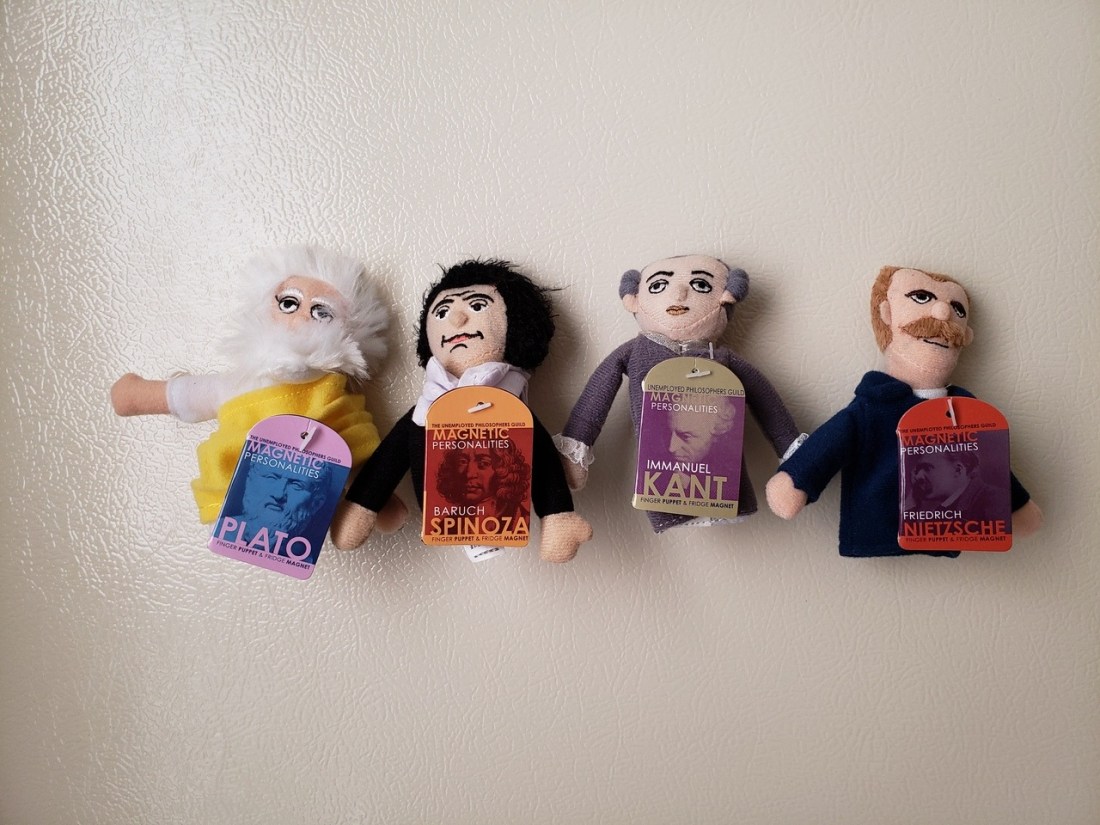
I complain about my sister a lot but she sent me these magnetic finger puppets from the Unemployed Philosophers’ Guild (which I highly recommend) as a graduation present, so she earns some points back for that. (I requested these 4 because it’s basically the entire history of philosophy as far as Nietzsche is concerned. Minus Heraclitus and Epicurus, but they’re not available in finger puppet form.)

Philosophy in “Infinity War” Part I: Thanos vs. Ultron

philosopherking1887:

As promised, I’m going to start talking about some of the philosophical issues raised in Avengers: Infinity War, and this first one gives me an opportunity to discuss something I’ve meant to for a while: why I find Ultron so interesting. Spoilers and long discussion are under the cut.

Keep reading

Popular opinion: Markus and McFeely are dimwitted hacks. Unpopular opinion: if Marvel wanted to delve into philosophical issues and create a villain who was interesting and compelling without necessarily trying to make him sympathetic… they shouldn’t have pissed off Joss Whedon.

Tagging some folks who might be interested: @foundlingmother, @fuckyeahrichardiii, @seidrade, @imaginetrilobites

Philosophy in “Infinity War” Part I: Thanos vs. Ultron

As promised, I’m going to start talking about some of the philosophical issues raised in Avengers: Infinity War, and this first one gives me an opportunity to discuss something I’ve meant to for a while: why I find Ultron so interesting. Spoilers and long discussion are under the cut.

We find out in IW that Thanos wants to kill half of the living things in the universe because of his views about overpopulation and scarcity, which align with those of Thomas Malthus: that populations will always tend to expand beyond the means of society to provide for them, resulting in poverty, disease, and conflict. Malthus, of course, never proposed mass murder as a way to prevent these terrible outcomes, though he did think that famine and war, as the natural consequences of overpopulation, were God’s and/or nature’s way of correcting the problem – and of (futilely) cautioning humanity against reproducing beyond its means. We also find out that Thanos arrived at these views based on harsh experience: his home planet, Titan, experienced ecological catastrophe as a result of overpopulation. Thanos warned his people as the catastrophe approached and proposed his solution – random culling of the population – but he was, of course, dismissed as a madman. He now lives (sometimes) on the lifeless, desert-like ruins of Titan, applies his solution to planets that he thinks are reproducing beyond their means – including Gamora’s home planet – and seeks the Infinity Stones so that he can apply it to the universe as a whole.

It seems obvious to me – and should be obvious to him – that this is only a temporary solution. He claims that the standard of living on Gamora’s home planet improved dramatically after he halved its population; but if that’s the case, then unless Thanos was also distributing free birth control and family planning education, people would just take advantage of their new prosperity to have more children. Maybe with all the Infinity Stones in the Gauntlet, he envisioned himself or one of his disciples doing The Snap every few centuries?

I’ve seen some commentary suggesting that Thanos’s outlook is only comprehensible or even remotely sympathetic from a very pro-capitalist standpoint which ignores the fact that capitalism generates artificial scarcity. There’s certainly something to that criticism; “Malthusian” views are usually dismissed in the same breath as “social Darwinism” as artifacts of 19th-century and/or mid-20th-century elitist, racist, greed-driven ideology. I think there’s a reason Titan’s demise was depicted as an ecological catastrophe, considering the looming threat of climate change. Burning fossil fuels was a major part of how humanity harnessed the energy resources to be able to overcome natural scarcity, and now it’s biting us in the ass. That said, the technological advances that were enabled by the burning of fossil fuels for energy would probably enable us to stop burning fossil fuels if not for vested financial interests. And since population growth declines dramatically as societies become better educated and have more gender equality, it seems like it should be possible to stabilize a planet’s population so that it never exceeds the ecosystem’s ability to sustain it without resorting to mass murder. So yes, Thanos’s perspective and imagination seem extremely limited, and he’s drawing the wrong lesson from what happened to Titan. I guess he’s just really pessimistic about any society’s ability to overcome greed and education inequality…?

Thanos’s philosophical reasons for supporting mass murder of course call to mind another villain with philosophical reasons for mass murder (indeed, specicide, if that’s a word): Ultron. Predictably, I think Ultron makes much better points than Thanos does because they’re founded on observations about human nature rather than speculation about economic necessity. From looking at all of recorded human history, Ultron concludes that humanity has no moral right to exist because human beings have always, everywhere, been horrible to each other. If we solved all the scarcity problems that motivate Thanos, that would probably cut down on violence, but it would not eliminate it. I’m not at all sure that it’s possible to civilize human beings to the point that violence, small-scale or large-scale, never happens. That’s why Ultron says that humanity “needs to evolve”: human nature would have to change fundamentally in order to prevent the horrors that have littered human history.

Of course there’s a moral question here: is it morally right to eliminate a kind of being whose existence is, on the whole, an evil, or does it incur rights simply in virtue of existing? Pretty clearly, Ultron (like Thanos) is making a utilitarian calculation: cause a moderate amount of suffering in the short term in order to prevent a greater amount of suffering over the long term. But is that an acceptable trade-off, when those who enjoy the benefits are not the same as those who bear the costs? This issue – consequentialist vs. deontological (i.e., rights-based, rule-based) ethics – is the same one that’s explored in Watchmen, where Adrian Veidt/Ozymandias represents consequentialism and Rorschach (Mr. Black and White) represents deontology. In the MCU, Tony seems to represent the consequentialist perspective while Steve represents the deontologist; this is especially clear in IW with all that “we don’t trade lives” stuff (which I’ll have to discuss in more detail later). I myself don’t come down on either side all the time; I think it depends on the scale of decision-making. When you’re in a position of authority over large numbers of people, you’re going to have to make some consequentialist calculations; but in small-scale interpersonal interactions, you should operate like a deontologist. Tony thinks on the large scale and in the long term; Steve treats everything like an interpersonal interaction. But even on the large scale, there are times when consequentialist calculations lead to (what seem to us like) horrific conclusions. Tony has a human moral compass that allows him to avoid those; Ultron represents Tony’s consequentialist instincts writ large, with no human emotions to keep them in check. But there’s another question here: are our emotions a moral correcting mechanism, or do they impair our judgment? Would machines actually be better moral reasoners than human beings?

Ultron’s conclusion also raises a couple of interesting issues from a specifically Nietzschean perspective: one (meta)ethical and one metaphysical. (I’m not sure whether it’s a coincidence that Ultron quotes Nietzsche: “Like the man said, ‘Whatever doesn’t kill me only makes me stronger.’”) The (meta)ethical issue (I’m calling it that because it doesn’t fit cleanly into either normative ethics or metaethics as practiced in contemporary philosophy, which is clearly a limitation of contemporary philosophy) is the one that motivates Nietzsche’s main philosophical project: If the (Christian-descended) morality of compassion and altruism – a morality that says that suffering and domination are the most terrible things, constituting an argument against the existence of anything that perpetuates them – leads us to the conclusion that humanity, or life in general, ought not to exist, then why should we buy into the morality of compassion? One man’s modus ponens is another man’s modus tollens – which, in English, translates to: one person who sees that a set of premises leads to a conclusion will just accept the conclusion; but another, finding the conclusion unacceptable, will instead reject one of the premises. Ultron, it seems, does not know how to reject the premise of the morality of compassion – and that is almost certainly because it’s part of what Tony and Bruce programmed into him. His purpose was to protect human beings from suffering and domination by preventing alien invasion; the assumption that violence, war, and conquest are bad is fundamental to his very existence. Put in the facts of human history – which make the prospects for an end to these things seem very dim – and consequentialist reasoning rules, and you get the conclusion he in fact comes to.

Vision seems to express a quasi-Nietzschean attitude in his conversation with Ultron toward the end: “Humans are odd. They think order and chaos are somehow opposites, and try to control what won’t be. But there is grace in their failings. … A thing isn’t beautiful because it lasts.” It’s interesting to me that Vision uses aesthetic terms in defense of humanity rather than moral ones. That’s another theme you find throughout Nietzsche’s writings. In The Birth of Tragedy (1872) he claims (under the influence of Wagner), “it is only as an aesthetic phenomenon that existence and the world are eternally justified”; by The Gay Science (1882), he has retreated to “As an aesthetic phenomenon existence is still bearable for us.” The world is not and cannot be good by the standards of the morality of compassion; suffering and exploitation are woven into its very fabric. The same is very likely true of humanity (and Nietzsche also thinks we wouldn’t like the result if humanity ever became entirely “good” in that sense…). If we judge them only by the standards of morality, they will always fall short; we must conclude that they are, on the whole, bad things, things that should not be. But humanity and existence can still be aesthetically interesting, even beautiful, in their mix of good and evil, smart and stupid, order and chaos.

The metaphysical question is: in what sense does the replacement of carbon-based human animals by robots count as an “evolution” of humanity rather than simply its extinction and the ascendance of something completely different? The movie encourages us to think about inheritance and legacy in nonstandard ways, most obviously by framing Ultron as Tony’s “child”: Ultron has learned some things from Tony and inherited some things from him via programming – and we are now accustomed to thinking of genetics as a kind of natural “programming.” Tony even calls Ultron “Junior” and says “You’re going to break your old man’s heart.” By extension, then, AI is the “child” of humanity in general, its “brainchild” – an expression that reflects how common procreation and childbirth metaphors are in talk of intellectual creativity (that’s all over the place in Nietzsche’s writing, btw). But the extreme difference between biological humanity and its AI “descendants” highlights a distinctively Nietzschean theme: the idea that success, for a species, is not a matter of its persistence in the same form, but of its “self-overcoming” (that’s an ideal that comes up a lot, for individuals as well as cultures and species). Often this means that the majority will have to perish, while only an unusual few survive: the mutants, the evolutionary vanguard (LOL, there’s another Marvel franchise…), the ones who are better adapted to changing conditions rather than the old environment that the species had previously been adapted for. The successor species might look very different from its progenitor species, even unrecognizable, but the former is still the legacy of the latter. What’s important is the survival of a lineage rather than the persistence of a type.

philosopherking1887:

Nietzsche understands the Will to Whump:

“Do you love tragedies and everything that breaks the heart? But I mistrust your bitch [sensuality]. Your eyes are too cruel and you search lustfully for sufferers. Is it not merely your lust that has disguised itself and now calls itself pity?” (Thus Spoke Zarathustra, Part I, “On Chastity”)