diazrosa:

i do not know a SINGLE person, not even out of my friends, not even out of the most woke people on this damn site, that only likes unproblematic things. every single one of us likes something that’s fucking garbage. so some of y’all can climb down off your high horses and stop competing for the “least problematic” award honest to god.

But more importantly… it’s fine to like problematic things with a full understanding of why they’re problematic. You will miss a lot of beauty and value in the world and in history if you wholly condemn every work, person, or movement that has problematic aspects. Colloquially, this is known as “throwing out the baby with the bathwater.” If “wokeness” is equated with allowing into one’s world only those things that are wholly pure (by the contingent, surely limited standard of a particular political sect in 2018), then the most “woke” person will have a very restricted, impoverished experience of the world.

squeeful:

feminismisahatemovement:

image
image

Male feminist fails, vol. #41009

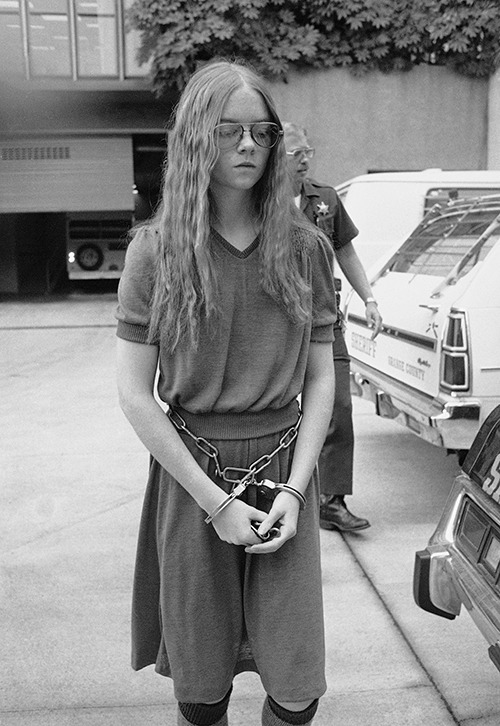
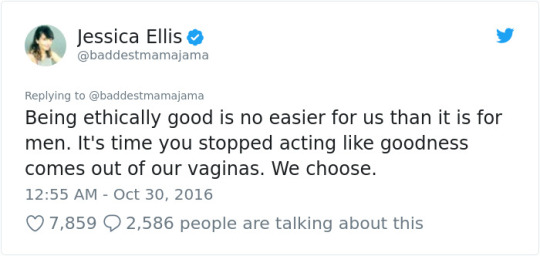
Women as the bastions of morality and virtue is straight out of the 19th century. It’s not feminism. It is a restrictive box that limits women, erases their complexity, frames their good choices as inherent and not chosen, glosses over their bad choices, and punishes women who transgress much more harshly than men who do. It is a system that venerates the redemption of men while women who fall die.

“punishes women who transgress much more harshly than men who do. It is a system that venerates the redemption of men while women who fall die.”

I just want to highlight this point. If you believe that goodness is somehow inherent to women while men have to work at it, then a man who does a bad thing is just a normally imperfect man who can work harder and do better; but woman who does a bad thing is regarded as a defective anomaly, therefore to be eliminated rather than rehabilitated and given another chance.

This point actually extends to beliefs about human nature in general. I took a history seminar my first year of college on the French Revolution, and the professor argued that the adoption of Rousseau’s view of human nature was non-accidentally connected with the Terror. If you believe that human beings are essentially good but can be corrupted by corrupt societies, then people who do bad things are either (again) defective anomalies to be eliminated, irretrievably corrupted and therefore to be eliminated, or (possibly) in need of radical re-education (and we know how that tends to go). Moral essentialism tends to lead to moral rigorism: the view that you’re either entirely good or entirely bad; that a single error is an unremovable stain, or evidence of an irredeemably evil character. It’s much easier to deal with inevitable human error if you start with the theory that human beings are naturally imperfect, a complex mix of good and bad impulses, either of which can be encouraged by different circumstances.

isaacsapphire:

burning-harvest:

Here’s what bothers me: the devotion to the Good Guys, and the adulation of the Good Guys, coupled with the refusal to sympathize or empathize with the Bad Guys.

It’s the thing I dislike about that one gif- the one that’s that guy going “Cool motive- still murder”.

I don’t think that anyone is obliged to emotionally care about or empathize with anyone else.

But I think that that’s not what’s happening here.

It seems like people notice that they are feeling sympathetic/empathetic towards Kylo Ren, then they specifically decide that he isn’t worthy of being sympathetic/empathetic towards because he’s a bad guy. That’s… a poor decision based on faulty ideas.

You don’t avoid evil or counter evil by Othering the bad guys. There is potential for evil within everyone, and there is too potential for good. Those who do evil things deserve to be cared for; and naturally arising feelings of care or relation or empathy shouldn’t be ignored.

Deliberately ignoring resonances with the Bad Guys prevents you from (1) exploring your own potential for darkness, managing it, determining whether it is truly evil, and drawing strength from it and (2) accurately viewing them as a full and actual person rather than as a standup strawman.

So much of it feels performative: I hate Kylo Ren and think he doesn’t “deserve” to be empathized with and therefore I’m a good person! I don’t feel connected to him in any way and would never make that kind of mistake!

That’s great. Really great. I’m glad that you’re perfect.

I’ve seen this before.

There’s a much bigger danger here then missing out on some fun media experience: not understanding how people do bad things, and worse, considering yourself someone who categorically cannot do bad things, is a set-up for doing bad things yourself.

Fiction, with the possibility of exploring characters who are labeled as “the bad guy” who still have understandable motives, are sympathetic, maybe even have Tragic Backstories of their own, helps us learn how to avoid repeating these mistakes, how to tell good ideas from ideas that in retrospect, will be “it seemed like a good idea at the time” ideas.

And yes, performance and purity are absolutely part of this.

touchtheowl:

prokopetz:

If we’re going to update the pantheon of regrettable artists, can we add “white male writer who was legitimately progressive twenty years ago, but hasn’t learned or grown as an artist in any way whatsoever since then, and now exists in a state of grumpy bewilderment at the fact that he’s being critcised for doing exactly the same stuff that used to win him praise”?

That’s a long winded way of saying Joss Whedon

When we say “regrettable artist,” do we mean that his entire existence is regrettable? That we’re not allowed to still like Buffy the Vampire Slayer, Firefly, or The Cabin in the Woods? Should we wish those things had never existed? Must we now condemn everything he writes as worthless in order to prove our social justice bona fides? I’m strongly suspecting the answer is “yes,” since I see a lot of very flimsy criticism of his characterization in recent films: because his feminism is imperfect, his writing must also be terrible in every way. No one who has any moral failings can have any virtues, even non-moral ones. The most ironic example of this I’ve seen lately is a juxtaposition of a gif from The Avengers of Captain America saying “Son of a gun” – claimed to be an example of Whedon’s inept characterization of Brooklyn-born army vet Steve Rogers as a euphemism-using prude – with a gif of Cap saying “Son of a bitch,” which is said to be more authentic. The irony, of course, is that the second gif is from Avengers: Age of Ultron, also written by Joss Whedon. In their haste to condemn every aspect of his writing, Tumblrites happily misattribute quotes.

I’m willing to concede that Whedon has not followed the zeitgeist on representation of women in action films. His approach is still to show the way women are sexualized, victimized, and underestimated on account of their gender (which, I can attest, is still accurate to the experience of women in male-dominated fields), while the favored strategy in progressive circles is now to depict a situation in which women are accepted and respected without question and gender is a non-issue. (Agents of S.H.I.E.L.D. does pretty well on that, as well as on racial diversity among women as well as men, but Joss Whedon’s involvement may be minimal at this point.)

But I still think that Whedon is a better writer of dialogue and, yes, character than most of the other staff hacks writing in the MCU. People also have a tendency to reduce his style to pop culture jokes, and yes, there are a lot of those. But there’s also “I remember a shadow”; “It’s a terrible privilege”; “Big man in a suit of armor. Take that off, what are you?” / “Genius, billionaire, playboy, philanthropist” / [Natasha shrugs]; “I’ve got red in my ledger, I’d like to wipe it out”; “Loki, he’s a full-tilt diva”; “Seeing as it’s a stupid-ass decision, I’ve elected to ignore it”; “Satisfaction’s not in my nature” / “Surrender’s not in mine” (yes, he wrote the Dark World bro-boat scene); “Actually, he’s the boss, I just pay for everything”; “That up there, that’s the endgame”; “If you step out that door, you’re an Avenger.” Those aren’t just punchy quotable quotes; they’re moments that tell you a lot about a character. Our conceptions of characters in the MCU are profoundly shaped by some of those moments, and people are happy to gif them and quote them in tribute to the characters, giving no credit to the person who wrote them, then turn around and unconditionally demonize the writer. And I’m really tired of it.

I wasn’t in Tumblr fandom in the mythical days I hear of when criticizing Joss Whedon was an unpardonable sin; all I’ve seen is the excessive backlash. I ask for nuance; I ask for credit where it’s due. And I’d really like people to stop implying that I’m a bad feminist (which, to the rigorist Tumblr Left, makes me an irredeemably wicked contributor to Oppression) for continuing to like Joss Whedon’s writing (or George R. R. Martin’s, for that matter). As a historian of philosophy, I’m used to dealing with people like Kant and Nietzsche whose attitudes were often Problematic, sometimes even regressive relative to their day. I’ve also learned how not to throw out the baby with the bathwater.

I wish tumblr could do the whole “Separate the bad parts of someone’s legacy or work from the good parts.” Yes, Kinsey did creepy stuff, X poet or writer was homophobic, and unicorns are racist, that doesn’t mean we should just totally ignore them.

pluckyredhead:

spaceshipoftheseus:

funereal-disease:

sigmaleph:

you basically have to write off the ninety nine point something percent of all humans who ever lived that did not grow up with your very specific set of values

that seems limiting

I keep seeing posts to the effect of “being a product of their time is no excuse” and I’m just like – that’s awfully easy to say from the other side of things. Awfully rich to assume that the values of 2017 progressives are the be-all end-all. Who knows what new prejudices our grandchildren will notice that we’re totally blind to? You can’t stand on the shore and yell at a fish for being immersed in the water.

I think it’s a really interesting exercise (but not a Rule for whether someone is Acceptable, because that’s not productive) to look at historical morality in context, not according to the prevailing attitudes of the times, but according to the range of attitudes. According to the moral principles genuinely under question and debate at the time! So, as a blatant example – I do judge people like George Washington and Thomas Jefferson for their ownership and terrible treatment of slaves, because abolition was an idea that existed in their time. Unpopular, but thinkable. And Jefferson at least was quite radical in other areas and fully capable of deviating from his predecessors and peers! Whereas I don’t judge Marcus Aurelius nearly as harshly, even though he too was a powerful leader of a slave-owning nation who tried to think seriously about moral principles and never considered freeing slaves, because the idea of slavery as a moral wrong had no traction or presence in the ancient world whatsoever. 

Context is relevant, but that doesn’t make it simple.

I think TJ and GW are perfect examples because yes, they absolutely knew that slavery was wrong – Jefferson said it was a corrupting influence on the entire state of Virginia – and yet they constantly talked in circles around the idea of actually freeing their slaves or actually speaking out in favor of immediately-executed, total abolition because, like, that would be hard and unpopular among their social circles and dangerous to their political careers and who would bring them lemonade and raise their children for them? But also, I think, because abolishing slavery would mean acknowledging how truly evil it was, and thus acknowledging their own complicitness. They couldn’t give up the perks and they couldn’t accept the blame.

Which is to say, yes, context is important, but so is self-examination. If you can acknowledge that admirable individuals who performed heroic feats and/or wrote beautiful words could also willingly engage in and profit from oppression, you can come closer to examining your own role in oppressive systems. If you acknowledge human beings can not only do both good and evil things, but choose good or evil things, you can move away from “But I’m a good person!” or “But I meant well!” and look at what effect your actions have, as well as other people’s.

TL;DR: Admiring someone’s legacy while acknowledging their flaws is a step towards being able to improve your own behavior.

nightfallgoddess:

frostyemma:

firebirdscratches:

shrineart:

exfoliate:

sapphicsupergirl:

“why aren’t u talking abt this one Problematic thing involving that actor/show u like??”

listen. i am tired. im putting down my pitchfork. i’ll acknowledge that thing was bad if it was but im tired of vilifying ppl for their mistakes just bc they’re famous. i want to enjoy things. i want Peace

For a long time I was second guessing everything I liked because they did this or that wrong, the actors did this, the writers did that, they left out this or ignored that… It’s just too much.

It’s just so tiring. Acknowledge where they can do better, but give yourself a break for the things you like. No one is perfect and you can like things that aren’t perfect.

Boom, there it is.

All-or-nothing thinking is so draining and toxic. It’s okay to say “I’m aware of x, y, and z, but I really like a, b, and c.”

It’s okay to have a multi-faceted, nuanced understanding of the people and things around you.

I just can’t get behind the whole “this person said/did this one bad thing this one time, therefore they are literal human trash #deleted forever bye!” all-or-nothing culture

it’s toxic and it’s draining, and it puts people in the awful position of being a hair’s breadth from “unproblematic fave” to “garbage person” with zero possibility of being allowed to grow or change

this kind of all-or-nothing thinking is *exhausting*. people fuck up. people grow. people make mistakes and sometimes say imperfect things and sometimes act shitty. people can also learn and change and move on

but it takes grace and compassion

@ Every fandom in history