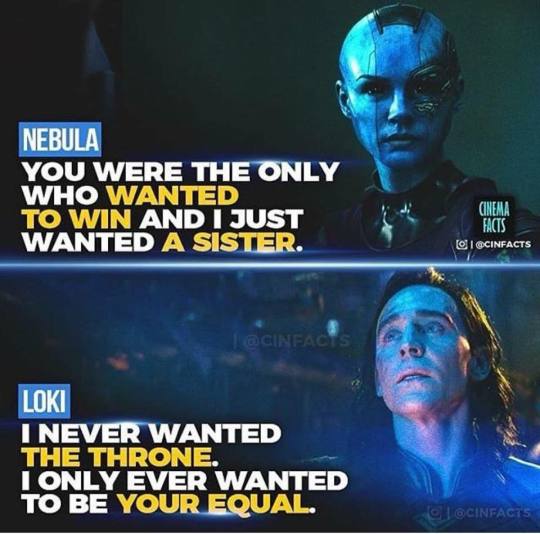
These lines are the MOST defining for these characters. Yet they seem to go lost on a large chunk of the audience. Except that Gamora at least acknowledged Nebula’s pain and validated her grievances. Whereas Thor continues to believe that Loki has only ever had ill intentions, and functions primarily to specifically antagonize him. And thus, the general audience continues to believe this as well.
The general audience doesn’t analyse beyond surface level and consequently doesn’t have a cooking clue about this difference. That’s fine, but I wish they wouldn’t tell me to shut up when I notice stuff like this. Because I’m not wrong. I’m just being more observant and critical.
Petition for there to be a Tony Stark cameo in every marvel film after A4 where he’s just chilling while the world goes to shit
signed
RDJ takes over as the new cameo guy in each MCU film. It’ll just be little things like:
Tony with cucumber slices on his eyes, treating himself at the spa; he hears a loud crash outside. He peels the cucumber slice off one eye, looking outside the window. Giant Man has just thrown a tractor trailer across town. He lays back down, “Glad it’s not my problem.”
Peter Parker has had a long adventure and then he gets a ping on his phone. It’s a video of Tony and baby Morgan playing with a Spider-Man action figure.
A quick flash on the news of interviewers hounding Tony while he’s feeding pigeons at the park. “Would Iron Man like to comment?” Tony just stares blankly at them, “Iron Man? Who’s that?” then rollers skates pop out of his loafers and he zips away.
please please please please please
this’d be even funnier if tony died in avengers 4 and just kept inexplicably appearing throughout the mcu and the news reporters are like ‘oh my god, tony stark’s alive!’ and tony just raises his sunglasses and says ‘my name is anthony stank’
Okay but Ego was super impressed about hearing that Peter could hold an Infnity Stone, even for a couple minutes, and said he had to be his son, had to be a Celestia to survive that.
Well Jane was possed by one for a few day, so who the Hell is she related too?
Low-key, since she a Peter are basically the same age, I’m gonna headcanon now Ego got busy with some other Earth lady (you can say Ego loves Meredith, but I mean, cheating is a thing, and how much love do we really think that psycopathic planet really had in him). And, also, like, her mom died of cancer in the comics when she was nine, just like with Peter in the movies, I’m just saying. They’re totally half siblings, fight me.
An explanation for why Yondu didn’t go pick her up along with Peter though, is maybe he told Ego he’d only pick up one kid at a time (since Ravagers apparently aren’t even supposed to deal with kids at all), and then while he had Peter, figured out what was happening to Ego’s kids, so obviously didn’t go back to Earth at any point to have gotten her.
This theory is incredibly intriguing. Now I’m trying to remember if we ever learned anything about Jane’s father….
Only, I think, that he was friends with Selvig, and (maybe) a scientist too (in the comics he’s a plumber),
But I dont think its a stretch to imagine Jane’s mom could have thought she’d never see Ego again, and when she ended up with another guy, that guy was around for her and Jane, and became Jane’s father and who she called dad regardless of blood relation.
(Ive been thinking about this theory non-stop since I thought of it last night. Could you imagine how dumb Odin would feel realised he didn’t think a Celestial was worthy of his Son)
Considering how Odin treated his own second son and underestimated him at everything, it’s definitely not something he would have anticipated.
My goodness, does it make sense though. Jane Foster as half Celestial. I’m taking this theory now. That’s incredible. That would also make her and Peter Quill half siblings. Peter Quill would have a sister haha.
Could you imagine after everyone found out and they’re just looking between Peter and Jane like “how?”
But also, I think Jane would be the younger sister, and we know Peter’s all about Classic Family Tropes (Play catch with his dad lmao) so he’d totally be all over Thor when he finds out they used to date, like “Don’t even look at my sister dude, you lost all privilege when you broke her heart!”
“she broke up with me!”
“You abandond her to go planet hopping!”
“Because your girlfriend dad was trying to murder the universe!”
(Nebula and Loki in the back ground like “i hate this family so much”)
I know I shouldn’t care this much, but right now I’m just feeling like it was such a waste… the MCU had so much potential to be something great, with strokes of casting genius like RDJ as Tony Stark, Samuel L. Jackson as Nick Fury (that one was a given), especially (as far as I’m concerned) Tom Hiddleston as Loki, even Chris Evans as Steve Rogers (he doesn’t seem to be a brilliant actor, but he fit into that role like it was made for him). They had Joss Whedon writing the first two ensemble films. Y’all hate him now because he turned out not to be a perfect feminist, but I saw “Firefly” before “Buffy” and I didn’t start liking his work for feminist reasons; it was for the storytelling, the snappy dialogue, the inventive characterization, the hints of philosophical themes, the distinctive voice. All of that was brilliantly on display in the first Avengers movie; AOU bit off more than it could chew, but I still admire the ambition and the ideas and I’m not nearly as bothered by the shipping choices as everyone else.
But with the possible exception of “Iron Man 3,” all of the MCU trilogies have suffered the curse of the modern superhero trilogy: the third one betrays the potential of its predecessors. Characterization crashed and burned in all of the part 3’s except IM. Could Whedon have evaded the curse if he had been writing “Infinity War”? I don’t know, maybe not… but the worst production of his I’ve seen was “Serenity,” which was definitely not bad (and no, I’m not considering the Wonder Woman script).
I’m kind of feeling the way I did about dumb choices in the LOTR movies – this could have been perfect, this was a convergence of opportunities that only comes around once, how could you screw this up? – only more so.
Get it? Cause they’re both blue? And bad guys? I’m hysterical, admit it.
In this meta, I will be examining the similarities between the sibling relationship arcs of Thor & Loki and Gamora & Nebula, from their childhood to their reconciliation (or “reconciliation”, as the case may be).
This meta will be split into two parts: Context and Argument.
The purpose of this meta is to explain why I am dissatisfied with the conclusion to Thor & Loki’s relationship arc. If you’re not a fan of Ragnarok criticism/discussion, this meta isn’t for you, and the tag you should blacklist if you’re following me is “ragnarok discourse”. It’s perfectly fine to tailor your dashboard to your preferences. I do it too. If you aren’t a fan of Ragnarok criticism, but would like to rebut my arguments, you’re more than welcome to do so politely.
Some people who might find this interesting/want to add something… @philosopherking1887, @imaginetrilobites, @lucianalight, @princess-ikol, @illwynd, @incredifishface, and @iamanartichoke (I know Ragnarok criticism isn’t always your thing, but when it comes to the Brodinsons’ relationship we seem to agree). I hate tagging people, but this post was too much work not to. I always feel like I’m bothering everyone. Do feel free to disregard if you would like.
Context
Childhood
Gamora and Nebula both lose everything, Thanos kidnaps them, and they’re trained and mutilated, turned into assassins who travel the galaxy and do his bidding. Thanos pits them against one another in a competition where Gamora always comes out on top. Nebula grew to resent Gamora for winning–that they were in this competition at all since she just wanted a sister–even though Thanos was ultimately responsible/the one at fault for this. Through it all, Gamora remained focused on her own problems, and in so doing unintentionally contributed to Nebula’s (ex: Gamora winning results in Nebula being augmented).
Thor and Loki, compared to Gamora and Nebula, have an idyllic childhood. They’re actually Odin and Frigga’s children. Odin and Frigga are bad/abusive parents, but they are parents. Both Odin and Frigga conceal from Loki his heritage. They allow Thor and others to spout racism against Frost Giants, even in Loki’s presence. They permit Thor’s worst impulses until after someone gets hurt. Odin pits them against one another in a competition where Thor always comes out on top. Loki grew to resent Thor for being the favored son–that they were in this competition at all since he just wanted to be equals–even though Odin was ultimately responsible/the one at fault for this. Through it all, Thor remained focused on his own problems, and in so doing unintentionally contributed to Loki’s (ex: Thor’s own insecurities and resulting arrogance lead to him reinforcing Loki’s insecurities with commands like, “Know your place, brother.”).
Conflict
To summarize the entire active conflict between Thor and Loki (two+ fucking films worth!) would be exhausting, so I’m merely going to enumerate the similarities where I see them.
Both pairs of siblings begin at a relatively equal moral position. Gamora and Nebula have both committed grave crimes against the galaxy at the behest of Thanos and Ronan. Thor and Loki both start firmly convinced of the vileness of the Frost Giant race. Gamora and Thor are, perhaps, worse than their siblings. Gamora easily steals an opportunity from Nebula in GotG. It’s not a stretch to infer Thanos and Ronan favored sending her on jobs, meaning she would have committed more crimes. Thor
has genocidal aspirations, where Loki does not (at first), wanting to destroy the Frost Giants in whole or in part (look at me exercising my knowledge of the U.N. definition of genocide like some pedantic asshole) because of the prejudice he’s absorbed from society and, almost certainly, Odin specifically.
Gamora and Thor both come to the realization that they were wrong. Gamora betrays Thanos and finds a new family, while Thor confronts his greatest flaws and adjusts his behavior and values.
Meanwhile, Nebula and Loki hurt innocent people to achieve their (sympathetic) desires. In Nebula’s case, she helps Ronan attempt to annihilate the Nova Empire in exchange for the opportunity to destroy Thanos, the “father” that’s tortured her all her life. In Loki’s case, he first attempts genocide against the Frost Giants in the midst of a mental breakdown/identity crisis in order to win Odin’s approval, and then attacks Midgard to survive Thanos, get away from the torture, and to lash out at the people he feels did him wrong (Thor and Odin).
At various points, Nebula and Loki attempt to kill their siblings. (I’m not going to list them–you know them.)
Gamora and Thor initially attempt to reason with their siblings, to talk them down from the conflict, but they both, inevitably, give up on them. Gamora gives up on Nebula at the end of GotG. At the beginning of GotG Vol. 2, Nebula is a bounty Gamora means to collect. Thor gives up on Loki twice. First, at the end of Avengers. Second, in Ragnarok.
Argument
You know, looking at the similarities between the sibling arcs, I have to wonder about fandom’s treatment of Nebula vs. Loki. I, for one, have never seen anyone claim that Nebula doesn’t deserve Gamora, despite the fact that both Nebula and Loki try to kill their siblings, lead armies that devastate a city, and attempt genocide/to massacre the people of an empire, not primarily out of a desire to kill (though in Loki’s case there’s certainly a bit of that when it comes to the Frost Giants), but for other reasons (family issues/Thanos issues). Granted, Nebula does both at the same time, whilst Loki spreads these things out, but that doesn’t explain the difference in the fandom’s treatment of these characters and their relationships with their siblings.
It’s a very thoughtful description of the two relationships. To summarize, Nebula and Gamora are independent characters with independent goals who reconcile as equals. Loki is narratively a prop for Thor and he skunks back to Thor’s shadow under the pain of abandonment.
A interesting detail is that Nebula is allowed a clean win in the field where their rivalry was centered (physical prowess). Loki is denied a clean win in the two fields where his rivalry with Thor was at its peak: he’s shown as a very lousy king/leader AND the generally unworthy brother throughout the film.
Not only that, but the movie shows him up in areas where he used to have the upper hand on Thor – manipulation and trickery. If you can call Thor’s hamfisted tactics “manipulation” and not bludgeoning. What next, are they going to make Thor an accomplished sorcerer? Oh wait, they already got Strange to overshadow Loki there too.
That’s a pretty standard narrative/mythic trope, the “trickster tricked.” It happens in the Norse myths, as when Loki turns into a salmon to try to escape punishment for causing Balder’s death and then Thor catches him in the fishnet that Loki had been weaving. (A very literal version of the weaver of schemes being caught in his own net.) We saw a little bit of that in TDW, when Thor handcuffed Loki instead of arming him (“I thought you liked tricks”) and pushed him out of the Dark Elf ship onto the skiff (“You lied to me. I’m impressed”). In theory, I don’t have a problem with that.
What @foundlingmother points to as the problem with their “reconciliation” is exactly right. Unlike GotG2 with Nebula, TR doesn’t even acknowledge, let alone validate, Loki’s perspective on the sibling conflict. Of course the in-story reason Loki doesn’t rebut Thor’s assessment is because he’s paralyzed by the obedience disk… but that parallels the structural narrative situation, too. He’s being silenced, physically by Thor* and narratively by the film’s implied perspective (which basically lines up with Thor*’s). By acquiescing to Thor*’s demands, apparently because he’s responded to the ultimatum, Loki appears to confirm Thor*’s and the film’s diagnosis that all of the problems in the relationship were the result of Loki’s selfish, capricious badness – never mind that 3 previous films made a point of showing that this is not the case.


























 Loki is the Philosopher King