writernotwaiting:

philosopherking1887:

pinknoonicorn:

writernotwaiting:

writernotwaiting:

I’m not quite sure why I feel compelled to make this declaration, though it may be vaguely related to posts I have seen floating around making statements about Loki and/or Thor that just flat out seem to defy logic. So here are a couple of short lists.

1. Things that are true in my head:

·       When we first meet Thor he really would have made an awful king.

·       Thor is not a dumb jock. He is intelligent, but at the start of the first movie he is really arrogant and lacks both empathy and the willingness to think about the long-term consequences of his actions.

·       That Loki was marginalized by Thor’s friends but not flat-out bullied. That for years he was the annoying little brother who they really didn’t want around but who wouldn’t leave. (As a little sister who grew up in a neighborhood where there were no other little girls to hang around with, I know exactly what it looks and feels like to be Big Brother’s Tag-along).

·       When Loki tells Thor that Odin is dead, it’s bc he still thinks Thor would be a horrible king and wants to make sure he stays on earth.

·       When Loki sends the Destroyer after Thor, he has no reason to believe Thor has changed at all. 

·      When Loki sends the Destroyer to eliminate Thor, Loki has also kind of started to go off the rails with self-loathing and is Not Thinking Rationally, and at this time he really did intend to inflict serious, permanent damage. Frigga really should have recognized this and shaken Loki by the collar. I am not sure why Marvel chose to portray Frigga so passively here. She is a an objet d’art in this movie, which is unfair to her character.

·       Loki fully intended to commit suicide when he let go of Odin’s spear, both bc of his perceived rejection by Odin and his internalized racism.

·       Thor really does love his bro and showed amazing self restraint in not pulverizing him when they fight on the Bifrost, esp bc he has no idea why his little brother is acting like a psychopath.

·       Thanos tortured Loki before sending him to earth (come on! look at that after credits scene with Selvig!).

·       When Thor initially shows up in the first Avengers movie, he was totally ready to take Loki back to Asgard and give him All The Hugs.

·       Loki would have taken All The Hugs had he not been scared shitless of Thanos.

·       When Loki dropped Thor from the helicarrier and when he stabbed him, his aim was to incapacitate Thor not kill him. Loki never believed anything he did would cause more than minor injury Thor (c’mon—that tiny little dagger? That’s like an Asgardian mosquito bite; plus, he probably thought Thor would get stuck in that glass cage long enough to stay out of the way–I will never be convinced that Loki believed the fall would be fatal).

·       Loki fully expected to lose the battle in NY and honestly figured being in jail on Asgard was the safest place to be.

·       Odin is a dick.

·       Loki really did get run through by Kurse’s blade trying to save his brother’s life. (and honestly this is the movie where I pinpoint his redemption arc, and I think that giving him a redemption arc in Ragnarok was redundant)

·       Loki really did almost die.

·       Loki disguised himself as Odin in order to hide from Thanos.

·       A couple of years in a nursing home would in no way hasten Odin’s death nor did Loki intend it to, though I’m sure Loki took great delight in the seeing his all-powerful dick of a father reduced to being spoon fed by someone who used baby talk (“Open wide, Mr. Borson! We don’t want your tummy to get upset when we take our medicine!”).

·       Thor is still not a dumb jock, but he is now capable of introspection and occasional outburts of humility. Jury’s still out on empathy, but I’m willing to be convinced.

2.    Things in my head that I hope are true:

·       That before Thanos showed up Loki and Thor at least talked about the fact that Loki took a big ass sword right through his sternum.

·       That they really did hug.

·       That Tony and Loki get shit-faced drunk together at some point and bitch about their shitty dads.

@foundlingmother–I’m not entirely sure I would call MCU Thor compassionate, because I think in order to feel compassion, one has to first be able to imagine what it’s like to be someone else, and as I said, I’m not entirely convinced Thor has developed much capacity for empathy. I’m thinking particularly in Ultron when Banner is traumatized over the destruction caused by the Hulk, and Thor goes all Viking warrior about the screams of the dead. Not so empathetic. (though, as I said, I am willing to be convinced if some one wants to take up that discussion).

I would say, however, that Thor has an incredibly strong senses of duty, honor, and obligation. That’s why he’s polite when he’s really supposed to be (hanging up Mjolnir when he goes to Jane’s apartment like the good boy his mother raised). That’s why he works so hard to save Asgard from Hela–it’s his duty.  That’s why he finally gives in and agrees to be king–obligation.

I would also repeat that he really loves his brother, dammit, and no one can convince me otherwise. So I think you are absolutely correct, @lola-zwietbeste, there is no way Thor knew that Loki had been tortured when he dragged him back home in chains. And even though he was a dick, I don’t think Odin knew, either. Certainly they would both have felt honor bound to revenge Loki’s torture as a slight against family and realm, though it is bit odd that no one thought to do a little bit of forensic investigating. Again, Odin=dick.

@writernotwaiting not one single thing here I disagree with. So refreshing to see rationality in this fandom.

I agree with @writernotwaiting on virtually all of this, except for two minor points:

1. I do think that it is partially accurate to say that Loki was “bullied” by Thor and his friends. I base that claim entirely on things we actually see in the movie and in the “Never doubt that I love you” deleted scene that we all accept as canon (so nobody go off on me about it having been deleted). Nonetheless, I do not hate them or entirely blame them for this. Consult my explanations at the bottom of the threads here and here.

2. I think that throughout the movies before Ragnarok, Thor is working on developing… sympathy, if not empathy. He slips up every now and then; he doesn’t really get why someone would be distraught over having killed enemies, but he catches on when Steve and Tony signal that he’s saying the wrong things and tries to backtrack. There’s something a bit incongruous about expecting someone from a warrior culture like Asgard to feel compassion, to treat someone else’s suffering as one’s own. As ever, I find Nietzsche’s contrast between noble and slave values enlightening: compassion and the imperative to relieve suffering are very distinctive of slave morality; of course Thor is driven by honor and duty – and respect for those he regards as his peers (if not his equals), including the human Avengers. Respect involves being aware of someone’s feelings, taking them into account, but also holding the person to the standards you accept for yourself – which explains why Thor flips out on Tony about the Ultron situation.

Finally: as you know, because I’ve said it a lot, I don’t think the version of Thor we see in Ragnarok, whom I call Thor* to mark the difference, is the same character as the Thor we see in Thor 1 through Age of Ultron. For that reason I think it’s misleading to try to track a development through Ragnarok and (to a lesser extent) Infinity War. It would be like trying to draw conclusions about the character of Thomas Jefferson from his depictions in 1776 and Hamilton (for the musical nerds out there…). The fact that different writers are involved isn’t necessarily prohibitive, because comics series can go through a number of different writers without losing continuity; it’s about whether the new writer respects the characterization that has been developed by previous writers and builds on it in a psychologically realistic way.

I think perhaps I’ll forgo a discussion of Ragnarok here, as I suspect it would rapidly devolve. There are quite a few things I see as problematic about it, but many other things that I quite liked, so we can save that for some other time.

@illwynd I think offered a very nice comment on the issue of compassion, but I think you’ve already seen that. I might quibble about how or in what way certain values and their expressions overlap. Compassion is not empathy, but it could still be argued that empathy is a prerequisite for compassion. And far be it for an English major to argue with Neitzsche, but I don’t see respect and compassion as mutually exclusive.

However, these are, arguably, differences only in the nuance of terminology rather than differences in substance. Thor is (again as illwynd points out) not static (ooh, I made an electricity pun! lol)—he is constantly trying to be better. He is (to completely misuse another philosopher) neither being nor not being—he is always becoming.

You’re right that a discussion about the quality of Ragnarok would probably rapidly devolve, but I bring it up because it’s not irrelevant to the disputes about Thor’s character and his regard for Loki that have been going around. People on both sides have been talking as if TRThor is continuous with pre-TR-Thor and I think that’s the source of some of the confusion: Loki stans treat Thor’s behavior in TR as evidence that Thor was always an abusive bully and never cared about Loki’s well-being; Thor stans treat how obviously Thor cares about Loki in previous films as evidence that he still shows genuine love and concern for him in TR. I’m wondering whether, if we carved off TR, there would be more agreement about Thor’s growth from where we see him at the beginning of Thor 1 and his imperfectly expressed but sincere love for Loki from Thor through TDW.

I had a discussion with @illwynd (also relevant to @foundlingmother‘s reblog) and we agreed that we have somewhat different understandings of “compassion.” I tend to align it more closely with both empathy and pity than some people do, largely because of the way it’s used to translate the German word Mitleid: literally “with-suffering” (or, more intuitively, “suffering with”), which is the direct translation of the Latin components of compassion. The etymology is going to be a lot more obvious to German speakers than to English speakers, since Mitleid is made up of two ordinary German words, so it makes sense that the English word has lost some of those connotations. If, in general, compassion is being used to mean “caring about someone else’s well-being,” “wishing others well,” “benevolence,” etc., I definitely agree that Thor has that in spades – and that he’s a work in progress, even as late as AOU, and that’s part of what’s so endearing about him.

The point was not that respect and compassion are mutually exclusive; it’s just that they represent different impulses, different ways of regarding your obligations toward others. In a noble value system, respect is given sparingly, only to those you have judged your equals; in some Christian-derived value systems, such as Kantian ethics, you owe respect to every human being simply in virtue of their being human. Respect is about regarding the other as an agent, as someone who has intelligible goals and does things for reasons; compassion is more about regarding the other as a patient, as someone who feels and suffers. Given how deeply feeling is interwoven with our desires and motivations, they can’t be so easily teased apart… Maybe I think of respect as involving holding someone else a little more at arm’s length, recognizing the reality and the importance of their needs and goals to them, but not making them your own, and definitely not assuming you always know what’s going on with the other person or how they feel about their situation. Thor’s failure to ask Loki his reasons for his bad actions was a failure of respect as much as of compassion.
pinknoonicorn:

writernotwaiting:

writernotwaiting:

I’m not quite sure why I feel compelled to make this declaration, though it may be vaguely related to posts I have seen floating around making statements about Loki and/or Thor that just flat out seem to defy logic. So here are a couple of short lists.

1. Things that are true in my head:

·       When we first meet Thor he really would have made an awful king.

·       Thor is not a dumb jock. He is intelligent, but at the start of the first movie he is really arrogant and lacks both empathy and the willingness to think about the long-term consequences of his actions.

·       That Loki was marginalized by Thor’s friends but not flat-out bullied. That for years he was the annoying little brother who they really didn’t want around but who wouldn’t leave. (As a little sister who grew up in a neighborhood where there were no other little girls to hang around with, I know exactly what it looks and feels like to be Big Brother’s Tag-along).

·       When Loki tells Thor that Odin is dead, it’s bc he still thinks Thor would be a horrible king and wants to make sure he stays on earth.

·       When Loki sends the Destroyer after Thor, he has no reason to believe Thor has changed at all. 

·      When Loki sends the Destroyer to eliminate Thor, Loki has also kind of started to go off the rails with self-loathing and is Not Thinking Rationally, and at this time he really did intend to inflict serious, permanent damage. Frigga really should have recognized this and shaken Loki by the collar. I am not sure why Marvel chose to portray Frigga so passively here. She is a an objet d’art in this movie, which is unfair to her character.

·       Loki fully intended to commit suicide when he let go of Odin’s spear, both bc of his perceived rejection by Odin and his internalized racism.

·       Thor really does love his bro and showed amazing self restraint in not pulverizing him when they fight on the Bifrost, esp bc he has no idea why his little brother is acting like a psychopath.

·       Thanos tortured Loki before sending him to earth (come on! look at that after credits scene with Selvig!).

·       When Thor initially shows up in the first Avengers movie, he was totally ready to take Loki back to Asgard and give him All The Hugs.

·       Loki would have taken All The Hugs had he not been scared shitless of Thanos.

·       When Loki dropped Thor from the helicarrier and when he stabbed him, his aim was to incapacitate Thor not kill him. Loki never believed anything he did would cause more than minor injury Thor (c’mon—that tiny little dagger? That’s like an Asgardian mosquito bite; plus, he probably thought Thor would get stuck in that glass cage long enough to stay out of the way–I will never be convinced that Loki believed the fall would be fatal).

·       Loki fully expected to lose the battle in NY and honestly figured being in jail on Asgard was the safest place to be.

·       Odin is a dick.

·       Loki really did get run through by Kurse’s blade trying to save his brother’s life. (and honestly this is the movie where I pinpoint his redemption arc, and I think that giving him a redemption arc in Ragnarok was redundant)

·       Loki really did almost die.

·       Loki disguised himself as Odin in order to hide from Thanos.

·       A couple of years in a nursing home would in no way hasten Odin’s death nor did Loki intend it to, though I’m sure Loki took great delight in the seeing his all-powerful dick of a father reduced to being spoon fed by someone who used baby talk (“Open wide, Mr. Borson! We don’t want your tummy to get upset when we take our medicine!”).

·       Thor is still not a dumb jock, but he is now capable of introspection and occasional outburts of humility. Jury’s still out on empathy, but I’m willing to be convinced.

2.    Things in my head that I hope are true:

·       That before Thanos showed up Loki and Thor at least talked about the fact that Loki took a big ass sword right through his sternum.

·       That they really did hug.

·       That Tony and Loki get shit-faced drunk together at some point and bitch about their shitty dads.

@foundlingmother–I’m not entirely sure I would call MCU Thor compassionate, because I think in order to feel compassion, one has to first be able to imagine what it’s like to be someone else, and as I said, I’m not entirely convinced Thor has developed much capacity for empathy. I’m thinking particularly in Ultron when Banner is traumatized over the destruction caused by the Hulk, and Thor goes all Viking warrior about the screams of the dead. Not so empathetic. (though, as I said, I am willing to be convinced if some one wants to take up that discussion).

I would say, however, that Thor has an incredibly strong senses of duty, honor, and obligation. That’s why he’s polite when he’s really supposed to be (hanging up Mjolnir when he goes to Jane’s apartment like the good boy his mother raised). That’s why he works so hard to save Asgard from Hela–it’s his duty.  That’s why he finally gives in and agrees to be king–obligation.

I would also repeat that he really loves his brother, dammit, and no one can convince me otherwise. So I think you are absolutely correct, @lola-zwietbeste, there is no way Thor knew that Loki had been tortured when he dragged him back home in chains. And even though he was a dick, I don’t think Odin knew, either. Certainly they would both have felt honor bound to revenge Loki’s torture as a slight against family and realm, though it is bit odd that no one thought to do a little bit of forensic investigating. Again, Odin=dick.

@writernotwaiting not one single thing here I disagree with. So refreshing to see rationality in this fandom.

I agree with @writernotwaiting on virtually all of this, except for two minor points:

1. I do think that it is partially accurate to say that Loki was “bullied” by Thor and his friends. I base that claim entirely on things we actually see in the movie and in the “Never doubt that I love you” deleted scene that we all accept as canon (so nobody go off on me about it having been deleted). Nonetheless, I do not hate them or entirely blame them for this. Consult my explanations at the bottom of the threads here and here.

2. I think that throughout the movies before Ragnarok, Thor is working on developing… sympathy, if not empathy. He slips up every now and then; he doesn’t really get why someone would be distraught over having killed enemies, but he catches on when Steve and Tony signal that he’s saying the wrong things and tries to backtrack. There’s something a bit incongruous about expecting someone from a warrior culture like Asgard to feel compassion, to treat someone else’s suffering as one’s own. As ever, I find Nietzsche’s contrast between noble and slave values enlightening: compassion and the imperative to relieve suffering are very distinctive of slave morality; of course Thor is driven by honor and duty – and respect for those he regards as his peers (if not his equals), including the human Avengers. Respect involves being aware of someone’s feelings, taking them into account, but also holding the person to the standards you accept for yourself – which explains why Thor flips out on Tony about the Ultron situation.

Finally: as you know, because I’ve said it a lot, I don’t think the version of Thor we see in Ragnarok, whom I call Thor* to mark the difference, is the same character as the Thor we see in Thor 1 through Age of Ultron. For that reason I think it’s misleading to try to track a development through Ragnarok and (to a lesser extent) Infinity War. It would be like trying to draw conclusions about the character of Thomas Jefferson from his depictions in 1776 and Hamilton (for the musical nerds out there…). The fact that different writers are involved isn’t necessarily prohibitive, because comics series can go through a number of different writers without losing continuity; it’s about whether the new writer respects the characterization that has been developed by previous writers and builds on it in a psychologically realistic way.

foundlingmother:

oneformischief:

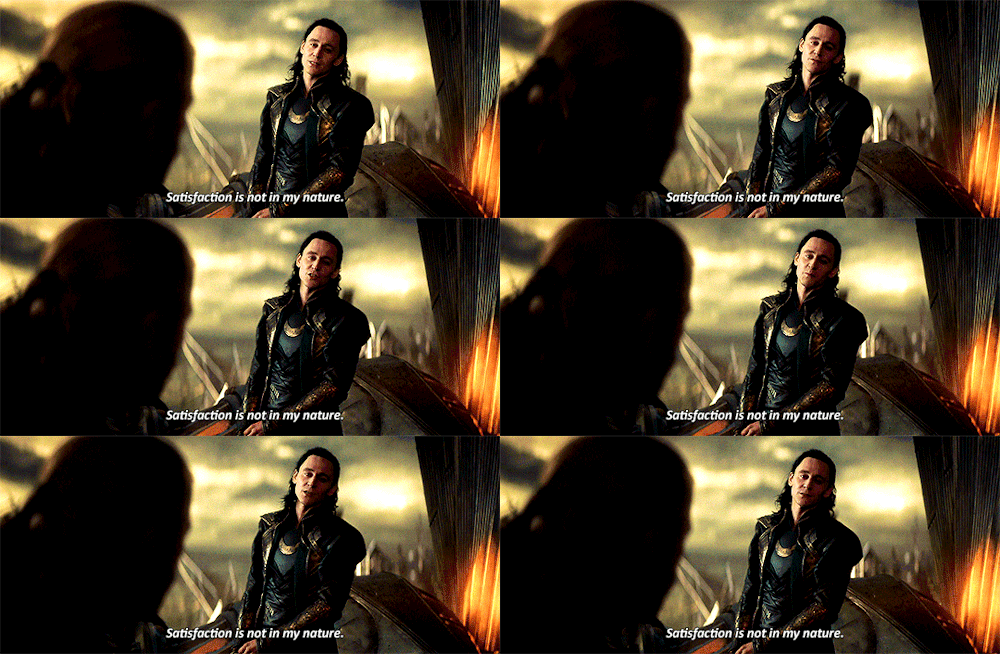
I’ve been thinking about this line a lot. And I’m not sure it’s given all the credit it deserves. It is well overshadowed by Thor’s immediate response (”surrender’s not in mine”), and by the line that steals this whole scene: “Trust my rage.” 

But there’s something about this line that gets me, and I think it’s because it is probably the truest thing Loki has ever said about himself. 

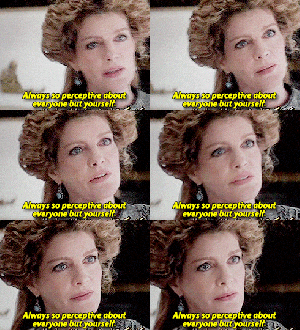
Loki, as we well know, is a master of avoiding his own problems, or else manipulating them to look like everyone else’s. He has told himself so many lies that he has begun to believe them: that he is hated, that he is alone, that he will never be anything but Loki. Frigga even points this out: “Always so perceptive, about everyone but yourself”. Loki can read everyone else, but when it comes to reading himself? Oh, Hel no. Those are dangerous waters, and he would rather not drown there. 

And that’s why this line is so surprising and just so good. The fact that Loki is never satisfied is, when you think about it, pretty much the root of all his problems (at least ones that he can control). As a child and young adult, he appears to have mastered magic, but that was never enough, because it wasn’t like Thor, it wasn’t what Asgard wanted, it wasn’t what Odin wanted (or so he thought). He wants to be Thor’s equal, little realising that in many ways he is, but that, too, is not enough. He tries to be Thor, and is never satisfied. He tries to be Loki, and is never satisfied. He goes out of his way to prove himself to his family, and still he craves more. And so it escalates. A throne. A planet. He keeps reaching and reaching, oblivious to the fact that whilst he is grasping for the mountain’s peak, the rocks beneath him are slipping away. 

And now we come to Ragnarok, and Loki has what he claims he has always wanted: the throne. A chance to rule. And I don’t think for a moment it is what he expects. Because once he has something, it no longer fulfills him; and he is stuck without a family, bearing the weight of the kingship, and I’m nintey-nine percent sure all he can do is sit there thinking ‘Well. Now what?’

And this is why happiness is so foreign to Loki, and always will be, and why he has doomed himself: for contentment, he must learn to settle, and because he is Loki, he will never settle. And so the cycle continues, and he proves time and time again that Loki’s worst enemy will always be Loki. 

On some points, I agree. Without a doubt, Loki’s greatest and most persistent enemy is himself. Fueled by insecurity, he twists words and/or his own thoughts/memories, refuses to trust and doubts/denies the love that others show him, and avoids confronting problems by pushing them aside, running, or retaliating with some prank (or worse). “Satisfaction is not in my nature,” is one of the truest lines Loki’s spoken. There is an element of never settling. Intelligent people often struggle with restlessness. There’s an urge for more, more, more to satisfy a brain that keeps turning (especially when that brain will turn on itself if left to its own devices). However, a far bigger reason that satisfaction is not in Loki’s nature is because he struggles with mental illness. Happiness is foreign to Loki not because he refuses to be content with what he has, but because he’s incapable, through no fault of his own, of being happy.

Now, till this point I’ve allowed the assumption that Loki should be content if he were capable of being so, but that’s not the case.

As a child and young adult, he appears to have mastered magic, but that was never enough, because it wasn’t like Thor, it wasn’t what Asgard wanted, it wasn’t what Odin wanted (or so he thought).

There’s no indication Odin wanted Loki to master magic. Odin never, in any movie, showed he felt an ounce of pride in Loki’s accomplishments. He does mention that Frigga would be proud, and perhaps it’s implied that he’s impressed as well. Asgard, too, doesn’t respect Loki’s skills. We’re given a clear example of this in a deleted scene (the servant laughing when Thor says that some do battle while others just tricks). Asgard adores Thor. They eat up his showboating when he enters his coronation.

He wants to be Thor’s equal, little realising that in many ways he is, but that, too, is not enough.

It’s true that Loki is Thor’s equal in many respects. He’s powerful and cunning. His strengths are Thor’s weaknesses, and vice versa. They balance one another out. However, Asgard does not treat them as equals. Even Thor slips into putting Loki in his place. We are shown this on Jotunheim.

Even if Loki’s problem was that he refuses to be content, that does not mean that that refusal is unjustified or unhealthy. Should he be content in a position where he’s disrespected, where he’s reminded of his place when he attempts to council Thor, and where people are quick to mistrust him? (Regardless of the fact that Sif and the Warriors Three are correct about Loki’s crimes in Thor, they come to that conclusion with little to no compelling evidence, and become angry that Loki told a guard to go to Odin despite the fact that this saved their lives.)

And now we come to Ragnarok, and Loki has what he claims he has always wanted: the throne. A chance to rule.

Loki claims he wants a throne. However, Loki’s never desired a throne because he wants to rule. He desires a throne because he wants respect and deference and freedom (which power supposedly provides).

I think people assume that Loki got a chance at everything he desired in between TDW and Ragnarok, and found, unsurprisingly, it wasn’t enough. The truth is Loki has never had what he wants. What he wants is freedom and for people to respect and accept him for who he is. He wants this without having to compromise what makes him Loki (and another struggle, of course, is discovering what exactly it means to be Loki, and whether Loki’s someone worth being). Disguised as Odin, Loki is not respected. Odin is. It’s true he rules, but under another’s name and face. Nothing about his time as Odin achieves Loki’s desires save for, perhaps, a feeling a security against the looming threat of Thanos.

It’s entirely possible that even if Loki had respect, freedom, acceptance, and good mental health he’d still feel discontent, but that’s not the situation we see in the MCU. The Loki we see deals (very poorly and (self-)destructively) with legitimate grievance about his treatment, and suffers from wretched mental health. The fix for that is not, and never will be, to learn to settle for what you’ve got. Or, to put it in the terms of so many people I’ve encountered in my life, to “choose happiness”.

I think @foundlingmother is exactly right about what Loki’s problem is and what he ultimately wants. But I suspect it’s not so easy to draw a line between his shoddy treatment in Asgard and his mental illness. We know very little about the etiology of mental illness: how much is inherited, how much is acquired due to environmental factors. Early childhood experiences seem to be very important in the development of a person’s “attachment style,” so called; though of course Loki does not remember being abandoned as a baby and spending a day or two hungry, cold, and alone, that experience might still have imprinted itself on his emotional systems and left him extremely insecure and convinced, regardless of the evidence, that anyone he cares about will eventually abandon him.

Whether or not that was a factor, his insecurity about his own worth and his reliance on the approval of others was almost certainly reinforced by all the signals he received throughout childhood and youth, subtle or explicit, that he was not as good as Thor, and that his talents were less valuable. Take a close look at his interactions with Thor and the Warriors Four in the first Thor movie – including Hiddleston’s body language – and you can take a guess at what his childhood was like: he’s quiet, withdrawn, a little strange; the other kids think he’s weird and don’t really like him but put up with him because he’s Thor’s brother; Thor knows him well and values his opinions, at least in private, but in front of other people he pushes Loki aside to assert his own authority. Was Loki quiet and withdrawn to begin with because he already had social anxiety, innately or due to early childhood trauma, or just because he’s an introvert? Or did he develop social anxiety because of this inconsistent treatment (Do Thor & friends like/respect me or not? How can I tell?) and become more quiet and withdrawn as a result?

To be completely clear: I do not hate Thor and the W4; I do not (unlike some Loki stans) think they’re nothing but terrible abusive bullies. I think Thor had his own insecurities and took them out on Loki; I think Loki probably was kind of a little shit independent of all the other stuff, and the W4 may well have had some legitimate reasons for not liking him. Like many fans, I characterize Loki as being very similar to myself, and I know that I am an acquired taste; I have a dry, very nerdy, sometimes pretentious, often bitchy sense of humor; I’m an unabashed snob (about some things) and misanthrope. People who are very earnest tend not to like me, and that’s fine. Loki’s problem may have been that he had trouble finding people in Asgard who shared his mindset, and he ended up going along with Thor’s friends by default. I get the sense that Fandral was the one of Thor’s friends who liked Loki the most (he’s the first to jump to his defense when Hogun accuses him in Thor, and in TDW, he never threatens to kill Loki for betrayal), and that makes perfect sense if Loki is like me in the ways I’ve suggested.

Finally, a bit of completely unnecessary riding of my own hobby horse: you know who wrote that perceptive line, “Satisfaction’s not in my nature” (as well as the beautiful and memorable lines that follow it up)? That’s right: Joss Whedon. Perhaps Tumblrites should consider that the next time they insist as proof of their own moral purity that he’s a terrible writer of character and dialogue.

Some time ago, you responded to a post from @oneformischief saying that Loki “struggles with mental illness” and that “Happiness is foreign to Loki … because he’s incapable, through no fault of his own, of being happy”. Would you mind elaborating on that? And if Loki can’t be fully happy, how can he come as close to happiness as possible?

foundlingmother:

Wow, I quite like what I said in that post! Thank you for the question and reminding me my own meta exists!

The way Loki’s depicted in the films, I see a lot of indicators of mental illness. He attempts suicide at least once (though I don’t think it’s hard to read the scene with Kurse as, at least, Loki displaying a disregard for his own survival). He openly admits to Frigga in a deleted scene that he wants to be unable to tell reality from illusion. These are some specific instances that feel very relatable to my own struggles with mental illness, but there’s just a general element to his character that speaks to many mentally ill fans. This offers an opportunity for a lot of different interpretations. I tend to characterize Loki as having depression, as I struggle with depression, but I know other people who characterize Loki as having bipolar disorder, BPD, etc. He has no stated diagnoses (something tells me Asgard’s even worse at treating mental illness than we humans are), so it’s really up to the viewer to determine that.

Like I said, I tend to think of Loki in terms of him having depression, or exhibiting depressive behaviors as part of another mental illness. People who are depressed, through no fault of their own, experience persistent sadness or apathy. This is the result of a malfunctioning brain. It’s not the choice of the individual. They are not choosing to be sad or apathetic, they are suffering from an illness. You’ve probably heard a similar comparison before, but when there’s a problem with someone’s… let’s say liver, we don’t demand that they fix it through sheer willpower. We treat the liver. The same should be true of the brain.

There are various ways to treat mental illness. Not everyone will take medication (though the more it’s destigmatized, the better). I can’t really imagine that Loki would ever take pills… or that they would work for him being a different species. However, I think he’d benefit from therapy (honestly, I can’t think of a MCU character that wouldn’t benefit from a bit of therapy). But, as I mentioned in that post, I think the first step is actually Loki getting what he wants, which isn’t anything unreasonable, imo. I mean, I think he has crimes to atone for, but people can still treat him with basic respect and decency while he does so. And Thanos’ defeat would certainly help Loki to feel a lot freer without that looming threat. (Let’s all live in a magical timeline where Loki isn’t dead!) After that point, where all of Loki’s basic needs are met and he has a support system, at least in his brother (though ideally he makes more friends), then he’s got to learn ways to manage his mental health and avoid self-destructive tendencies (oh boy does Loki have self-destructive tendencies). That’s about as specific as I can get on how he gets as close to happiness as possible. It’s management of a chronic illness. Some days are good. Some are alright. Some days are bad. You learn ways to continue, and when it’s a good time to let yourself have a break.

I hope this answered your question, or made it a little clearer what I meant in that post. I don’t know… do you want to add anything @philosopherking1887 (or any of my other followers–you’re all welcome to contribute with your perspectives)?

Nothing to add here. I think I do on the linked post, though. Off to do that.

mikkeneko:

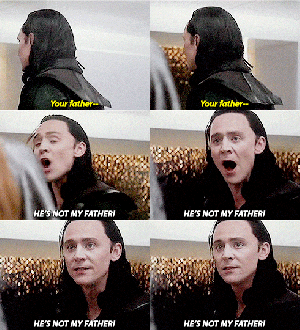
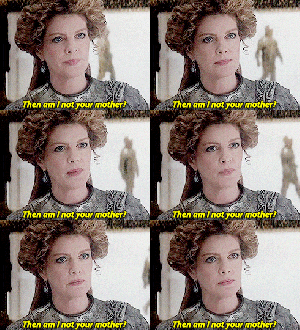
Something about this scene really struck me. In this scene, why does Loki deny Frigga? The correct answer is obviously ‘yes.’ It’s obvious he wants to say ‘yes.’ There’s no spiteful pleasure or sarcastic glee in his face when he says it, so he’s not enjoying it. So why does he say no?


Because the way this conversation has been set up, admitting that Frigga is his mother consequently means he admits he was lying (or at least, recants) his denial that Odin is his father. He can’t have one without the other. By yoking the two together in this way, Frigga is basically holding her motherhood of Loki hostage on the condition of Loki admitting that Odin has parental authority over him and that is something Loki will not – can not – do.

I’m certain that the equivocation (if not the cruelty inherent in it) was deliberate on Frigga’s part.  Frigga has always played the role of peacemaker in this family – she did in the first movie and she’s doing it again here. She asked the question in that way precisely because she wants to force Loki to admit that Odin is his father. She’s angling to get Odin and Loki to reconcile – whether as part of a campaign to get Loki’s sentence reduced, part of a campaign to get Loki’s services available once more to the crown, or simply aiming to reduce the conflict in their household (or possibly all three.)

But to Loki, Odin is not only the man who put him here, but the liar and the hypocrite who fucked up his life in ways beyond counting. Frigga wants him to submit to Odin’s authority not only as a king, but as a parent, meaning that Odin not only has the right to sentence him legally but also to chastise him emotionally and Loki simply can not stand that, not now. So he denies Frigga – even though it is obviously hard and painful for him to do so – because it would hurt him more to have Odin as father than it would help him to have Frigga as mother.

Loki said what he did not to be cruel and spiteful to Frigga, but because he was backed into a corner. Which is kind of the story of his life lately, really.

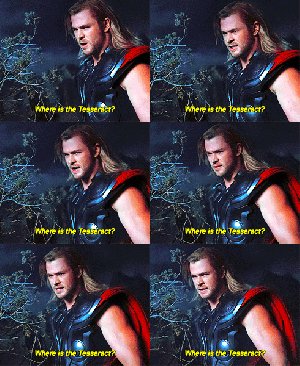
#mcu brodinson edit#fandom: marvel#gif#reminder that this is the first thing thor says to loki#and that’s why loki’s convinced that thor’s only here for the tesseract#no matter how much thor begs him to come home#it’s all just because he needs the tesseract#is what loki tells himself#like obviously we know thor loves loki and wants him to come home#but loki doesn’t know that#at all (via @foundlingmother)

Of course this is an irrational assumption, and we all know that. But Loki is (1) severely depressed, which leads him to believe that no one really loves him and to seize on any evidence that could be construed to support that belief; and (2) under severe pressure from Thanos to retrieve the Tesseract, which means he has to fight Thor, which means that he’s strongly motivated to find any reason he can to want to fight Thor.

can someone explain this plothole: loki tells the revengers that hes run out of favor with the grandmaster and in exchange for a ship, he wants passage through the devils anus. Then thor tells him in the elevator that this is a perfect place for you, lawless yada yadh and both agree that he should stay (even though 2 seconds ago he told thor he’s run out of favor with the grandmaster) did loki betray thor last minute so he can stay on Sakaar like Thor wants him to? did thor not even hear him

juliabohemian:

shine-of-asgard:

edge-of-silvermoon:

lokihiddleston:

.

They need Loki to betray Thor for no reason so they can stomp on Loki’s character harder, and give Thor a chance for grandstanding, what else is there to it? This betrayal literally serves no other purpose than give Thor the chance to deliver his “you can be more” lectures. It’s lazy and sloppy writing.

Waititi and Hemsworth wanted a scene of Thor triumphing over Loki as a “payback” for 3 movies or Loki outsmarting him, and they wrote… that. Whatever the hell it was. And it’s been proven that it was a last minute addition because the official novel doesn’t have this last “twist”. Loki leaves with everyone, willingly.

Could we just re-shoot the movie and have it like the novel? So it isn’t this ridiculous mess? Like did no one edit this film besides TW? Did anyone check for consistency or to be sure that it made sense? How does something make it all the way to the theater with that many mistakes?

This thread is missing the original answer, which was a screenshot of another anonymous ask:

“It’s not really a plothole. Loki has only fallen out of favor with the Grandmaster because he did not return with Thor and his champion as promised. But Thor/Valkyrie are staging a revolt with Korg. So once the Grandmaster is out of power, Thor knows Loki could take over. However, Loki decides that he could regain favor with the Grandmaster by giving him Thor and then probably Bruce. I think though that Loki partially chose this route because he honestly didn’t think that Thor stood a chance against Hela […] I think at least partially, Loki is trying to keep his brother alive.”

There is something to that… but I still think @edge-of-silvermoon and @shine-of-asgard​ hit the nail on the head. Not only were Loki’s last-minute betrayal and Thor*’s (this is not the same person as the Thor of previous films) ultimatum/electrocution combo not in the novel (which I haven’t read), but we have some indication from the trailers that they shot a version where Loki came in the small ship with the rest of the Revengers: the clips of him standing on the bridge in a row with Thor, Valkyrie, and Hulk, and that shot of Hulk punching him off the bridge like he did to Thor in The Avengers. The betrayal and subsequent smackdown were a later addition – probably by Waititi rather than the screenwriter (Eric Pearson), possibly at Hemsworth’s behest – and I suspect that they wanted three things out of it:

  1. To show Thor*’s “character growth”: he has learned not to fall for Loki*’s tricks and illusions anymore (I’m using Loki* because the motivation for the betrayal, which I still think is basically “shits and giggles,” is not in keeping with Loki’s established character).
  2. The famous “trickster tricked” narrative trope. That’s fine in and of itself; we saw it in The Avengers when Black Widow successfully pulls her “wounded gazelle” act on Loki and again when Hawkeye shoots an arrow at Loki, Loki catches it, and then the arrow explodes. We also saw it in TDW when Thor handcuffed Loki and then pushed him out of the Dark Elf ship onto the skiff. This version, however, is undermotivated and unnecessarily cruel, and I really do think the purpose was to assert Thor*’s superiority over Loki. It also gives us the completely unintended irony of Thor*, who has reverted to a cruelty and arrogance worse than that he was humbled for in Thor 1, lecturing to Loki, who has evolved quite a bit over the past 3 films, about the need for “growth and change.”
  3. As @endiness​ argued a while back: “i do legitimately believe that loki’s character was regressed in order to make thor responsible for loki’s character growth (rather than loki himself) to kind of prop thor up and have him come off as the better character […] loki’s character had to start out in ragnarok regressed (and far beyond where he was at the end of tdw) and passive, stay that way for most of the movie as most of his actions were dictated by other characters, and then only ‘change’ after and because thor prompted him to through reverse psychology.”

incredifishface:

lokiofasgaaaard:

incredifishface:

lokiofasgaaaard:

incredifishface:

fandom-and-feminism:

delyth88:

lokiloveforever:

leanmeanand-green:

I hate that during this scene the warriors 3 are basically trying to bully Loki, the current King of Asgard, into doing what they want him to do as always. They had clearly been nothing but disrespectful to him his entire life and I honestly wonder why Loki put up with it so long. Like, fuck them. And Loki baby, I am so glad you treated them in the most King-like fashion, never lowering to their level, and maintaining that poise and elegance that trademarks you as royalty and superior. Yet, I am proud of you for putting them in their place💚

“We’re done.” 👏🏼👏🏼👏🏼

Nothing but respect for my King 👑

<3<3<3<3<3

So something I’ve been wondering about ever since I saw the deleted scene where Loki is legitimately made king, is what did Sif and the Warriors Three think? Did they think, like the audience was meant to think, that Loki had seen his chance and just taken power and locked his mother away with Odin? Or do you think they believed what he said? If they thought he had stolen power unjustly and had hurt Odin and Frigga then their behaviour is more understandable. But if not then they were just being spoilt children.

I firmly believe that they thought Loki was a usurper. That Loki saw his chance and seized it. It looks to an outsider that all of the events of this movie were a carefully planned coup to get rid of Thor, when all it was was a bad prank gone awry and Loki adapting to it in a way that protected him. (I’m not defending his bad choices, don’t get me wrong.) Loki had no idea Odin would go into his Odinsleep. Loki didn’t know Odin would banish Thor for attacking Jotunheim. Thor was constantly reminding Loki of his “place” – Loki felt as though he had extremely limited influence on any situation that involved his brother and would do anything for Thor’s approval, so he went along. Frigga knew who and what Loki was, and still gave him Gungnir and the throne. Loki was king by his own right, and not a usurper.

…bullying him???

*facepalm*

Well, maybe not “bullying”. But disrespect him as new king, like it was all a joke. Sif was about to slap him if I’m not mistaken. And that laugh from Volstagg when he says the word “king” is mockery. Maybe that’s a better word…

it’s a vastly different thing, and something tells me they would have taken the mickey out of Thor too if it had been him. Those looks at Thor’s coronation are the kind that promise the King of Asgard is going to be put in his place by his mates after the coronation, lest he should forget he’s still just Thor.

As for Loki, finding HIM on the throne comes to them as a total shock, but when they realize it’s serious, they do the kneeling and “my kinging” thing as due, if unsettled by the new turn of affairs. No disrespect at all once they are convinced is not a joke. Then of course they are further unsettled when they request Loki to allow Thor to return and Loki gives an answer that disturbs them and furthers their notion that something is very wrong here, which it absolutely is. 

As for Volstagg specifically, the man laughs at everything, and he also says the “silver tongue turned to lead” quip, but he was the first to jump to Loki’s defense when Hogunn suggested he might be the one behind the frost giants in the throne room. No, wait, I think Fandral is the first.

Sif doesn’t like Loki and he doesn’t trust him, and the roots for that animosity can be argued to come directly from myth, but personally from sir Ken’s editing choices I think there’s a huge element of jealousy there i wonder why , and Hogun I have no idea but in any case his suggestion that Loki might be behind the frost giant thing is 100% right, so you can argue this is a case of prejudice against Loki, that Hogunn is always ready to think the worst about him (but we don’t have ANY other indication about that in the MCU, not a lot of interactions between Hogun and anyone to be able to tell), but you could just as well argue this is… intelligence, insight, the ability to read a person beyond the screens he hides behind. 

I insist the whole notion that Loki is bullied by Asgard, Sif and the Warriors 3 is not a fair assessment of the situation as described. 

I think Loki does feel like nobody likes him and that he doesn’t fit, and he’ll find confirmation of that wherever he likes, because that’s what his type of mentality breeds. But that’s on Loki and his mental problems. 

what I see in that throne room is the very disturbing notion of all that power suddenly bestowed on a highly perturbed man who’s just discovered a terrible truth about himself, and hasn’t told anyone about it, on the back of a serious upheaval in his family. I see a tyrant in the making, uptight as fuck, on the defensive from the first moment bc he’s ready to be confronted (rightly so, his hold on power is extremely weak, and he must be feeling guilty af about what happened to his father, not to mention the Jotun thing), and he acts in a way that is making everybody very fucking nervous. That scene is meant to describe precisely that. The Villain is in Power, the Good Guys are in Danger. The Warriors 3 and Sif are very fucking right in feeling suspicious and concerned about Thor’s fate, and their own. There’s something fishy there, and Loki is not to be trusted, but feared, with power already gone to his head. Not ideal in a new king.

ABSOLUTELY 100% FUCKING RIGHT. 

no bullying anywhere.

I think the interpretation of the scene varies if there are different headcanons involved. I like that about the MCU – the films are made in a way that is ambiguous and open to interpretation. If you include the myth or not, if you have some simliar experiences yourself or not, defines what you see and the scene is open enough for all those perspectives. This is the source of all those glorious fanfiction 🙂

What I’m trying to say is, that it is totaly valid to see Loki as harrased, bullied or else here if you depicture the relationship between him and the warrior’s three/sif until now as a Thor-centric where Loki has always been the loser who is just allowed because he happened to be Thors brother. But your points are totaly valid and interesting too 🙂

you’re right. the way I put it, it sounds as if I think there’s no room for interpretation, and of course there is. Having said that, there is a place for headcanon and interpretation, but canon is also there. You can’t claim black was white and say that white is canon. You have to substantiate your interpretation on something that other people can see too, or you’re just making things up, and we’re playing a different game. In other words, you’re free to make up a verse in which Loki was a perfectly wholesome and adjusted boy who was bullied and mistreated so much by Thor and the Warriors 3 that he ended up suffering a complete breakdown and so became a genocidal maniac, but that’s not canonverse as we are shown it. 

And I certainly cannot share the view that what we are shown in that scene amounts to any form of bullying. Not the way I understand the word, anyway. As for disrespecting the king, I disagree entirely too. The jokes end very quickly, the moment they realize that Loki somehow is truly officially king, and that it’s not a prank. They request respectfully in respectful words and tone that he let Thor return. Whether or not that respect is heartfelt is another thing. 

Personally, I think it is. Among other things, because respect is something you earn, and Loki doesn’t start on the right foot, making suspicious things more suspicious with his decision to keep his brother away (a cruel punishment according to all of them, Loki included) which is indeed very very suspicious if Loki loves his brother as much as he claims, and if Loki’s place on the throne is as clear and strong as he makes it to be, in which case he should have nothing to fear from Thor’s return (and indeed when Loki goes to see Thor on Earth, Thor humbly accepts his removal from the throne and Loki’s rule and just asks to come home). Their friends know them both. If things were all right, if Loki was not up to something, he could easily let Thor return, no problems. Any of the warriors 3 or Sif in Loki’s place would do it, and the reason Loki gives for not doing would always sit wrong with them, first because it’s a big fat lie, and second because among their group, politics shouldn’t go above friendship. For some reason, Loki’s keeping his brother away, and they won’t stand for that. Which is what heroes do, even if you love Loki very very much and feel for him a lot. Fair is fair.

…and maybe I should leave this here? I ramble.

FWIW, I think we are intended to read Loki’s treatment by Thor, the W3, and other Asgardians as (not entirely deserved) bullying. It’s most obvious in the deleted scene, when Thor says “Some do battle, others just do tricks” and the servant laughs: even the lowest-status Asgardians look down on Loki’s magic and think he’s not a “real” warrior. Loki’s reaction is petty and might be construed as bullying itself, since he’s in a position of power over the servant, but that’s character-appropriate: Loki is not one to turn the other cheek, and there’s a satisfying irony in seeing the person who laughed at how pathetic his “tricks” are unnerved by those same tricks. No one is behaving well here, but you can see how the constant grating of underestimation and quiet snickering behind his back would fray Loki’s nerves and push him into occasional cruelty. Not to mention that in a hierarchical society like theirs, it’s extremely inappropriate and galling for a servant to mock a prince.

I also think we’re supposed to interpret the “Silver tongue turned to lead?” comment as unkind. I got that impression just from the actors’ performances – there’s something cold in the delivery of the line, and Loki’s (Tom’s) facial expression and body language in response to it is pained – but there’s also evidence in the script: the direction before the line is “Volstagg walks beside the frustrated Loki, needles him.” My sense of the word “to needle” (reinforced by checking some online dictionaries) is that it’s not friendly teasing. Now, in the online script, Volstagg’s remark is followed by a nasty retort from Loki – “Get me off this bridge before it cracks under your girth” – and “Volstagg and Fandral share a laugh.” I’m not sure how to interpret that (Loki can dish it out but can’t take it?), but I think there’s a good reason that response was cut. Well, two good reasons: one is that it’s unnecessary fat-shaming; but I suspect the other reason is that we’re supposed to get the sense that Loki doesn’t quite fit in with Thor’s group of friends, and it would be less clear if we saw him giving as good as he gets.

The overall impression I got is that Thor’s friends, and often Thor himself, think of Loki as Thor’s weird tag-along little brother and kind of tolerate his presence without actually liking him. Part of that might be because they’ve been the targets of the “mischief” we’re told about, but the conclusion I drew from the “some do battle, others just do tricks” bit was that they also don’t entirely respect or trust him because of his use of magic. He’s not the prototypically macho Asgardian warrior; he’s a little effeminate, he’s a nerd where Thor & co. are jocks. And we see that Thor & friends aren’t always nice to him, which includes Volstagg’s comment and the way Thor cuts him off when he’s trying to negotiate with Heimdall and snaps “Know your place, brother” when Loki tries to talk sense into him in Jotunheim. I also inferred from the staging and the body language that this isn’t unusual: the way Loki tends to stand a little apart from Thor’s friends and hold himself slightly stiff; the way he looks down and his mouth tightens when Thor interrupts him on the bridge, keeps standing there looking humiliated as Thor et al. walk past him and Heimdall, looks hurt when Volstagg makes his snide remark and continues to hang back.

So I think everyone is getting something right and missing something about what happens in the throne room. Yes, Sif and the W3 are disrespectful; they don’t seem to believe that Loki inherited legitimately, Sif says “my King” in a defiant and mocking way, Volstagg is laughing half-nervously and half-disbelievingly when he starts making an obsequious plea for Loki to “reconsider.” Their mistrust and disdain aren’t completely unjustified, but I think Loki’s previous behavior doesn’t warrant it to that extent. Loki is also acting suspicious, saying some weird authoritarian bullshit about “continuity,” and enjoying his new power over the people who always looked down on him. Part of the reason Loki is “a tyrant in the making, uptight as fuck, on the defensive from the first moment bc he’s ready to be confronted” is because he’s used to being disrespected; it’s no wonder that, especially given the recent upheaval in his life and family, the power starts going dangerously to his head. No one is completely in the right or completely in the wrong – which is what makes this movie so complex and interesting: its villain is sympathetic and understandable, its heroes are flawed.

foundlingmother:

Someone: In Thor: Ragnarok, for the first time we see Loki acting mischievous and hedonistic, but ultimately heroic! We see Loki acting like actual canon Loki! But you guys only like him when he’s talking about subjugating the Earth, spewing the typical mustache-twirling, one-dimensional villain lines.

Me: What Thor did you watch where Loki’s a one-dimensional villain? What Avengers did you watch where Loki’s a mustache-twirling villain? WHAT THOR: THE DARK WORLD DID YOU WATCH WHERE LOKI’S A FUCKING VILLAIN?!

Also, like… what “actual canon”? The comics? Which comics: classic comics or recent ones (i.e., Agent of Asgard and later)? The MCU characters are not exactly the same as the comics characters – which would actually be impossible, because they’ve been reinvented so many times in the comics; the MCU has to pick one characterization and stick with it. Loki’s characterization in Thor 1 was, I think, modeled on Loki in the “Blood Brothers” and “The Trials of Loki” miniseries, where he’s portrayed as a tragic anti-villain.

But I get the sense that in the recent comics, Loki still has more psychological depth and angst that the writers take seriously than Loki in Thor: Ragnarok, since he’s struggling with his evil past incarnations. And that the comics don’t mock his mental health problems. (I don’t know much, since all I’ve seen is panels people post on here… I’m still struggling to work my way up to his reincarnation as Kid Loki, but the older comics are slow going.)

Not sure if you saw this epically ridiculous thread… but I spend some time at the bottom explaining why Loki in Thor 1 was an “interesting, conflicted trickster” and not the “bland pretentious baddie” that the TR/Waititi/Thor* stans seem to think he was. Istg, they didn’t even watch the previous movies… or whenever they watch a movie it gets turned into a simplistic cartoon version.

foundlingmother:

imaginetrilobites:

pet peeve – when people call loki’s speech in iw character development

1. it’s not development when it comes out of nowhere

2. it’s not development if it was all resolved in the previous movies

i just hate how loki was used in the past two movies. they just needed him to get from point a. to point b. no explanations for his actions. i think this is what i personally dislike most about both ragnarok and infinity war. yeah there are important changes but i don’t feel them. i used to -get- loki. i don’t anymore. idk maybe it’s just me. 

Oh gosh! Yes!

The part that sticks out the most is the way Ragnarok and IW handled Loki being a Frost Giant (I’m sure we’re on exactly the same wavelength in thinking that). Ragnarok shows Loki revealing he’s a Frost Giant to Asgard, and never explores why he did this or the reaction of the people (perhaps because it doesn’t understand or care about how the previous movies would suggest their reaction would be negative).

The why part’s interesting to explore. Some people, myself included, have speculated Loki did a lot of self-healing in the four years he posed as Odin. There are ways that Loki could have been written where it would make sense that he reveals himself (I’m exploring one way in Debts). However, the purpose of the play isn’t to assure us that Loki’s been caring for himself and coming to terms with what he is. It’s to summarize the important points from the previous films in a “respectfully disrespectful” (I believe those were TW’s words) manner, and to show off how silly Loki is for writing a bad play about himself.

And then in IW he claims he’s the rightful king of Jotunheim. What?! The last mention of your feels were in a single line to Thor about how much being lied to hurts. Was I supposed to take from that and the weird play that everything was cool now? That the major fucking catalyst for Loki’s emotional breakdown in Thor was resolved by four years of relaxation and Thor (Loki’s brother who used to talk about how he was going to slay every fucking Frost Giant) ignoring Loki’s mention of it? I refuse!

And on the fandom side of things… the people who say Loki finally proved he loved Thor and was willing to die for him in IW drive me up a wall! First, did you not watch TDW? Even if you’re assuming Loki was only pretending (which doesn’t make sense but whatever) or planned to pretend to die, he couldn’t have predicted the black hole grenade that nearly took him out. He wasn’t protecting Jane for her sake. Second, Loki doesn’t die for Thor in IW. I’m sorry, but that’s the truth. Loki’s actions don’t prevent Thanos from killing Thor. He could have easily done so after finishing off Loki. Loki’s death in IW is meaningless. It’s just there to say “see how easily our new bad guy takes out the old one”.