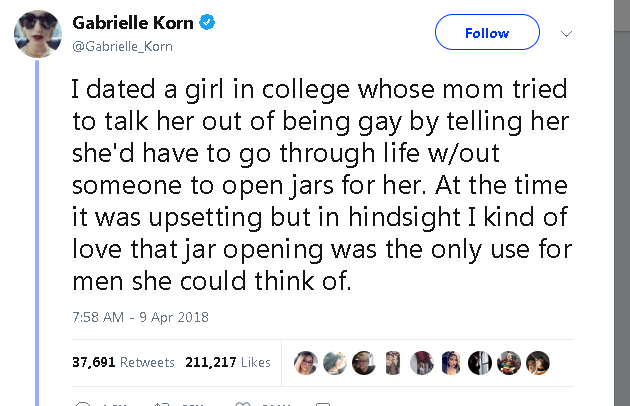
joanielspeak:

overwhelmsion:

the-wolfbats:

lasrina:

alpacamyhedgehog:

marthawells:

obovoid:

i don’t want to achieve equality by sinking to men’s level, i want them to get on ours! why should i have to unlearn the conversational art of waiting my turn, unlearn sexual self-restraint, unlearn trust in others’ good intentions, unlearn the impulse to cater to others’ needs, just to have a chance at success among savages? why can’t the men learn some fucking manners so we can all conduct our affairs in a civilized manner? i shouldn’t have to stop saying sorry, you say sorry!

In the 80s when I was in my freshman year in college, they still had entirely separate mens and women’s dorms. I was in class waiting for a final to start and one of the guys was telling someone about how he had had to go into a women’s dorm to drop something off, and he was startled to see posters on the walls, flowers, curtains, etc. He said his men’s dorm had holes in the walls, things on fire, fights, guys walking around with open wounds and he just didn’t understand why they had to live like this. He said, “I want to live with the women, in civilization.”

Am reading Sisterhood of Spies, about women working for the OSS during WWII. One of the stories mentions that the women in London had a male visitor who would eat in their mess hall once a month. He was married and wasn’t interested in hitting on any of the women; he just wanted to eat in an atmosphere where people said “Please pass the butter,” instead of “PASS THE GODDAMNED GREASE”

I dated a guy who brought me along on group activities (movies, video game night, etc.) with four or five other male friends. Once I mentioned to one of the other guys that I hoped I wasn’t intruding on their “guy time” or some such. He got this sort of rueful look and said, “The truth is, I really like it when you’re here because it gives us a reason to act better. When it’s just guys, we all have to try to outdo each other with how vile we are.”

So the moral of these stories are men don’t even treat each other like human beings.

Me to my 6-year-old son: “You seem to like playing with the girls at school more than the boys. Why do you think that is?”

6-year-old son: “Sometimes I just don’t want to be pushed. It hurts and is mean. And the girls always pretend to be princesses or fun animals and stuff when they have tea parties. The boys just dump the tea all over the place. That’s just stupid and I don’t like wasting all that tea. It takes forever to make.”

Me: “Wow, I can understand why you’d rather play with the girls. The boys seem like they’re kind of rough.”

6-year-old son: “And when I play with the girls they make me the king because none of the other boys want to play tea party.”

Me: “Do you like being the king?”

6-year-old son: “Not really – I’d rather be a wizard, but it makes Georgia and Vivian happy.”

annaknitsspock:

paulatheprokaryote:

lenyberry:

yayfeminism:

Why does being a woman put you at greater risk of having anxiety?
Part biology, part what we teach our kids about their place in the world.

So we’re teaching girls to be anxious wrecks and boys to disregard the possibility of consequences for incautious behavior. 

This explains a lot of things. Like… why women are anxious wrecks and men are frequently surprised when it turns out their actions do in fact have consequences.

And why men don’t bother asking for help even when they really need it, and thus more frequently die from treatable health conditions (including depression), while women end up getting a broad stereotype of being hypochondriacs (and then having a hard time getting treatment for legitimate health concerns).

https://www.ted.com/talks/caroline_paul_to_raise_brave_girls_encourage_adventure/transcript

Great example of how feminism serves not just women but people of all genders, including men.

oakttree:

ithelpstodream:

1. There’s No Such Thing As “Looking Non-Binary”

Most people understand that you don’t have to wear dresses to be a cis woman or wear pants to be a cis man. Yet many people seem to believe you need an androgynous style to be non-binary, creating the assumption that I and other non-binary people who wear women’s clothes must be women. But you can’t tell how someone identifies based on what they look like, which is why it’s so important to ask.

“I wish that people wouldn’t automatically use she/her pronouns just because of how I present,” says 19-year-old Kelley Cantrell. “They need to stop gendering people’s presentations.”

“I wear my hair long, and I’m coded as feminine, read as a cis woman. That doesn’t invalidate the fact that I’m non-binary,” agrees 24-year-old Alaina Leary. “There is no one specific way that it looks to be non-binary. Non-binary people have all types of gender presentations just like women and men do.”

2. Being Non-Binary Doesn’t Mean You Can’t Have Any Other Gender Identity

Some people identity as non-binary and as a man or woman or trans or something else. I personally identify as a non-binary woman because, to me, this identity acknowledges both that I don’t have an innate identification with any gender and that I’ve been socialized as a woman. Having more than one gender identity means different things to others, though. 24-year-old Rey Noble identifies as both non-binary and a woman to acknowledge that she loves her female-coded body but doesn’t always feel it accurately represents her.

3. Not All Non-Binary People Go By They/Them Pronouns

Non-binary people can also have a variety of pronouns. Some go by they/them, some go by she/her, some go by both, and some go by more than that. The only way you can know is to ask.

Similarly, some non-binary people will go by any pronoun, while others have a strong preference and feel deeply unacknowledged when it’s not honored. 21-year-old Yven likens it to being called by the wrong name. “There’s a real physical pang when someone call me by the incorrect names,” they say.

4. We Are Not All Intersex, Transgender, or Anything Else People Assume We Are

There’s some confusion about what it means to be non-binary. Some equate it with being intersex — that is, having a body not traditionally classified as male or female — but it has nothing to do with your biology. Intersex people can be non-binary, but so can people who are not intersex. Others equate being non-binary with being transgender, i.e. identifying with a gender other than the one you were assigned at birth. Some non-binary people feel this definition applies to them, but others don’t.

5. Non-Binary Identity Is Not Just a Quirk or Trend

“People are becoming more accustomed to the idea of transgender people, since it’s easier to explain the idea of feeling more attuned to the ‘opposite gender,’ but something that’s in the middle or completely absent from the gender spectrum at all is still difficult,” says Yven. “I have people asking me what that feels like and then dismissing it when I describe or try to say it more of personality quirk rather than a genuine experience.” Manduley also comes across the idea that non-binary identity is just a trend — or, as they put it, “a Tumblr invention.”

Being non-binary is not just a personality trait or a phase — it’s a real identity that’s existed for thousands of years.

6. We Don’t All Feel We Were “Born in the Wrong Body”

This is a common narrative about transgender people as well as non-binary people, and while it’s true for some, it doesn’t make the identity of someone who does not relate to the “born in the wrong body” narrative less valid.

I personally don’t feel I was born in the wrong body; I feel I was assigned the wrong gender based on people’s misconceptions about my body. My non-binary identity isn’t the result of my brain chemistry; it’s a reflection of my disagreement with the whole system of gender.

“There’s no non-binary card people have to get validated via distress about their bodies,” says Manduley. “Relatedly, dysphoria can be common and is sometimes influenced by the ways in which society (at large and even LGBTQ-specific spaces) often pushes people to gender binaries and leaves non-binary people feeling broken, confused, and unsettled, like they’re doing something wrong for ‘not picking a side already.’”

Similarly, non-binary people don’t always feel they were “born that way,” Manduley adds. “For some people, their realization (or even discomfort with a binary assignment of man or woman) doesn’t materialize until later in life,” they explain. “For some, there’s little to no distress, and just an internal acknowledgement that their gender is different and/or more complex than man or woman.”

7. You Don’t Have to Be Equally “Masculine” and “Feminine” to Be Non-Binary

“I’d like people to know that non-binary isn’t just ‘you are 50% man and 50% woman,’” says 23-year-old Kay Bashe. Non-binary people all identify as feminine and masculine to different degrees, just like men and women, and that may even change from time to time. Some don’t identify with masculinity or femininity at all.

It’s not possible for anyone else to say how “masculine” or “feminine” someone is. Masculinity and femininity are just arbitrary labels we give certain traits. What seems masculine to one culture or person might seem feminine to another. And none of them are right or wrong.

8. You Don’t Have To Prove You’re Non-Binary

I used to feel like a fraud for saying I was non-binary because I didn’t do anything differently from when I identified as a woman. I dressed the same, I acted the same, and I didn’t talk about being non-binary with many people.

Being non-binary doesn’t have to be a huge deal, though. You don’t have to do anything special or come out to anyone or behave any differently than you did before. The thing about gender is that it’s totally personal to you, so no matter what you say your gender is, you are right. You can’t be wrong.

“Being non-binary isn’t as difficult or complicated as it might seem,” says Noble. “It’s messy and weird in the fact that it’s hard to think outside of the box that society constructed for us, but ultimately, it’s a term that is welcoming and accepting of whatever you need for it to mean to you. It’s something you can create for yourself.”

9. Learning All These Things Isn’t Excessive Political Correctness — It’s Part of Being a Nice Person

Why is it worth our time to unlearn these assumptions, educate ourselves about non-binary identity, and try to understand how the people in our own lives identify? Because it makes us more supportive friends, partners, family members, and human beings.

“For people who don’t identify as something outside of their assigned at birth gender, it can be difficult to understand the experience non-binary and trans people as a whole go through,” says Yven. “But learning to accept that people have completely different lives and experiences is part of being human. Supporting that someone is trying to be more comfortable in themselves is something that society should strive for and encourage.”

https://www.teenvogue.com/story/9-things-people-get-wrong-about-being-non-binary

I have to admit that some of this confuses me. If I present in a way that means 99.999% of people who see me will assume “woman” (even “cis woman”), and I use she/her pronouns, and I even identify as a woman in addition to non-binary— what is the meaningful distinction, materially, between me and an “actual” woman?

I’ve been trying to figure this out, and frankly I just can’t see what makes me a cis woman and not a non-binary person; if it’s not my presentation or my pronouns, and I don’t have an innate sense of myself as a woman (and I don’t, I don’t really even know what that would feel like)… What Does It Mean?

I’m not trying to provoke, I’m just really confused. In the past I’ve wondered if this means I am non-binary or genderqueer on some level, and then I think, well, isn’t there some political utility in identifying as female, in a world that denigrates women so much? and I tie myself in knots trying to figure it all out.

Help, basically?

It seems to me that there are a lot of people (myself included) who are confused about what it means to “feel like” a man or a woman in a way that floats free of either (1) being aware of, feeling like one has, or (conversely) feeling alienated from male or female physical characteristics, or (2) identifying positively with traditionally masculine or feminine personality traits and/or styles of dress and self-presentation. I want to be a supportive ally to trans folks, so I try to take it on board when I am told that someone can be a man or a woman even if they were assigned the opposite at birth due to physical characteristics, do not feel as if they were “born in the wrong body,” have no desire to transition either surgically or hormonally, and still dress and present in a way consistent with the gender assigned at birth. All I can conclude is that gender is some sort of core felt essence… but I feel no such gendered core essence, and neither do a number of other people I’ve talked to (who generally present as the gender assigned at birth, mostly as the path of least resistance). Does that make me (us) non-binary? If so, there are probably a lot more non-binary people out there than self-identify as such.

Maybe it’s just a matter of my own ignorance, but I find the idea of a gendered core essence to be extremely odd and even a little troubling. In fact, I don’t like the idea of core essences of any kind, because I’m actually a late nineteenth-century modern philosopher and I was born in the wrong time period… (oh wait, does that mean my core essence is late-nineteenth-century?) Anyway, I think contemporary identity politics is full of weird essentialism and I don’t like it.

heyblackrose:

blackgiornogiovanna:

dandridgegirl:

dandridgegirl:

“It is a radical upheaval, a national reckoning with massive social and political implications,” says Traister. “Across classes, and races, we are seeing a wholesale revision of what female life might entail. We are living through the invention of independent female adulthood as a norm, not an aberration, and the creation of an entirely new population: adult women who are no longer economically, socially, sexually, or reproductively dependent on or defined by the men they marry.”
So, we might summarize one trend as: “Independent Single Ladies on the Rise.”
For more than forty years I have specialized in working with men. I’m seeing a disturbing trend of increased male irritability and anger, along with a rise in the depression and suicide rates for males. In doing research for my book, The Irritable Male Syndrome: Understanding and Managing the 4 Key Causes of Depression and Aggression, I developed a quiz that has now been taken by more than 60,000 men throughout the world.
I’ve seen a disturbing trend where more and more men feel disconnected, disrespected, and angry. We see the anger acted out in violent attacks such as the ones we saw in Orlando and also in the rhetoric of presidential candidate Donald Trump. We also see it in a rise of male loneliness.
Unfortunately, this is a common experience for an increasing number of men. Joiner concludes that “Men’s main problem is not self-loathing, stupidity, greed, or any of the legions of other things they’re accused of. The problem, instead, is loneliness; as they age, they gradually lose contact with friends and family, and here’s the important part, they don’t replenish them.”
I see these two trends interweaving and reinforcing each other. As women become more independent and self-sufficient they are not willing to settle for a marriage where their needs are not met. They would rather get their social and emotional support from work associates, friends, and family.
As men feel unable to meet women’s needs for economic, emotional, and social support, they feel more inadequate and distance themselves even more, often escaping into pornography, increased alcohol consumption, and compulsive work habits. I hear from many women that “there just aren’t any good men out there to marry” and they become even more self-sufficient and self-contained. I hear from men who say, “Women just don’t want intimacy anymore.” They become more fearful of reaching out to women and risking rejection.”

https://goodmenproject.com/featured-content/women-saying-no-marriage-men-becoming-angry-depressed-lonely-wcz/

When are males going to collectively decide to change?

Go to therapy, make better friends, stop being rapist, develop some interests other than porn, develop better social skills, become more empathetic, gain knowledge on actually giving a woman an orgasm, repair their relationships with their family, read a book on social skills, take a class on social skills, stop having sexual Tourette’s, develop a life that a woman would actually say yes to if you propose.

I can’t be sympathetic because most males don’t move an inch to change their lives for the better. They just get madder that no woman wants them.

^^^^^^ It’s easier for them to blame us then to take any real responsibility for their actions

let the church say amen.

Men need to change, yes, but we as a society also need to change the way boys are raised and socialized and the messages they’re sent in media. We’ve started telling girls some of the things that only boys used to be told – that they should aspire to career success, be confident in and cultivate their talents – but we don’t teach boys how to take responsibility for their own social and emotional well-being. I suspect the reason for this is much the same as the reason it’s now considered normal for women to wear trousers but not for men to wear skirts: that taking on “masculine” features is still considered an upgrade for a woman, while taking on “feminine” features is considered a humiliating downgrade for a man. We still, as a society, have trouble acknowledging the immense value of “feminine” skills and characteristics. When these things are touted by conservatives, it’s clearly a disingenuous effort to relegate women to that social role; the low value they really place on it is clear from the fact that they don’t think it’s worthy of men.