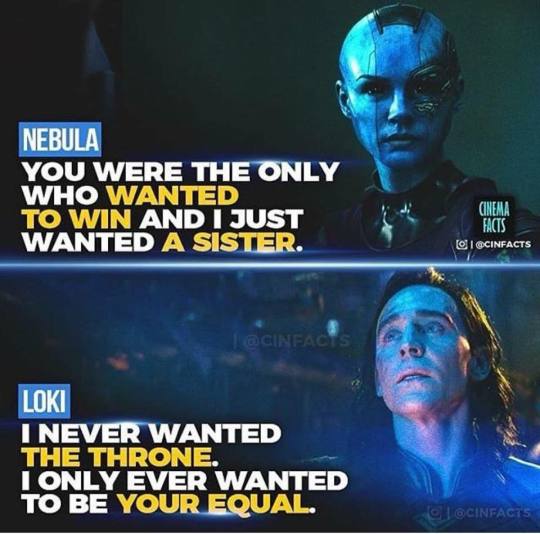
These lines are the MOST defining for these characters. Yet they seem to go lost on a large chunk of the audience. Except that Gamora at least acknowledged Nebula’s pain and validated her grievances. Whereas Thor continues to believe that Loki has only ever had ill intentions, and functions primarily to specifically antagonize him. And thus, the general audience continues to believe this as well.
The general audience doesn’t analyse beyond surface level and consequently doesn’t have a cooking clue about this difference. That’s fine, but I wish they wouldn’t tell me to shut up when I notice stuff like this. Because I’m not wrong. I’m just being more observant and critical.
Get it? Cause they’re both blue? And bad guys? I’m hysterical, admit it.
In this meta, I will be examining the similarities between the sibling relationship arcs of Thor & Loki and Gamora & Nebula, from their childhood to their reconciliation (or “reconciliation”, as the case may be).
This meta will be split into two parts: Context and Argument.
The purpose of this meta is to explain why I am dissatisfied with the conclusion to Thor & Loki’s relationship arc. If you’re not a fan of Ragnarok criticism/discussion, this meta isn’t for you, and the tag you should blacklist if you’re following me is “ragnarok discourse”. It’s perfectly fine to tailor your dashboard to your preferences. I do it too. If you aren’t a fan of Ragnarok criticism, but would like to rebut my arguments, you’re more than welcome to do so politely.
Some people who might find this interesting/want to add something… @philosopherking1887, @imaginetrilobites, @lucianalight, @princess-ikol, @illwynd, @incredifishface, and @iamanartichoke (I know Ragnarok criticism isn’t always your thing, but when it comes to the Brodinsons’ relationship we seem to agree). I hate tagging people, but this post was too much work not to. I always feel like I’m bothering everyone. Do feel free to disregard if you would like.
Context
Childhood
Gamora and Nebula both lose everything, Thanos kidnaps them, and they’re trained and mutilated, turned into assassins who travel the galaxy and do his bidding. Thanos pits them against one another in a competition where Gamora always comes out on top. Nebula grew to resent Gamora for winning–that they were in this competition at all since she just wanted a sister–even though Thanos was ultimately responsible/the one at fault for this. Through it all, Gamora remained focused on her own problems, and in so doing unintentionally contributed to Nebula’s (ex: Gamora winning results in Nebula being augmented).
Thor and Loki, compared to Gamora and Nebula, have an idyllic childhood. They’re actually Odin and Frigga’s children. Odin and Frigga are bad/abusive parents, but they are parents. Both Odin and Frigga conceal from Loki his heritage. They allow Thor and others to spout racism against Frost Giants, even in Loki’s presence. They permit Thor’s worst impulses until after someone gets hurt. Odin pits them against one another in a competition where Thor always comes out on top. Loki grew to resent Thor for being the favored son–that they were in this competition at all since he just wanted to be equals–even though Odin was ultimately responsible/the one at fault for this. Through it all, Thor remained focused on his own problems, and in so doing unintentionally contributed to Loki’s (ex: Thor’s own insecurities and resulting arrogance lead to him reinforcing Loki’s insecurities with commands like, “Know your place, brother.”).
Conflict
To summarize the entire active conflict between Thor and Loki (two+ fucking films worth!) would be exhausting, so I’m merely going to enumerate the similarities where I see them.
Both pairs of siblings begin at a relatively equal moral position. Gamora and Nebula have both committed grave crimes against the galaxy at the behest of Thanos and Ronan. Thor and Loki both start firmly convinced of the vileness of the Frost Giant race. Gamora and Thor are, perhaps, worse than their siblings. Gamora easily steals an opportunity from Nebula in GotG. It’s not a stretch to infer Thanos and Ronan favored sending her on jobs, meaning she would have committed more crimes. Thor
has genocidal aspirations, where Loki does not (at first), wanting to destroy the Frost Giants in whole or in part (look at me exercising my knowledge of the U.N. definition of genocide like some pedantic asshole) because of the prejudice he’s absorbed from society and, almost certainly, Odin specifically.
Gamora and Thor both come to the realization that they were wrong. Gamora betrays Thanos and finds a new family, while Thor confronts his greatest flaws and adjusts his behavior and values.
Meanwhile, Nebula and Loki hurt innocent people to achieve their (sympathetic) desires. In Nebula’s case, she helps Ronan attempt to annihilate the Nova Empire in exchange for the opportunity to destroy Thanos, the “father” that’s tortured her all her life. In Loki’s case, he first attempts genocide against the Frost Giants in the midst of a mental breakdown/identity crisis in order to win Odin’s approval, and then attacks Midgard to survive Thanos, get away from the torture, and to lash out at the people he feels did him wrong (Thor and Odin).
At various points, Nebula and Loki attempt to kill their siblings. (I’m not going to list them–you know them.)
Gamora and Thor initially attempt to reason with their siblings, to talk them down from the conflict, but they both, inevitably, give up on them. Gamora gives up on Nebula at the end of GotG. At the beginning of GotG Vol. 2, Nebula is a bounty Gamora means to collect. Thor gives up on Loki twice. First, at the end of Avengers. Second, in Ragnarok.
Argument
You know, looking at the similarities between the sibling arcs, I have to wonder about fandom’s treatment of Nebula vs. Loki. I, for one, have never seen anyone claim that Nebula doesn’t deserve Gamora, despite the fact that both Nebula and Loki try to kill their siblings, lead armies that devastate a city, and attempt genocide/to massacre the people of an empire, not primarily out of a desire to kill (though in Loki’s case there’s certainly a bit of that when it comes to the Frost Giants), but for other reasons (family issues/Thanos issues). Granted, Nebula does both at the same time, whilst Loki spreads these things out, but that doesn’t explain the difference in the fandom’s treatment of these characters and their relationships with their siblings.
It’s a very thoughtful description of the two relationships. To summarize, Nebula and Gamora are independent characters with independent goals who reconcile as equals. Loki is narratively a prop for Thor and he skunks back to Thor’s shadow under the pain of abandonment.
A interesting detail is that Nebula is allowed a clean win in the field where their rivalry was centered (physical prowess). Loki is denied a clean win in the two fields where his rivalry with Thor was at its peak: he’s shown as a very lousy king/leader AND the generally unworthy brother throughout the film.
Not only that, but the movie shows him up in areas where he used to have the upper hand on Thor – manipulation and trickery. If you can call Thor’s hamfisted tactics “manipulation” and not bludgeoning. What next, are they going to make Thor an accomplished sorcerer? Oh wait, they already got Strange to overshadow Loki there too.
That’s a pretty standard narrative/mythic trope, the “trickster tricked.” It happens in the Norse myths, as when Loki turns into a salmon to try to escape punishment for causing Balder’s death and then Thor catches him in the fishnet that Loki had been weaving. (A very literal version of the weaver of schemes being caught in his own net.) We saw a little bit of that in TDW, when Thor handcuffed Loki instead of arming him (“I thought you liked tricks”) and pushed him out of the Dark Elf ship onto the skiff (“You lied to me. I’m impressed”). In theory, I don’t have a problem with that.
What @foundlingmother points to as the problem with their “reconciliation” is exactly right. Unlike GotG2 with Nebula, TR doesn’t even acknowledge, let alone validate, Loki’s perspective on the sibling conflict. Of course the in-story reason Loki doesn’t rebut Thor’s assessment is because he’s paralyzed by the obedience disk… but that parallels the structural narrative situation, too. He’s being silenced, physically by Thor* and narratively by the film’s implied perspective (which basically lines up with Thor*’s). By acquiescing to Thor*’s demands, apparently because he’s responded to the ultimatum, Loki appears to confirm Thor*’s and the film’s diagnosis that all of the problems in the relationship were the result of Loki’s selfish, capricious badness – never mind that 3 previous films made a point of showing that this is not the case.
it’s incredible to me how gamora and nebula’s childhood together was so much worse than thor and loki’s and they were literally raised to hate each other but literally the moment nebula blurts out a vulnerable feeling gamora is like “…oh my god I’m so sorry” and next thing you know they’re saving each other and hugging and stuff and meanwhile, thor and loki,
Thor did the same to Loki though. Apologize I mean.And Loki responded by tring to murder him.
I’m not going to act like Thor’s apology in the first movie as he approached the Destroyer wasn’t coming from a good place, because it was, but there’s a very clear parallel between “I never wanted the throne! I only ever wanted to be your equal!” and “You just had to be better, and all I ever wanted was a sister!” and the fact that the latter caused an actual pause in the conflict and reevaluation of the situation and the former didn’t is telling. I absolutely get why Thor’s apology was basically “I don’t know what I even did to you, but I’m sorry”, but there was a tiny window of opportunity to go “wait, THAT’S what your problem is?” well after that, under very similar circumstances, that was bypassed.
Except that Loki didn’t want to be Thor’s equal. He got that when Thor was banished, and threw it away.
you know, you could make literally just as much of an argument that Nebula had already thrown away her chance at just being sisters in the first movie when she cut off her own hand to spite Gamora and escape and therefore didn’t really want it, but that’s dumb because she’s not a real person, she’s a fictional construct, and we kind of have to take her words at face value instead of remotely imposing an opposing view on them, and the same goes for Loki! amazing.
The difference is that Nebula was tortured thoughout her entire childhood, while Loki just found out he was adopted.
I don’t know how to tell you this, but trauma is trauma is trauma and bad parenting doesn’t have to involve cutting your children up. Loki was raised to fear and hate his own species, so it’s not just that he was adopted, it was finding out he’s literally something his father raised him to despise *as well as* Odin putting them in competition with each other too, in a much more mundane but, to use @morethanprinceofcats ’s term, insidious way than Thanos did with Nebula and Gamora, but it was still psychologically harmful.
The difference between the way Nebula’s arc goes and the way Loki’s does is 100% the result of the MCU needing Loki to stay a villain. Thor goes ‘I don’t know what I did to you, but I’m sorry about it’ and that’s as close as the story ever allows them to get to the kind of moment Nebula and Gamora have in GOTG 2. Thor isn’t responsible for Loki’s mental state or his crimes but there is no room ever allotted for him to try to understand where Loki’s coming from, either. Even if he went ‘Loki, I get it, I understand your feelings, our dad really screwed you over, but blowing up New York isn’t going to fix anything and is still wrong’ it would be an improvement over how it’s actually handled. Acknowledging that his feelings are justified doesn’t mean justifying his actions!
I love love love Nebula with a depth of affection I only rarely feel about fictional characters, but drawing this huge line between her and Loki is just that whole Tumblr thing where a woman can do whatever kind of evil shit onscreen and people will still unambiguously defend her as a Strong Cool Lady, *especially* if she has a traumatic excuse for it, but a man having the same situation is dismissed as just boring manpain. This isn’t even nonsensical inverted anti-male sexism, it’s just plain old everyday misogynistic sexism. The idea that women are just naturally purer of heart than men regardless of what they do and their sadness matters more is a patriarchal concept based in the idea that women are also more fragile than men. Nebula is not a better person than Loki, the narrative just allowed her an opportunity for healing and reconciliation where he got none- and I also feel like if he did, there would be people complaining about it on here.
I get that the Loki fandom of old was obnoxious but Christ, this backlash is no better and no more willing to engage with the problems in the source material.
i do not wanna write thor and loki discourse it is TWO THOUSAND AND SEVENTEEN, i s2g
So we’re introduced to Thor and Loki as babbies and this scene takes place, not incidentally or just as mere exposition, but to demonstrate the dynamic that psychologically sculpted the princelings:
Odin: [scary story about the frost giants and their savagery and the wars with them] Loki as a child: [terrified of frost giants] Thor as a child: When i am king, i’ll hunt the monsters down and slay them all, just as you did, father! Odin: Both of you were born to be kings, but only one of you will be! Loki as a child: [looks petrified and anxious] Thor as a child: [looks a bit smug and very excited]
When Loki discovers he is a monster by birth, his immediate train of thought is: So this is why I would never be considered for heir! You would never put a FROST GIANT on the throne of Asgard!
And his immediate train of thought is to kill all of the frost giants and win their father’s approval – a literal 1:1 exists between what Loki does in the midst of a visible mental breakdown and what Thor boasted he would do when he was like, 9.
Killing Thor starts to enter into the picture because if Thor returns and ruins his plot he’ll never show their father, he’ll never prove he was any good!
I’m not excusing this, it’s both bonkers and, you know, to put it mildly, unethical. But this is literally 100% Odin’s shitty child-rearing and imperialistic Asgardian values rearing their ugly head. Like Thor started the movie wanting to start another bloody war with the frost giants himself. Loki is not alone in his arrogance, his militarism.
You know what else there’s a 1:1 between? That time in Avengers Loki stabs Thor in a non-fatal stabbing area with a teeny tiny knife and ruefully says “Sentiment” with tears in his eyes, and Nebula choking Gamora in her hand while ready to thrust a blade into her, and then throwing her aside because she can’t bring herself to kill her.
I am not saying that Thor is a bad person for giving up on Loki after this. I’m just saying it’s a clear executive mandate that he do so because it would take only the barest adjustment in his attitude to get him to reach out to Loki, and there’s honestly no reason to believe that if somebody did – genuinely did – empathize with him and validate his feelings about Odin’s wrongdoings, he wouldn’t respond favorably – or at least start to respond favorably, like Nebula does, without committing to anything.
Nebula and Gamora have committed literally all of the same crimes. The only thing Nebula did that Gamora didn’t do was stick with Ronan after Gamora left, and she had no choice in that. Her first words to Gamora when she meets her in GOTG2 are, inexactly, “You ran off with the stone and abandoned me [to Ronan and Thanos] without looking back, and yet here you stand a hero.” This is probably the best moment of holding-heroic-characters-to-some-semblance-of-an-ethical-standard in the entire MCU because that is literally eactly what Gamora did. She wasn’t even assigned to the mission of getting the Infinity Stone; Nebula was, and Gamora immediately suggested Nebula wasn’t good enough to do it (in an environment where, clearly, Nebula not being as good as Gamora was literally grounds for having her mutilated!) and replaced her.
She didn’t offer to go with her by saying it was too important to send one of them. She didn’t ask Nebula to come leave with her. And it’s clear from GOTG that if she had, Nebula would have done so.
Nebula stayed with Ronan because she had nowhere else to go. She stays with him after he acquires the stone for similarly clear reasons.
Nebula: After Xandar, you’re going to kill my father? Ronan: You dare to oppose me? Nebula: You see what he has turned me into. If you kill him, I will help you destroy a thousand planets.
No fucking wonder homegirl doesn’t leap on board when Gamora asks her to help – now. After ditching her to sell the orb and get as far away as possible. After leaving her with Ronan and Thanos all by herself. No one has ever cared about Nebula otherwise. No one has ever reached out to her except as an afterthought.
It would be perfectly justified, after Nebula tried to kill her (literally; she would be dead if not for Peter) and all of fucking Xandar (even though Nebula actually ditched Ronan before he made it to ground), for Gamora to go with her Plan A and deliver her sister’s ass to Xandar for a bounty. But she doesn’t, because she realizes Nebula and she were in Thanos’ fucked up web of misery together, and Nebula has good reason to hate her.
By comparison, when Thor, knowing his brother had some kind of a legitimate breakdown that made him do unthinkable things, catches up to Loki again, he chides him, “Do you remember none [of our childhood together]?” and tells him all of his problems with Thor are imagined (and they’re not, by the way! They are certainly exaggerated, but they are not in his head), then supposes that the only reason Loki wants to take over Midgard is to hurt Thor, personally. There’s no effort made to empathize with him, there’s no condemnation of Odin’s keeping the secret of his being a frost giant secret; there’s no telling him that he doesn’t mind, specifically, Loki’s being a frost giant. (This has SCARCELY been brought up in the MCU and I’m so pissed off. What IS continuity, Thor franchise??) I’m not saying Thor is obligated to do this! I’m just saying, seeing how Nebula and Gamora’s relationship plays out highlights that Thor doesn’t do it.
There is just not enough of a distinction between their situations, Nebula trying to kill Gamora and Gamora realizing Thanos and his favoritism is responsible for their interpersonal problems and trying to atone for her part in that favoritism, and Loki trying to kill Thor and Thor never questioning their father, ever, and writing Loki off, to say that Loki is just too evil for a comparison to be made. Nebula and Gamora are two of the best and bloodiest assassins in the galaxy and by the time they make up Nebula happily tried to kill her and left Yondu, Rocket and even baby Groot in the jaws of death, so you better not argue that Gamora owed her any more than Thor owes Loki.
Footnote: I didn’t even touch on Thanos’ role in Avengers as the one who sent Loki to Midgard to get an Infinity Stone for him in the first place (Avengers and GOTG have the literal same plot; GOTG does it better). I didn’t mention that Thanos explicitly had Loki do this under the threat of torture – Thanos, who tortured Nebula, Gamora and their siblings to make them better soldiers, out of benevolence, threatened to torture Loki totally malevolently if he failed – or that Loki shows up in Avengers looking and acting like the reanimated cat in Herbert West: Reanimator, twitchy, half-dead and ready to climb every wall in the building and steal some Infinity Stones, and he’s all out of walls. The narrative comparison between Nebula and Loki is not something Megan or I invented out of whole cloth, it’s right there. But the suits want Loki to be a bad guy, and meanwhile James Gunn is apparently writing this from space itself and that’s why his space scenes are so realistic. That’s the difference.
“I get that the Loki fandom of old was obnoxious but Christ, this backlash is no better and no more willing to engage with the problems in the source material.”

 Loki is the Philosopher King