
strange and weird that me not shaving my legs & leaving them in their natural fuzzy state and really never thinking about it is seen as an active choice, and maintaining nakey bald legs with careful weekly upkeep is seen as a default
Tag: feminism
“She stood upon her chariot, spear in hand, a frightful sight and spoke:
‘I am avenging lost freedom, my scourged body, the chastity of my daughters. Behold the proud display of warlike spirits, and consider the motives for which we draw the avenging sword. On this spot we must either conquer or die with glory. There is no alternative. I am a woman but my resolution remains firm. You men can either fight or die.’”— Cassius Dio about Boudicca





I’ve said this before and I’ll point it out again –
Menstruation is caused by change in hormonal levels to stop the creation of a uterine lining and encourage the body to flush the lining out. The body does this by lowering estrogen levels and raising testosterone.
Or, to put it more plainly “That time of the month” is when female hormones most closely resemble male hormones. So if (cis) women aren’t suited to office at “That time of the month” then (cis) men are NEVER suited to office.
If you are a dude and don’t dig the ladies around you at their time of the month, just think! That is you all of the time.
And, on a final note, post-menopausal (cis) women are the most hormonally stable of all human demographics. They have fewer hormonal fluctuations of anyone, meaning older women like Hilary Clinton and Elizabeth Warren would theoretically be among the least likely candidates to make an irrational decision due to hormonal fluctuations, and if we were basing our leadership decisions on hormone levels, then only women over fifty should ever be allowed to hold office.
Reblogging hard for that last comment.
I WANTED TO SAY THIS BUT THEN SOMEONE ELSE DID and I’m damn proud.
GLORIOUS



“If you criticize X in women but do not criticize X in men, then you do not have a problem with X, you have a problem with women. For X please insert words like ‘anger,’ ‘ambition,’ ‘loudness,’ ‘stubbornness,’ ‘coldness,’ ‘ruthlessness.’”
—Chimamanda Ngozie Adichie, Dear Ijeawele, or a Feminist Manifesto in Fifteen Suggestions



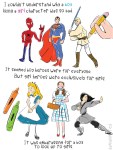

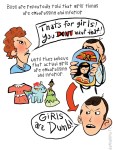
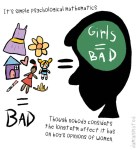



At Target this lady told her son he couldn’t have a Wonder Woman doll because “that’s for girls” and then bought her daughter the same one. It got me thinking about how often I see people bar young boys from appreciating girls/women as protagonists and heroes, and my own experience with it as a kid.
Mansplaining protip:
When a man starts
explaining a concept you already told him you understand,
instead of saying “I know” over and over until you die, try one of these:
- Ok, which aspect is confusing you?
- It seems like
you have the basics down; Would you like me to recommend some good articles so you can get a more nuanced understanding?- So did
you have a specific question, or do you just want a more in depth
explanation?SAVAGE
teacher-zone him
I’ve also had some good results with, “Wait, stop. It sounds like you’re disagreeing with me, but nothing you’ve said has contradicted anything in my initial argument. What, precisely, are you disagreeing with?”
I was walking behind a woman for five minutes and she got catcalled three times.
I usually walk everywhere with my headphones on, but I had them in my bag and I was reading a book on my phone instead (I do that when the foot traffic is light). A young Latina was coming down the street as I was coming up the avenue, and when she got to the corner a few paces ahead of me, she turned to walk in the direction I was going. We were traveling at the same speed, but since she was like ten paces ahead and it’s bright outside in the middle of the day, I didn’t feel the need to fall back or slow down to give her more space. At night, I try not to walk too close behind women just so they don’t feel like I’m any sort of threat.
We got to a corner and this dude standing outside of the bodega was like, “Slow down mama where you goin? You don’t have to work today, you can stop and speak.”
She didn’t break her stride. “I’m going to the gym.” The Walk sign was on, so I didn’t break mine either.
A block later, a young guy was coming toward us on the sidewalk riding his bike.
“What’s good shorty?”
She didn’t respond.
“Well you was lookin, you can say something, stuck up bitch.”
We kept walking.
In the middle of the next block, an older man was walking toward us and he put on a friendly smile and said, “Smile young lady, it’s a beautiful day.”
I don’t know if she smiled, but we kept walking. She went into the gym and I kept on toward where I was going thinking about how that was just five minutes of her day. How many other blocks of five minutes are just like that?
Only one of them was truly aggressive. The other two guys seemed nice enough and it felt more like a pleasant compliment. It felt like the kind of thing a guy says who argues with women online about catcalling. “We’re not all bad guys. We can’t even compliment women? We can’t even say something nice?”
No. You really can’t. I was annoyed in that five minutes and I just happened to be walking behind her with no headphones on. Can you imagine those five minutes over and over every day of your life? Nobody wants to be spoken to by strangers day in and day out forever regardless of what they’re saying.
So no. You can’t say anything. The quality of your life has not decreased because you aren’t allowed to say nice things to strange women on the sidewalk, but your silence greatly increases the quality of hers. So just be quiet, and let her go where she’s going.
So no. You can’t say anything. The quality of your life has not decreased because you aren’t allowed to say nice things to strange women on the sidewalk, but your silence greatly increases the quality of hers. So just be quiet, and let her go where she’s going.
So no. You can’t say anything. The quality of your life has not decreased because you aren’t allowed to say nice things to strange women on the sidewalk, but your silence greatly increases the quality of hers. So just be quiet, and let her go where she’s going.
So no. You can’t say anything. The quality of your life has not decreased because you aren’t allowed to say nice things to strange women on the sidewalk, but your silence greatly increases the quality of hers. So just be quiet, and let her go where she’s going.
So no. You can’t say anything. The quality of your life has not decreased because you aren’t allowed to say nice things to strange women on the sidewalk, but your silence greatly increases the quality of hers. So just be quiet, and let her go where she’s going.
So no. You can’t say anything. The quality of your life has not decreased because you aren’t allowed to say nice things to strange women on the sidewalk, but your silence greatly increases the quality of hers. So just be quiet, and let her go where she’s going.
Got it, my dudes?
Women have more power and agency in Shakespeare’s comedies than in his tragedies, and usually there are more of them with more speaking time, so I’m pretty sure what Shakespeare’s saying is “men ruin everything” because everyone fucking dies when men are in charge but when women are in charge you get married and live happily ever after
I think you’re reading too far into things, kiddo.
Take a break from your women’s studies major and get some fresh air.Right. Well, I’m a historian, so allow me to elaborate.
One of the most important aspects of the Puritan/Protestant revolution (in the 1590’s in particular) was the foregrounding of marriage as the most appropriate way of life. It often comes as a surprise when people learn this, but Puritans took an absolutely positive view of sexuality within the context of marriage. Clergy were encouraged to lead by example and marry and have children, as opposed to Catholic clergy who prized virginity above all else. Through his comedies, Shakespeare was promoting this new way of life which had never been promoted before. The dogma, thanks to the church, had always been “durr hburr women are evil sex is bad celibacy is your ticket to salvation.” All that changed in Shakespeare’s time, and thanks to him we get a view of the world where marriage, women, and sexuality are in fact the key to salvation.
The difference between the structure of a comedy and a tragedy is that the former is cyclical, and the latter a downward curve. Comedies weren’t stupid fun about the lighter side of life. The definition of a comedy was not a funny play. They were plays that began in turmoil and ended in reconciliation and renewal. They showed the audience the path to salvation, with the comic ending of a happy marriage leaving the promise of societal regeneration intact. Meanwhile, in the tragedies, there is no such promise of regeneration or salvation. The characters destroy themselves. The world in which they live is not sustainable. It leads to a dead end, with no promise of new life.
And so, in comedies, the women are the movers and shakers. They get things done. They move the machinery of the plot along. In tragedies, though women have an important part to play, they are often morally bankrupt as compared to the women of comedies, or if they are morally sound, they are disenfranchised and ignored, and refused the chance to contribute to the society in which they live. Let’s look at some examples.
In Romeo and Juliet, the play ends in tragedy because no-one listens to Juliet. Her father and Paris both insist they know what’s right for her, and they refuse to listen to her pleas for clemency. Juliet begs them – screams, cries, manipulates, tells them outright I cannot marry, just wait a week before you make me marry Paris, just a week, please and they ignore her, and force her into increasingly desperate straits, until at last the two young lovers kill themselves. The message? This violent, hate-filled patriarchal world is unsustainable. The promise of regeneration is cut down with the deaths of these children. Compare to Othello. This is the most horrifying and intimate tragedy of all, with the climax taking place in a bedroom as a husband smothers his young wife. The tragedy here could easily have been averted if Othello had listened to Desdemona and Emilia instead of Iago. The message? This society, built on racism and misogyny and martial, masculine honour, is unsustainable, and cannot regenerate itself. The very horror of it lies in the murder of two wives.
How about Hamlet? Ophelia is a disempowered character, but if Hamlet had listened to her, and not mistreated her, and if her father hadn’t controlled every aspect of her life, then perhaps she wouldn’t have committed suicide. The final scene of carnage is prompted by Laertes and Hamlet furiously grappling over her corpse. When Ophelia dies, any chance of reconciliation dies with her. The world collapses in on itself. This society is unsustainable. King Lear – we all know that this is prompted by Cordelia’s silence, her unwillingness to bend the knee and flatter in the face of tyranny. It is Lear’s disproportionate response to this that sets off the tragedy, and we get a play that is about entropy, aging and the destruction of the social order.
There are exceptions to the rule. I’m sure a lot of you are crying out “but Lady Macbeth!” and it’s a good point. However, in terms of raw power, neither Lady Macbeth nor the witches are as powerful as they appear. The only power they possess is the ability to influence Macbeth; but ultimately it is Macbeth’s own ambition that prompts him to murder Duncan, and it is he who escalates the situation while Lady Macbeth suffers a breakdown. In this case you have women who are allowed to influence the play, but do so for the worse; they fail to be the good moral compasses needed. Goneril, Regan and Gertrude are similarly comparable; they possess a measure of power, but do not use it for good, and again society cannot renew itself.
Now we come to the comedies, where women do have the most control over the plot. The most powerful example is Rosalind in As You Like It. She pulls the strings in every avenue of the plot, and it is thanks to her control that reconciliation is achieved at the end, and all end up happily married. Much Ado About Nothing pivots around a woman’s anger over the abuse of her innocent cousin. If the men were left in charge in this play, no-one would be married at the end, and it would certainly end in tragedy. But Beatrice stands up and rails against men for their cruel conduct towards women and says that famous, spine-tingling line – oh God, that I were a man! I would eat his heart in the marketplace. And Benedick, her suitor, listens to her. He realises that his misogynistic view of the world is wrong and he takes steps to change it. He challenges his male friends for their conduct, parts company with the prince, and by doing this he wins his lady’s hand. The entire happy ending is dependent on the men realising that they must trust, love and respect women. Now it is a society that is worthy of being perpetuated. Regeneration and salvation lies in equality between the sexes and the love husbands and wives cherish for each other. The Merry Wives of Windsor – here we have men learning to trust and respect their wives, Flastaff learning his lesson for trying to seduce married women, and a daughter tricking everyone so she can marry the man she truly loves. A Midsummer Night’s Dream? The turmoil begins because three men are trying to force Hermia to marry someone she does not love, and Helena has been cruelly mistreated. At the end, happiness and harmony comes when the women are allowed to marry the men of their choosing, and it is these marriages that are blessed by the fairies.
What of the romances? In The Tempest, Prospero holds the power, but it is Miranda who is the key to salvation and a happy ending. Without his daughter, it is likely Prospero would have turned into a murderous revenger. The Winter’s Tale sees Leontes destroy himself through his own jealousy. The king becomes a vicious tyrant because he is cruel to his own wife and children, and this breach of faith in suspecting his wife of adultery almost brings ruin to his entire kingdom. Only by obeying the sensible Emilia does Leontes have a chance of achieving redemption, and the pure trust and love that exists between Perdita and Florizel redeems the mistakes of the old generation and leads to a happy ending. Cymbeline? Imogen is wronged, and it is through her love and forgiveness that redemption is achieved at the end. In all of these plays, without the influence of the women there is no happy ending.
The message is clear. Without a woman’s consent and co-operation in living together and bringing up a family, there is turmoil. Equality between the sexes and trust between husbands and wives alone will bring happiness and harmony, not only to the family unit, but to society as a whole. The Taming of the Shrew rears its ugly head as a counter-example, for here a happy ending is dependent on a woman’s absolute subservience and obedience even in the face of abuse. But this is one of Shakespeare’s early plays (and a rip-off of an older comedy called The Taming of a Shrew) and it is interesting to look at how the reception of this play changed as values evolved in this society.
As early as 1611 The Shrew was adapted by the writer John Fletcher in a play called The Woman’s Prize, or The Tamer Tamed. It is both a sequel and an imitation, and it chronicles Petruchio’s search for a second wife after his disastrous marriage with Katherine (whose taming had been temporary) ended with her death. In Fletcher’s version, the men are outfoxed by the women and Petruchio is ‘tamed’ by his new wife. It ends with a rather uplifting epilogue that claims the play aimed:
To teach both sexes due equality
And as they stand bound, to love mutually.
The Taming of the Shrew and The Tamer Tamed were staged back to back in 1633, and it was recorded that although Shakespeare’s Shrew was “liked”, Fletcher’s Tamer Tamed was “very well liked.” You heard it here folks; as early as 1633 audiences found Shakespeare’s message of total female submission uncomfortable, and they preferred John Fletcher’s interpretation and his message of equality between the sexes.
So yes. The message we can take away from Shakespeare is that a world in which women are powerless and cannot or do not contribute positively to society and family is unsustainable. Men, given the power and left to their own devices, will destroy themselves. But if men and women can work together and live in harmony, then the whole community has a chance at salvation, renewal and happiness.
In the immortal words of the bard himself: fucking annihilated.
instead of reporting the murder, i would like to help you bury thE BODY CAUSE DAAMN
YALL HIS BLOG’S DEAD
Rebecca Solnit: Whose Story (and Country) Is This?
“Women often internalize that sense of responsibility for men’s needs. Stormy Daniels felt so responsible for coming to a stranger’s hotel room in 2006 that she felt obliged to provide the sex he wanted and she didn’t. She told Anderson Cooper, ‘I had it coming for making a bad decision for going to someone’s room alone and I just heard the voice in my head, “well, you put yourself in a bad situation and bad things happen, so you deserve this.”’ (It’s worth noting that she classified having sex with Donald Trump as ‘bad things happen’ and the sense in that she deserved it was a punitive one.) His desires must be met. Hers didn’t count.”
How do I not remember hearing about that when she did the interview…?
“But the follow-up story to the #MeToo upheaval has too often been: how do the consequences of men hideously mistreating women affect men’s comfort? Are men okay with what’s happening? There have been too many stories about men feeling less comfortable, too few about how women might be feeling more secure in offices where harassing coworkers may have been removed or are at least a bit less sure about their right to grope and harass. Men themselves insist on their comfort as a right.”
Yeah, I’ve been getting some of that from my own advisor, who keeps complaining about how professors can’t have meetings with their students with the office door closed and he’s not allowed to make any remarks about female colleagues’ appearance, even if it’s just that they look professional. One of these days I need to tell him that it’s fine to make a comment on a woman’s appearance if and only if he would make the exact same comment to a man and no one would find it odd or “gay.”
 Loki is the Philosopher King