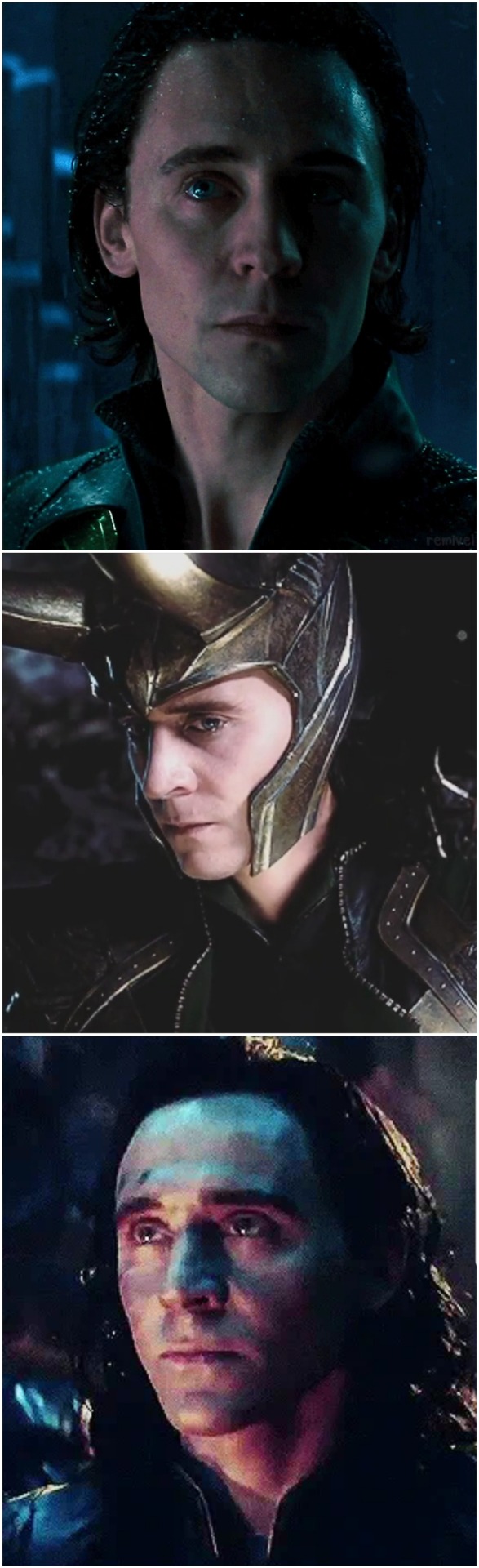
mentallydatingahotcelebrity:

just-another-millenial97:

I usually say very little when it comes to things like this, but come on, Hemsworth! This is so unprofessional. He literally calls it “meh”

I’m just so mindblown that he would do that. Like I can have respect for him not caring for it. Every actor probably has a piece of work that they regret, but to go out and trash it. Why is that necessary??

Hiddleston doesn’t trash Ragnorak despite having every reason to.

Hemsworth has to right to speak down about this film

He almost sounds like he has no idea what he’s talking about. I would take TDW over Ragnarok any day. In my personal opinion the worst movie is Ragnarok, because it’s essentially just him wandering around a set in a costume being him. At least before it felt like a movie instead of some weird skit that just felt fake and plastic and… bad. I honestly can’t believe that the cinematic industry is devolving this much to call Ragnarok good moviemaking and TDW bad moviemaking. 

I’ve seen bad movies. I actually just watched three of them on netflix today, and TDW in no way compares to them. This is just sad, the only reason he’s saying TDW is bad is because that’s what other people are saying, and the only reason he’s saying Ragnarok is good is because that’s what the majority is screaming. If it was the other way, his tune would be sounding way different.

He’s just really, really lucky people seem to now have no concept of what makes good movies and what makes bad movies.

I think the reason he’s saying TDW was bad is because he was “bored” of actually trying to act in dramatic roles instead of just dicking around in expensive costumes on expensive sets with expensive visual effects to distract from his non-acting.

And TDW may have been a classic archetype of masculinity, but I’ll definitely take that over the frat boy pseudo-humor we get from every Seth MacFarlane movie and “Thor: Ragnarok.” It was not progressive. It was not deflating the guy who’s trying to act cool, the way everyone who says it’s a distinctively Maori kind of humor claims it is – unless the “guy trying to act cool” is Loki, because it definitely put *him* in his place. Thor took a couple of pratfalls, but otherwise succeeded at everything he did, or if he didn’t it was always someone else’s fault. So Thor came out looking fine… unless we were actually *supposed* to perceive his behavior as deeply unpleasant, which I very much doubt. I thought the point of this (purported) Maori style of humor was to make your “cool” hero look foolish or incompetent, not like a narcissistic bully.

philosopherking1887:

eliannaeldari replied to your post “How can you come from a monotheistic family and have a deep…”

(1/7) Um, no, we never ever ever believed in the validity of multiple Gods as an aspect of our religion, though paganism was definitely a problem for us in biblical times. There are multiple stories of god breaking idols, etc, but that’s intended to demonstrate that they were just “ivory and wood, silver and marble”, “eyes that do not see, lips that do not speak, and ears that do not hear”. This whole thing is seriously misguided, I’m sorry. Taika seems to have followed

(2/7) A charachterization closer to that described in the eddas than in the comics, but that’s probably due to him just going ahead and reading the eddas. They aren’t all that hard to get a hold of. 

(3/7) I know very little about Islam, but while in Judaism god is described as jealous, it’s never “of other Gods”, it’s more like possessive. According to Judaism, there are no other Gods, and large factions of Judaism don’t believe in any non-god supernatural forces whatsoever. Christianity is mostly only considered monothiest by Christians, and while some Jewish sages say that it is, plenty say that it’s polythiesm, especially Catholicism and any involving the Trinity or

(4/7) Saints. We aren’t even allowed to pray in a church- aren’t even really supposed to go in them, though many people are lax about that. Mosques, on the other hand, we’re allowed to pray in- though are not supposed to take part in Muslim services. We have hymns and descriptions and poetry and legal writings from before Jesus was even a glimmer in his parents’ eyes about the oneness, unity, and lone existence of god. That doesn’t mean that Jews back then followed the

(5/7) Mitzvot/rules any more than they/,we do now, but that’s entirely different than claiming that *as a matter if religion* we acknowledged foreign Gods.

(6/7) We say, three times a day, (plus it’s supposed to be the last thing we say before we die) “hear Israel: the Lord is our God, the Lord is one”. 

(7/7) God absolutely doesn’t want us wasting our time and efforts worshipping God’s that don’t exist, instead of following his commandments. That’s made pretty damn clear. Now, to be honest, *I believe in a “clockmaker” god, and am no longer orthodox*. But I couldn’t let this lie, as it’s very misinformed and misleading. I assume that OP simply didn’t have as much information, and was writing in good faith, but that doesn’t mean that the analysis is based in fact. 

OK, first of all, @eliannaeldari – I am Jewish. Not religiously, anymore, but by heritage and upbringing. But I grew up Reform Jewish, in a family and a congregation that respected secular academic scholarship… and of course I’m in academia now, studying a period in history when secular Biblical scholarship and history was a relatively new thing that was (along with Darwin) contributing to Europe’s religious crisis.

My information – coming from the cantor at the synagogue where I grew up, as well as from interacting with scholars of Jewish history in religious studies departments – is that very early Judaism embraced monolatry, the worship of only one god, rather than monotheism, the belief in the existence of only one god. I was under the impression that that was the scholarly consensus. The Jewish Virtual Library concurs; the Wikipedia article on monolatry cites a number of scholars who defend this thesis; My Jewish Learning, a site for prospective converts, teaches the controversy (so to speak), but only cites two scholars who hold that Judaism was monotheistic from the beginning.

So no, I was not claiming that we ever “believed in the validity of multiple Gods as an aspect of our religion.” It is not clear whether by validity you meant “actual existence” or “worth and acceptable worship.” The concept of monolatry indicates that there is an important distinction. The idea is that while there are other gods, they are other people’s gods, not ours. It’s fine if those other people worship them; we are not allowed to.

Some poking around suggests that I was mistaken about the timing of the shift from monolatry to monotheism, so thanks for questioning me on that. The various sources I’ve come across all seem to put the date around the time of the Babylonian exile, so 6th century BCE (here’s another one that’s clearly written). Deuteronomy, in which the text of the Sh’ma is found, was mostly composed in the 7th century BCE, and partly during the exile. There’s some speculation that monotheism developed as a response by the educated elite to the cataclysm of exile, and some that Persian Zoroastrianism may have been a relevant influence.

It must have been a trend: Greek religion was also showing monotheistic drift by the time of Plato and Socrates (5th century BCE); many gods were still officially recognized, but Zeus was definitely expanding in importance and starting to take on those omni- characteristics that predominate in philosophical monotheism. I was aware that Greek philosophy influenced the early development of Christian theology, and I had thought that was where principled monotheism had come from; it looks like monotheism was an earlier development, and it was more philosophical theology – issues like the problem of evil, which may or may not have originated with Epicurus – that came from the Greeks. And that might have entered Judaism directly, without being mediated by Christianity.

I don’t want to get into the issue of whether Christianity is “really” monotheistic with the trinity and the saints and all that. Syncretism, appealing to local pagans, whatever. The moral landscape of Christianity is distinctively monotheistic: there is one source of goodness and power, and any conflicting forces are (a) evil and (b) ultimately subordinate. The pagan worldview recognizes multiple competing forces, and while different groups of people may have different divine allegiances, it’s not really a matter of “good” vs. “evil.” The Trojan War as related in the Iliad is a case in point: different gods took different sides, and the Trojans were still regarded as noble and heroic, even though the perspective was Greek. One thing Judaism has in common with various pagan religions (and some but not all forms of Zoroastrianism, apparently) but not with Christianity and Islam is the absence of proselytism. It is kind of unusual for a monotheistic religion to be tribal rather than universalistic… but I guess since Judaism doesn’t really have a concept of “salvation” it might not matter that much.

Addendum: I also don’t give a crap about whether Taika gave a more accurate representation of the Norse gods. That wasn’t, as I understood it, the goal of the MCU Thor movies. I doubt very much that he’s read the Eddas but the writers of “Thor 1” and “The Avengers” hadn’t. (Markus & McFeely are another story.) If that’s what he was aiming for, he did the wrong assignment. But I also doubt very much that he had any such aim in mind.

How can you come from a monotheistic family and have a deep understanding of polytheism?

philosopherking1887:

For background, this is in reference to (my bitching about) the post claiming that Taika Waititi has a better understanding of the gods of Norse mythology than Bad White Christian Joss Whedon, first (presumably) because he’s Maori and therefore closer to paganism (never mind that a significant proportion of the Maori population has been Christian since the 19th century), and then, according to a later commenter, because he’s Jewish (on his mother’s side) and therefore has a more down-to-earth conception of God.

This is not completely crazy, because while Judaism only recognizes one god, it has not always been strictly monotheistic in the sense in which Christianity and Islam are. According to ancient Jewish religion, the gods of other tribes/nations do exist, but we only worship one god, and there’s only one god worth worshiping, because he’s cooler than all the other gods (he created the world, so there) and can kick their asses any day. (There’s actually a story about that in First Samuel, when the Ark gets stolen and put in a Philistine temple and God comes out at night and breaks the idol of their god.) That’s why the Hebrew Bible says all that stuff about God being “a jealous god”; that wouldn’t make a whole lot of sense if God just didn’t want us wasting our time praying to gods that don’t exist. God has a personality, and it’s not always perfect; he’s jealous, he’s vengeful, he gets angry easily.

Since then, Judaism has become more properly monotheistic under the influence of Christianity in Europe and Islam under the medieval Caliphate (Maimonides, one of the most important Jewish theologians, lived in Caliphate-ruled Spain and wrote in Arabic. Sometimes empires can be cool). The God of Judaism has gotten closer to the omnipotent, omniscient, unfailingly benevolent God of philosophical monotheism, which runs you into the problem of evil… and that has definitely been a problem in Jewish history, especially recently. The main respect in which Judaism differs from Christianity (I don’t know about Islam) is that it doesn’t emphasize how sinful and unworthy human beings are compared to God. Sure, there’s some of that “what are we that You should take notice of us?” stuff in the psalms… but the fact remains that God has not only taken notice of us, but made an agreement with us on more or less equal terms; that’s what the covenant is. Paul claimed that the whole point of the covenant was to demonstrate that human beings are incapable of living up to God’s standards of goodness on their own, which is why they needed God to step in and save them (from Himself, apparently). Jews don’t buy that. Yes, it’s hard to do what God demands of us. Try anyway. When you mess up, apologize to God and to the people you’ve wronged, then try again.

I’m honestly not sure what any of that has to do with Taika Waititi’s and Joss Whedon’s portrayal of Thor and Loki, except that maybe someone raised Jewish is used to the idea of a god being an asshole and going overboard on punishing people (*cough*electrocution*cough*), which God definitely does in the Books of Moses. But rabbinic Judaism is as likely to try to justify that as Christianity is. And also I just don’t think it’s true that Whedon was trying to portray Thor as a perfect Christ figure and Loki as a completely evil Satan. European Christian culture has evolved; we have Milton’s Satan, we have Goethe’s Mephistopheles, we have flawed and human versions of Jesus. Whedon is well-read and educated; he refers to existentialist philosophy and the canon of great Western literature – including pre-Christian classical literature – in his work. If all people are seeing is a simplistic black and white Jesus vs. Satan, that’s their problem, not his.

I spent way too long writing this little essay, so I’m reblogging it in hopes that someone will actually see it.

How can you come from a monotheistic family and have a deep understanding of polytheism?

For background, this is in reference to (my bitching about) the post claiming that Taika Waititi has a better understanding of the gods of Norse mythology than Bad White Christian Joss Whedon, first (presumably) because he’s Maori and therefore closer to paganism (never mind that a significant proportion of the Maori population has been Christian since the 19th century), and then, according to a later commenter, because he’s Jewish (on his mother’s side) and therefore has a more down-to-earth conception of God.

This is not completely crazy, because while Judaism only recognizes one god, it has not always been strictly monotheistic in the sense in which Christianity and Islam are. According to ancient Jewish religion, the gods of other tribes/nations do exist, but we only worship one god, and there’s only one god worth worshiping, because he’s cooler than all the other gods (he created the world, so there) and can kick their asses any day. (There’s actually a story about that in First Samuel, when the Ark gets stolen and put in a Philistine temple and God comes out at night and breaks the idol of their god.) That’s why the Hebrew Bible says all that stuff about God being “a jealous god”; that wouldn’t make a whole lot of sense if God just didn’t want us wasting our time praying to gods that don’t exist. God has a personality, and it’s not always perfect; he’s jealous, he’s vengeful, he gets angry easily.

Since then, Judaism has become more properly monotheistic under the influence of Christianity in Europe and Islam under the medieval Caliphate (Maimonides, one of the most important Jewish theologians, lived in Caliphate-ruled Spain and wrote in Arabic. Sometimes empires can be cool). The God of Judaism has gotten closer to the omnipotent, omniscient, unfailingly benevolent God of philosophical monotheism, which runs you into the problem of evil… and that has definitely been a problem in Jewish history, especially recently. The main respect in which Judaism differs from Christianity (I don’t know about Islam) is that it doesn’t emphasize how sinful and unworthy human beings are compared to God. Sure, there’s some of that “what are we that You should take notice of us?” stuff in the psalms… but the fact remains that God has not only taken notice of us, but made an agreement with us on more or less equal terms; that’s what the covenant is. Paul claimed that the whole point of the covenant was to demonstrate that human beings are incapable of living up to God’s standards of goodness on their own, which is why they needed God to step in and save them (from Himself, apparently). Jews don’t buy that. Yes, it’s hard to do what God demands of us. Try anyway. When you mess up, apologize to God and to the people you’ve wronged, then try again.

I’m honestly not sure what any of that has to do with Taika Waititi’s and Joss Whedon’s portrayal of Thor and Loki, except that maybe someone raised Jewish is used to the idea of a god being an asshole and going overboard on punishing people (*cough*electrocution*cough*), which God definitely does in the Books of Moses. But rabbinic Judaism is as likely to try to justify that as Christianity is. And also I just don’t think it’s true that Whedon was trying to portray Thor as a perfect Christ figure and Loki as a completely evil Satan. European Christian culture has evolved; we have Milton’s Satan, we have Goethe’s Mephistopheles, we have flawed and human versions of Jesus. Whedon is well-read and educated; he refers to existentialist philosophy and the canon of great Western literature – including pre-Christian classical literature – in his work. If all people are seeing is a simplistic black and white Jesus vs. Satan, that’s their problem, not his.

stmonkeys:

philosopherking1887:

stmonkeys:

philosopherking1887:

Anyone I see reblog that bullshit post about how Taika Waititi characterized Thor and Loki so much better than Joss Whedon because Taika has a Deep Pagan Understanding of Norse mythology while Joss is beholden to Bad Western Christianity and therefore thinks God is a fascist… you will be unfollowed. You are all hereby on notice.

(I just went looking through the notes to see if I could find my own comment, which I might reblog just to try to stem the idiocy, and saw another hot take, this one about how Taika’s compassionate understanding of gods reflects his Jewish heritage, and I am just… no. I’m about as proud to claim Adam Sandler as a landsman. At least he wrote the Chanukah song. Several of them.)

@philosopherking1887 taika’s jewish? I haven’t heard anything about that. There’s a plethora of jewish representation in the MCU, but I thought taika was part Australian Aboriginal. I have no great love for taika’s version of the odinson saga, but there were a few redeeming moments. I was really disappointed by the Russo brothers, because I held them in a much higher esteem. We watched IW again last night, and after my 3rd viewing I still find the firsr 10 minutes excruciating to watch.

He’s half Maori (New Zealand’s indigenous people), half Jewish.

I can’t decide whether I’m more pissed at him or at Markus & McFeely (who wrote IW) and the Russos. Well, Waititi shares my ire with Hemsworth, who brought him on and instigated the radical recharacterization, and Feige, who gave it the go-ahead.

As a fellow member of the tribe, I can’t exactly write him off, I’m proud of the Jewish representation in the mcu. I absolutely don’t agree with all the choices TW made in ragnarok, but there were some great moments. Do they outweigh the serious character assasinations that occurred? I don’t know, perhaps that blame rests with Kevin feige and the other powers that be.

I can hardly even appreciate the great visual moments because the assassination of the main characters was so egregious and insulting to fans of the previous movies. The way Thor, the supposed hero, behaves toward his supposed friends and the way Loki’s pretty clear signs of mental illness in prior canon are callously written off says nothing good to me about the ethical character of the creators. (And yes, it was more Waititi and Hemsworth riffing than the screenwriter’s screenplay.)

Here’s my obligatory mention of his hiring of Australian aboriginal workers. That was good. Doesn’t mean I like him personally.

stmonkeys:

philosopherking1887:

Anyone I see reblog that bullshit post about how Taika Waititi characterized Thor and Loki so much better than Joss Whedon because Taika has a Deep Pagan Understanding of Norse mythology while Joss is beholden to Bad Western Christianity and therefore thinks God is a fascist… you will be unfollowed. You are all hereby on notice.

(I just went looking through the notes to see if I could find my own comment, which I might reblog just to try to stem the idiocy, and saw another hot take, this one about how Taika’s compassionate understanding of gods reflects his Jewish heritage, and I am just… no. I’m about as proud to claim Adam Sandler as a landsman. At least he wrote the Chanukah song. Several of them.)

@philosopherking1887 taika’s jewish? I haven’t heard anything about that. There’s a plethora of jewish representation in the MCU, but I thought taika was part Australian Aboriginal. I have no great love for taika’s version of the odinson saga, but there were a few redeeming moments. I was really disappointed by the Russo brothers, because I held them in a much higher esteem. We watched IW again last night, and after my 3rd viewing I still find the firsr 10 minutes excruciating to watch.

He’s half Maori (New Zealand’s indigenous people), half Jewish.

I can’t decide whether I’m more pissed at him or at Markus & McFeely (who wrote IW) and the Russos. Well, Waititi shares my ire with Hemsworth, who brought him on and instigated the radical recharacterization, and Feige, who gave it the go-ahead.

Anyone I see reblog that bullshit post about how Taika Waititi characterized Thor and Loki so much better than Joss Whedon because Taika has a Deep Pagan Understanding of Norse mythology while Joss is beholden to Bad Western Christianity and therefore thinks God is a fascist… you will be unfollowed. You are all hereby on notice.

(I just went looking through the notes to see if I could find my own comment, which I might reblog just to try to stem the idiocy, and saw another hot take, this one about how Taika’s compassionate understanding of gods reflects his Jewish heritage, and I am just… no. I’m about as proud to claim Adam Sandler as a landsman. At least he wrote the Chanukah song. Several of them.)

juliabohemian:

philosopherking1887:

philosopherking1887:

Ugh, I really don’t like it when people reblog stuff about Loki’s death scene in Infinity War as if it’s touching or redemptive. It was just stupid. He would have done Thor a lot more good if he’d actually tried to be a mole in Thanos’s campaign and pull another long con. As far as he knew, Thanos was just going to kill Thor as soon as he’d killed Loki; he did, in fact, leave Thor to die, and Thor was just lucky the Guardians happened to be close by. If Loki had actually tried to make a go of the double-cross, Thanos might have kept Thor alive to use as leverage over Loki. Which would not have been fun for either of them, but at least Loki would have known that he was safe-ish, and it would have bought both of them time to figure out a way to get the better of Thanos.

I’m never going to write that better version of Infinity War, because I don’t really know how to write comic book movies and also I don’t have time. But in my head there’s a vague version of what it would have been like if Joss Whedon had been writing it, including Loki pretending to be on Thanos’s side for most of the movie(s) and setting up some truly ingenious way to betray him at the end. And maybe he would then die heroically or maybe he would actually survive to start over with Thor, I don’t know. But his arc would have been worthy of the character as Hiddleston, Miller & Stentz, Branagh, and Whedon had established him.

Oh, and we would have found out WHAT FUCKING HAPPENED with Loki and Thanos in between “Thor 1” and “The Avengers.”

I think that some people are choosing to interpret aspects of that scene as touching or redemptive because it makes them feel better. Because the alternative is embracing that it was utterly pointless and that Loki’s death was just torture porn, a plot device to hype Thanos as a villain and to fuel Thor’s manpain. And that is a bitter pill to swallow.

What I mostly can’t handle are posts that say shit like:

Aww…isn’t it sweet how Odin forgave Loki in Ragnarok. No. Because that’s not what actually happened at all. And Loki’s list of grievances against Odin are far greater than anything Odin might hold against him. One might be able to argue that Odin voluntarily stayed in exile because he realized what a piece of shit he was and felt guilty about it. Perhaps Odin learned what happened to Loki when he fell from the Bifrost and felt bad for imprisoning him. But since nothing was explicitly stated, we can’t know that for sure.

Aww…isn’t is touching how Thor forgave Loki at the end of Ragnarok. No. Because that’s not what happened. Loki realized that in order to make things work with Thor, he would have to set aside his long list of valid grievances and accept that Thor was simply never going to understand his suffering. Thor was never going to understand him. And Loki finally embraced that his quest to be regarded Thor’s equal was a futile one. This isn’t to say Thor is a bad person either. Just that he doesn’t have the capacity to accept or understand what Loki has experienced or to give him what he needs. As I have stated in previous meta, Thor is a product of a flawed society and flawed parenting, just as Loki is.

Aww…isn’t it sweet how Heimdall accepted Loki at the end of Ragnarok. Well no. Because that’s not what really happened either. Heimdall is no saint in all of this, although I suspect he’s a good deal more responsible than most of the people who surround him. He is aware of a lot more than anyone else too. Meaning he has no plausible deniability. He should have been aware of at least SOME degree of Loki’s interaction with Thanos, even if he didn’t see any of the possible torture or abuse. He was also probably aware that Odin chose to stay on Earth, instead of reclaiming the throne, and of all the positive things that Loki did while posing as Odin (such as separating infinity stones and sending them far away) which is why he does not attempt to arrest Loki for his deception.

Aww…isn’t it cute how Loki accepted who he was in IW? No, it’s not cute. Yes, I do believe that Loki said Odinson and looked at Thor as a way of saying “we are brothers, regardless of all the other bullshit”. It may have been his way of saying goodbye. But a lot of his dialogue during this scene comes from a place of deep dysfunction. Thor’s last words to Loki are words of disapproval. Which is appropriate, since the bulk of their exchanged dialogue is basically Thor either judging or disapproving of Loki in some capacity. Loki accepting that he is Jotun is good, in a way. But it still does not address the racism that prevented him from doing so sooner. Loki stating that he is the god of mischief is actually rather confusing. Because the word mischief implies a lack of purpose. It implies just doing random shit for laughs. And that is actually the opposite of the Loki we saw prior to Ragnarok.

People interpret things in a way that comforts them. A lack of continuity is frustrating. So they will knit things together in a way that makes them feel consistent, even if they are most certainly not.

I mean, Thor was also a victim of unbelievably shitty writing – or should I say “writing”? since so much was improvised or just dictated on the spot by TW – in Ragnarok.

The terrible interpretation of Loki’s character in Thor: Ragnarok

yume-no-fantasy:

Things that Thor: Ragnarok director Taika Waititi said of Loki:

  • “Not to really wanna humiliate Loki all the way through the film, but because he was most definitely over-powered for a lot in the other films in terms of presence and his story, and kind of overshadowed (…) a little bit… This one, it was just nice to kind of switch it around, after all the shitty things that Loki’s done in the last few films…” (Source: Empire Film Podcast)
  • “space orphan”
  • “someone who tries so hard to embody this idea of the tortured artist, this tortured, gothy orphan”
  • “…this little emo goth hanging out by himself. He was like the kid in Harry Potter [Malfoy].”
  • has been trying to kill Thor his entire life
image
image
image
image

A number of significant ways in which Loki’s character was retconned in Ragnarok:

1.

Tom: Loki’s death on Svartalfheim was written as a death, and Chris and I played that scene for real. That was meant to be sort of that he redeemed himself. He helped save his brother and helped save Jane Foster, but he, in the process, sacrificed himself.

Ragnarok!Thor: You FAKED your own death

2.

TDW!Thor: Loki, for all his grave imbalance, understood rule as I know I never will.

Ragnarok!Thor: And what do I find, but the Nine Realms completely in chaos. Enemies of Asgard assembling, plotting our demise, all while you, Odin, the protector of those Nine Realms, are sitting here in your bathrobe, eating grapes.

3.

Tom: The best thing about Loki is that if he is afraid he won’t show it. He’s been highly trained through the experience of his slightly traumatic life to shield his fear. 

Loki in all other films:

image

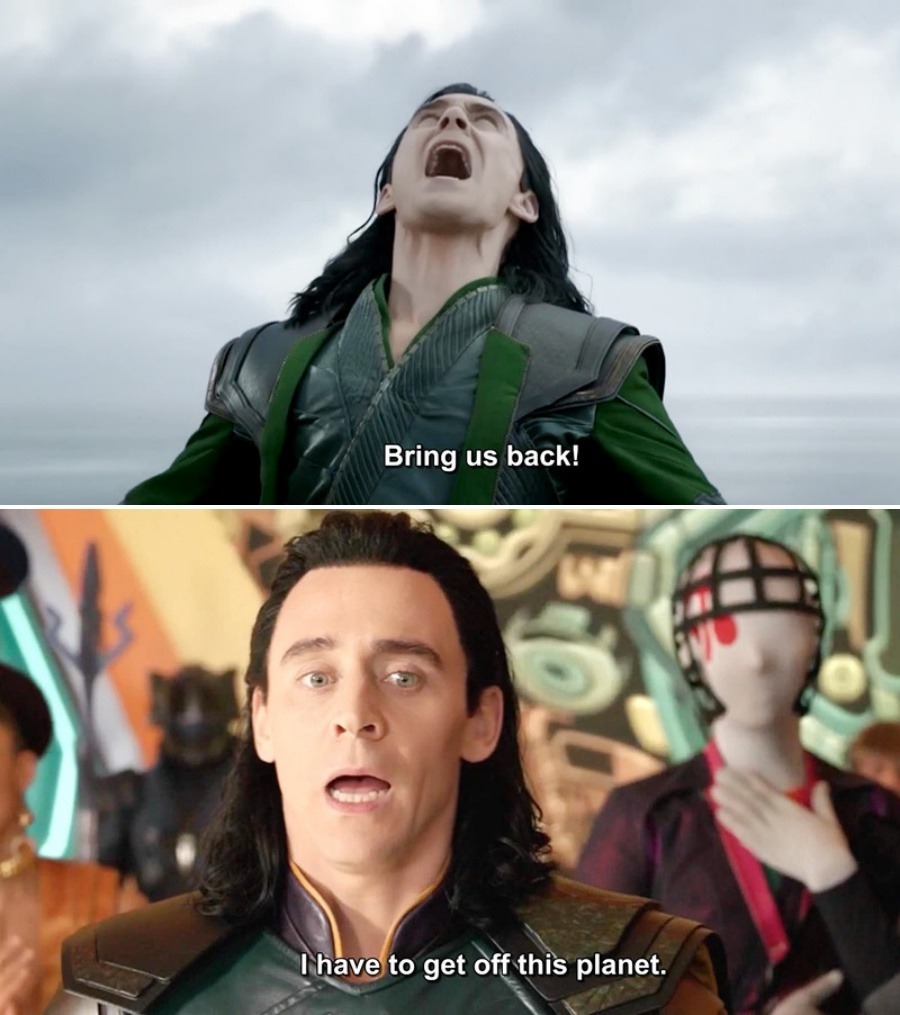
Gagnarok!Loki:

image

Bonus:

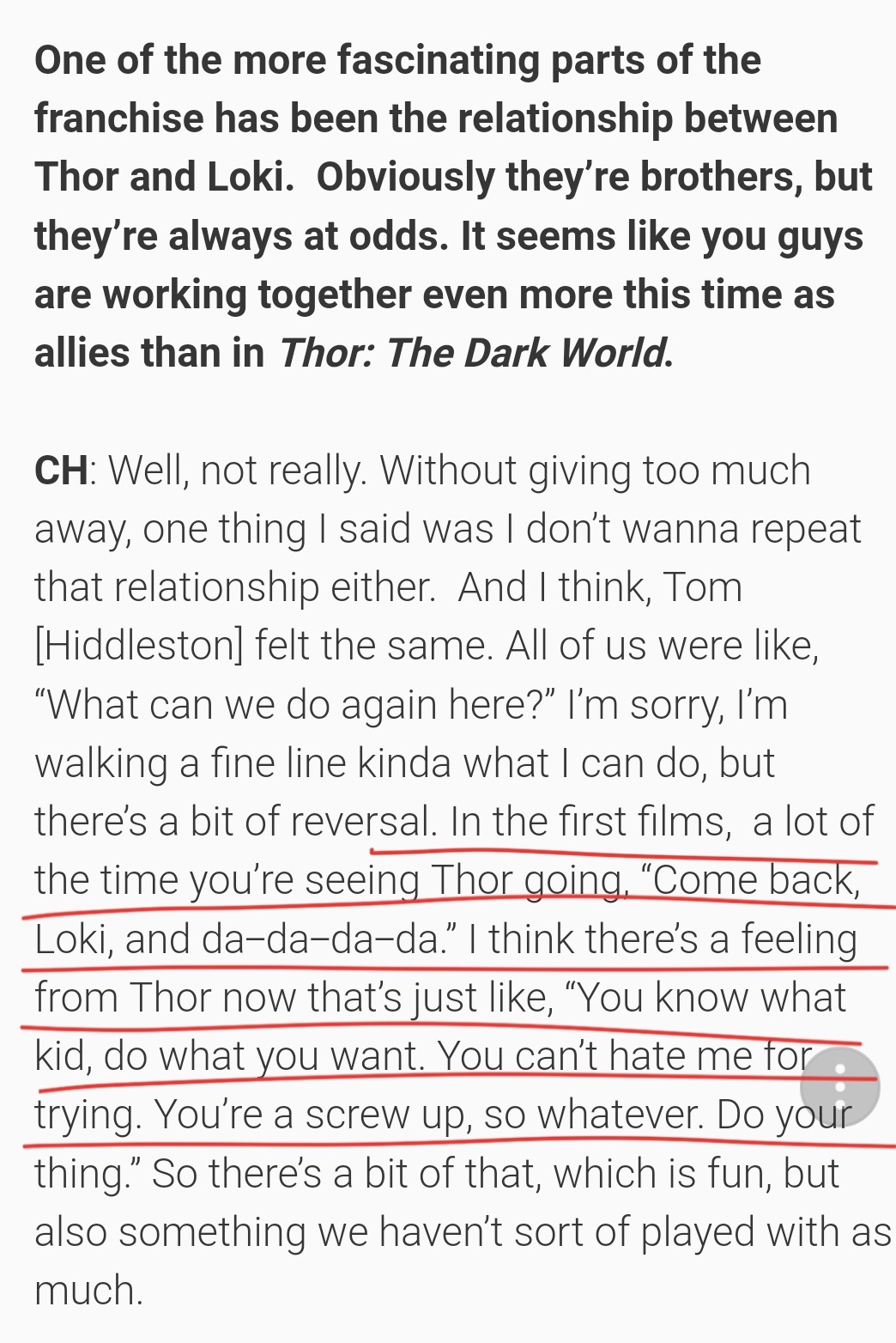
image

“You’re a screw up, so whatever.”

For the people out there who still don’t believe that Taika Waititi *and Chris Hemsworth* have been overtly contemptuous of Loki.

NB: this is not a spewing of venom, it is a presentation of evidence. (I don’t endorse the “Gagnarok” label, on grounds of taste rather than substance.)

iamanartichoke:

Friendly reminder that Loki never showed any general ill-will toward Asgard or intent to destroy Asgard and that usurping Odin at the end of TDW didn’t necessarily have to bode ill for Asgard’s fate, as we had no reason to believe he would rule poorly. That Ragnarok revealed his “evil plan” being community theatre shouldn’t be much of a surprise – by which, I mean I didn’t expect the community theatre part, but I didn’t expect to see Asgard in tyrannical ruins under Loki’s rule, either. Loki has always proven himself sensible, analytical, and highly intelligent. He would have absolutely nothing to gain by using Odin’s form to run Asgard into the ground. Despite what Thor says about the Nine Realms being in chaos, I’m pretty sure things were fine and were always going to be fine under Loki. 

#loki#loki as odin#the dark world#thor ragnarok#sorry but i just get tired of seeing posts about#how everyone was worried after Loki was revealed as Odin#at the end of tdw#like it meant asgard was doomed#why would anyone think that?#ragnarok didn’t do us some huge favor#of painting loki as a benevolent ruler#to everyone’s surprise#it did however#make him look very narcissistic with that play#which i’ve always been uncomfortable with#but i just pretend it doesn’t exist#and i manage okay

And the other thing is… that line about the Nine Realms being in chaos – which has encouraged everyone to trash Loki as a terrible king and paint his usurping Odin as another horrific crime for which he deserved any maltreatment Thor subsequently decided to inflict on him – is an example of just how half-assed Ragnarok’s “critique of imperialism” really is (as @foundlingmother and I have discussed at length). So conquest is bad, but non-interventionism is equally bad? Sudden withdrawal from protectorates that have been left in no condition to protect or govern themselves is certainly not great, but it’s a complicated issue exactly what kind of aid or training withdrawing conquerors should provide. (Is it “weaning” away from dependency, or just extending the period of dependency? Doesn’t “teaching” self-governance involve a kind of cultural imperialism, as the conqueror generally ends up teaching the ex-protectorate how to imitate its own system of government?) It’s understandable that a comic book action movie isn’t going to explore those kinds of issues in depth (and boy, did Civil War massively fail on that score – though Black Panther did a pretty good job wrestling with it), but… if you’re going to bring it up in the form of a ham-handed allegory, you can’t also have this glaring (at least apparent) inconsistency and not address it.

This appears to be another example of the film dropping the ball on its otherwise worthy anti-imperialism message when it comes to Loki – probably deliberately, considering the lack of sympathy and respect the film and its creator show for Loki in just about every other context. As I’ve also discussed at length, Ragnarok missed, or simply passed on, an obvious opportunity to address Loki’s place in Asgard’s imperialist history, as the child of a conquered people raised in ignorance of his heritage and with such contempt and hatred toward his own kind that when he discovered he was one of them he tried to wipe them out. I’m going to excerpt the most relevant part of that old post:

  • Loki’s story could have been used to flesh out the narrative about colonialism. Recall Hela’s dismissive remark about bogus “peace treaties” commemorated on the redecorated walls of the throne room: that might have been an allusion to the one-sided “treaties” that Britain and the U.S. signed with American Indian nations and then trampled all over. Loki could have been one of those stolen indigenous children raised among the colonists and taught to scorn the people to whom he was born. But for some reason Waititi and the writers didn’t make the connection, or didn’t want to tie Loki in to that aspect of the story. … maybe it was just because Loki has been a villain and they didn’t want to draw a connection between a (part-time) villain – or anyway, a character they just don’t like – and the oppressed of colonialism (though making him queer is OK, I guess). For whatever reason, they wanted to keep Loki firmly coded as White (which makes him easier to ridicule!) and gloss over the part where he’s only white-passing (literally; he’s actually blue). 

And I’m not the only one; @endiness put it nicely:

  • the movie features asgard’s ‘past’ history of imperialism and colonization as a major plot point… but then it excludes loki from the narrative when he easily has a place in it. like, how could he not when he’s the adopted (kidnapped) son of the leader of an enemy nation left in ruin after losing to asgard? and when odin literally admitted that he took loki for political purposes? but, again, nothing about any of this at all. (actually, even worse than loki and his heritage and the circumstances being entirely excluded from the story, it isn’t; it’s brought up but only in the context of humor explicitly at loki’s expense to make a mockery of the emotional complexity and depth of his character in the previous movies.)

So the upshot seems to be: hammer in your anti-imperialist message except when Loki might appear to be on the oppressed rather than oppressor’s end of the equation, when the issue threatens to give him more depth and complexity and make him remotely sympathetic. Condemn Hela and Odin (but only sometimes; Thor can still appeal to him for strength at the end) for being imperialists, but condemn Loki for failing to be imperialist enough.