it is seldom when I audibly react to art, but I can say a “holy shit” escaped me. how do you art things. i’ll go sit in a corner. chew on my pencils since it’s all they’re good for now.
Waiting to see this again so I could reblog! So gorgeous.
I was doing some giffing and basically re-watched Thor for the purpose (like it was a sacrifice, haha), and I just realised something that gives me new heartache.
Look at this gif:
When Thor broke the Bifrost, he and Loki went flying into the air and would have both fallen into the Void if Odin hadn’t caught them. Thor had no idea – he just couldn’t know – that Odin was going to grab Thor’s leg and save both brothers from dying/becoming lost in the space-time continuum. Still, Thor grabbed Gungnir, for which Loki was trying to reach in some desperate attempt to save his life. Thor still wanted to save Loki, after everything that had happened, and Thor didn’t have much hope, but he saw Loki falling underneath him, trying to get a hold of anything, and they both went for the staff, Loki to save himself, Thor to save Loki, even when he had no way of knowing it was even going to work. But fuck, this hurts the man. Thor tried to be there for his little brother when everything was literally and figuratively falling apart around them, and by the Norns, they might both die, but they’ll die holding that staff together and Thor will die trying to save Loki.
Fun fact: That is made with real indigo grown on a farm.
The heat index real indigo can take is up to 1500 degrees Fahrenheit, which is why it was used for centuries.
Another fun fact: Japanese firefighters were hardcore and very proud of their job and abilities. If anyone is interested, I can dig out some amazing images.
Okay guys, so here it is: History lesson about the firemen in Edo, Japan. (Because I need to impart some knowledge before I get to the fun part.)
Edo (now Tokyo) in the 17th century had some massive problems. The city had only become the official capital in 1603. Before the 16th century, it had been an inconsequental fishing town. After becoming the capital, the city boomed and population more or less exploded.
The numbers I could find are the following:
1640: 400′000 residents
1693: 800′000 residents
1721: 1′100′000 residents
All in all, Edo became a massive, sprawling city in a very short amount of time. All kinds of people came to Edo, from poor women that were literally sold into prostiution by their parents to the leaders of the country.
The rapid population growth wasn’t the only problem the city faced, however. Some other factors include:
Building material: Most houses were built almost entirely out of wood, which, surprise, burns easily.
Building structures: Houses were often built in rows, with narrow streets in between, perfect for the quick spread of fire
Weather: Constant strong winds, especially in the winter and in spring, helped along with that, too
Arson: Yes, people literally set fires in the hope that they would manage to loot something valuable in the process. These people were often from the lower strata of society, showing that not all was well in Edo. (In short: being poor sucks massively.) Sometime merchants just wanted to destroy their rival’s business, though. Burn that fucker to the ground, or something like that.
Due to these factors, the city experienced 49 large fires between 1601 and 1867, and over a thousand smaller fires. Which means there were approximately 7 smaller fires a year, as well as one massive fire every five years… not great odds if you just wanna do your thing in the big city. The largest fire in 1657 killed around 100′000 people, which was, if you look at the numbers up there, probably around a quarter of the population.
While the shogun quickly commanded the creation of a firefighting force to prevent the burning of his buildings, he was less concerned about the rest of the city. It took until the 18th century (I think somewhere in the 1720s) until he finally ordered the creation of a city-wide firefighting force that protected people from fires and put them out.
In short, because of the frequency of the fires, this was a massively important job.
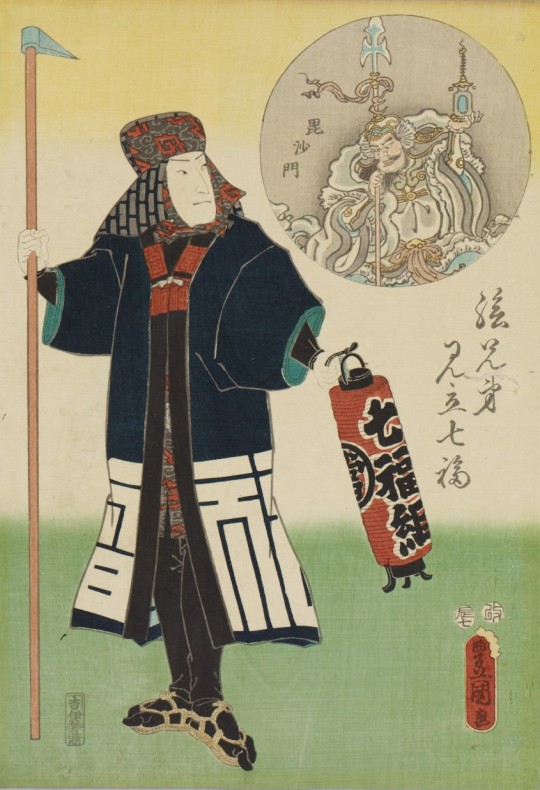
(Above: Fireman in gear. Take note of the fire hook. These hooks were standard gear for any firefighter, and usually used to destroy buildings to prevent the spread of a fire.)
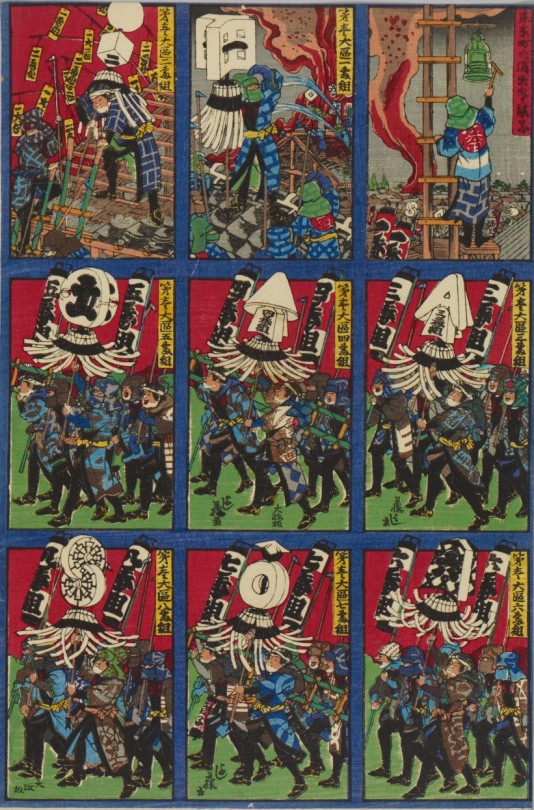
(Above: Firemen at work. The lanterns and the matoi they are carrying are symbols to identify the “department”.)
And I don’t know, but it seems like an universal rule that important people like to show off, or maybe it’s just a side-effect of running into rapidly-spreading fires, but at some point, they started the tradition of “ladder climbing.” It’s now part of a yearly ceremony that takes place just after new years, but the exact origin of this tradition is unclear.
(Above: We have no time for your foolish safety measures. Get on our level. Hahahaha.)
Anyway, what they do every year in this ceremony is this:
One or more dudes climb a straight ladder that’s only secured with the fire hooks of their colleagues on the ground (you can see them do that in the image), and on top of that ladder they perform various acrobatic feats to show off their awesome firefighting skills (not really). Now if you say this is obviously a print and does not depict reality at all, let me direct you towards some newer technology:
(Above: AAAAH.)
And the tradition lives on until today:
(Above: You can also clearly see this goddamn ladder is not secured at all, other than with the fire hooks. You can only hope none of your colleagues are planning to murder you.)
And if you want to see the entire thing in movement:
In this video, you can see some very nice close-ups of the ladder and the way it’s being secured by the fire hooks. The best stunts come towards the end. Here you can see three dudes on the ladder, and here’s a video of a woman doing the stunts.
Honestly, I could go on enternally, but there you go. The badass firefighters of ye olde Japan.
His hand is around his once-brother’s throat, fingers slowly tightening enough to perceive the flutter of a pulse beneath Loki’s skin.
“What are you waiting for, brother?” there’s a hint of a tease in Loki’s voice, and his green eyes shimmer with unspoken words that Thor can’t even begin to fathom. “Do it.”
Thor’s fingers tighten a fraction more and he clenches his jaw, battling within himself so as not to rise to the bait Loki has placed oh so clearly in front of him. It’s always difficult with the trickster, because Loki knows him so intimately. He knows exactly where to push and nudge in order to provoke a reaction.
Loki is dangerous, he has told himself that since aligning with the Avengers of Midgard. He is dangerous and he needs to be subdued.
But Loki is his brother. Ties of blood matter not when they have grown and fought side by side since infancy. Theirs is a bond deeper than blood.
The hand curled over his forearm flares blue and Thor hisses in response to the mild chill against his skin. Though he is indeed of the Jotun, Loki is not quite powerful enough to harm him this way. He could slay a mortal easily, but an immortal god has innate defenses against this side of Loki’s true nature.
Thor sighs, parting his lips as Loki slips a cerulean-tinged thumb past them in order to stroke his tongue, coating it with a thin layer of ice which melts instantaneously.
“Oh, Thor,” he whispers, and there is something unaccountably old in his voice now. “Sometimes I wonder if I should fear for your safety when I’m not around.”
“You are not a monster,” Thor bites back defiantly, already fully aware that Loki never truly believes him, no matter how sincere he is.
“But I am,” Loki murmurs in reply, leaning in to place a chaste kiss on the Thunderer’s mouth. “I am more dangerous than all of these insects your mortal friends face in battle put together. You know this.”
Unable to compete with his not-brother’s tongue when Loki is in a mood, Thor settles for silencing the trickster with another kiss, this one far less chaste. And when Loki chuckles against his lips, Thor considers it a victory.
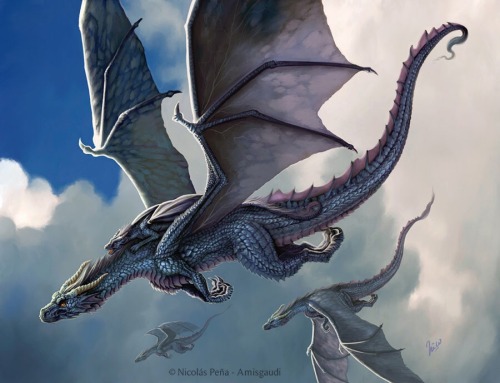
The eyes-in-the-front thing (usually) only applies to mammals. Crocodiles, arguably the inspiration for dragons, have eyes that look to the sides despite being a predator.
hey what up I’m about to be That Asshole
This isn’t a mammalian thing. When people talk about ‘eyes on the front’ or ‘eyes on the side,’ they’re really talking about binocular vision vs monocular vision. Binocular vision is more advantageous for predators because it’s what gives you depth perception; i.e, the distance you need to leap, lunge, or swipe to take out the fast-moving thing in front of you. Any animal that can position its eyes in a way that it has overlapping fields of vision has binocular vision. That includes a lot of predatory reptiles, including komodo dragons, monitor lizards, and chameleons.
(The eyes-in-front = predator / eyes-on-sides = prey thing holds true far more regularly for birds than it does for mammals. Consider owls, hawks, and falcons vs parrots, sparrows, and doves.)
But it’s not like binocular vision is inherently “better” than monocular vision. It’s a trade-off: you get better at leap-strike-kill, but your field of vision is commensurately restricted, meaning you see less stuff. Sometimes, the evolutionary benefit of binocular vision just doesn’t outweigh the benefit of seeing the other guy coming. Very few forms of aquatic life have binocular vision unless they have eye stalks, predator or not, because if you live underwater, the threat could be coming from literally any direction, so you want as wide a field of view as you can get. If you see a predator working monocular vision, it’s a pretty safe assumption that there is something else out there dangerous enough that their survival is aided more by knowing where it is than reliably getting food inside their mouths.
For example, if you are a crocodile, there is a decent chance that a hippo will cruise up your shit and bite you in half. I’d say that makes monocular vision worthwhile.
Which brings us back to OP’s point. Why would dragon evolution favor field of view over depth perception?
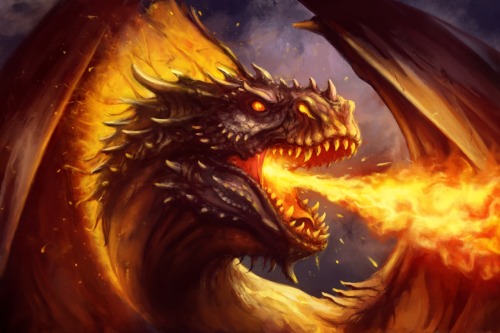
A lot of the stories I’ve read painted the biggest threats to dragons (until knights with little shiny sticks came along) as other dragons. Dragons fight each other, dragons have wars. And like fish, a dragon would need to worry about another dragon coming in from any angle. That’s a major point in favor of monocular vision. Moreover, you don’t need depth perception in order to hunt if you can breathe fucking fire. A flamethrower is not a precision weapon. If you can torch everything in front of you, who cares if your prey is 5 feet away or 20? Burn it all and sift among the rubble for meat once everything stops moving.
Really, why would dragons have eyes on the front of their heads? Seems like they’ve got the right idea to me.




 Loki is the Philosopher King