
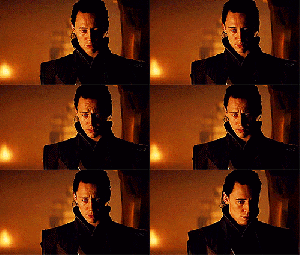
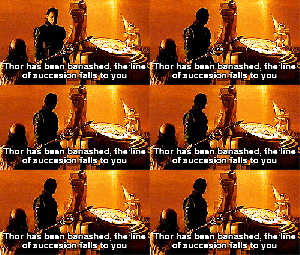
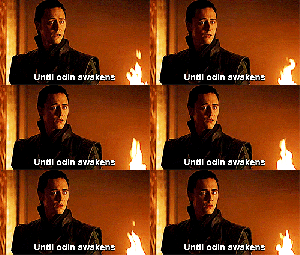
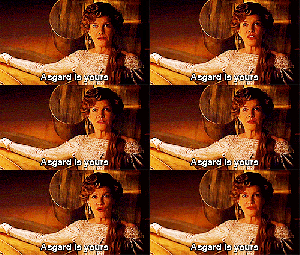
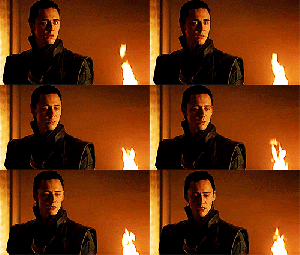
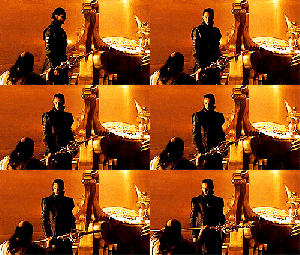
I love this scene too. It’s such a shame it was cut from the final film. I wish Marvel did extended edition dvds. When I saw it, it put Loki’s comment about having been king in a different light. And it also gives the following scene with the Warriors Three a different tone, more nuanced, less outright lying villan.
This is relevant to a recent discussion about that scene in the throne room with Sif and the Warriors Three. I think we’re supposed to think that they mistrust and dislike him more than his previous actions actually warrant; they turn out to be correct that he is up to no good, but they have no way of knowing that or the actual reason for it (i.e., the shattering revelation of his identity). We’re also supposed to think they have some reason for mistrusting him (“Loki’s always been one for mischief”), but not as much as they do: they seem to think that he’s usurped the throne (and maybe deliberately harmed Odin?!), but we know that the inheritance was completely legitimate and Frigga-approved.
From the deleted Thor & Loki scene where Thor says “Some do battle, others just do tricks,” the servant laughs, and Loki scares him by turning wine into snakes, I got the impression that Asgardians are simultaneously disdainful and suspicious of sorcery, especially when used by men and/or on the battlefield. That’s perfectly in keeping with the actual attitude toward the practice of seidr in ancient Norse culture: men who practice it were tarred with ergi, “unmanliness” (the major implication being that they bottom during sex with men). You see a similar attitude toward a man’s use of anything considered a “woman’s weapon,” such as poison: it’s considered cowardly, underhanded, dishonorable; but it’s also especially frightening because it’s hard to see coming and defend against. Asgardians expect Loki to be sneaky, not least because he’s a sorcerer. This may be a stretch, but it seemed to me that Hogun’s accusation drew attention to this connection: “A master of magic could bring three Jotuns into Asgard.” On the surface, he’s just saying that Loki had the capability to do it; but more implicitly he’s also suggesting that Loki is the type of person who would do it.
I suspect there’s something distinctively Shakespearean going on here: the villain who becomes a villain in part because everyone expects him to be one. One notable example is Richard III, who implies that he chose to become a monster in part because his deformity makes people see him as a monster already: “Deformed, unfinish’d, sent before my time / Into this breathing world, scarce half made up, / And that so lamely and unfashionable / That dogs bark at me as I halt by them… And therefore, since I cannot prove a lover, / To entertain these fair well-spoken days, / I am determined to prove a villain…” Another example is Shylock, who pursues the forfeit of a pound of flesh because Antonio has consistently spat on him and insulted him and his people. He puts the point elegantly: “Thou call’dst me dog before thou hadst a cause; / But, since I am a dog, beware my fangs!” I think both of these examples are instructive in Loki’s case. Loki accuses Odin of wanting to “protect him from the truth” of his origin “because I am the monster parents tell their children about at night”; and I have a variety of reasons for connecting Loki with Shylock.
 Loki is the Philosopher King