
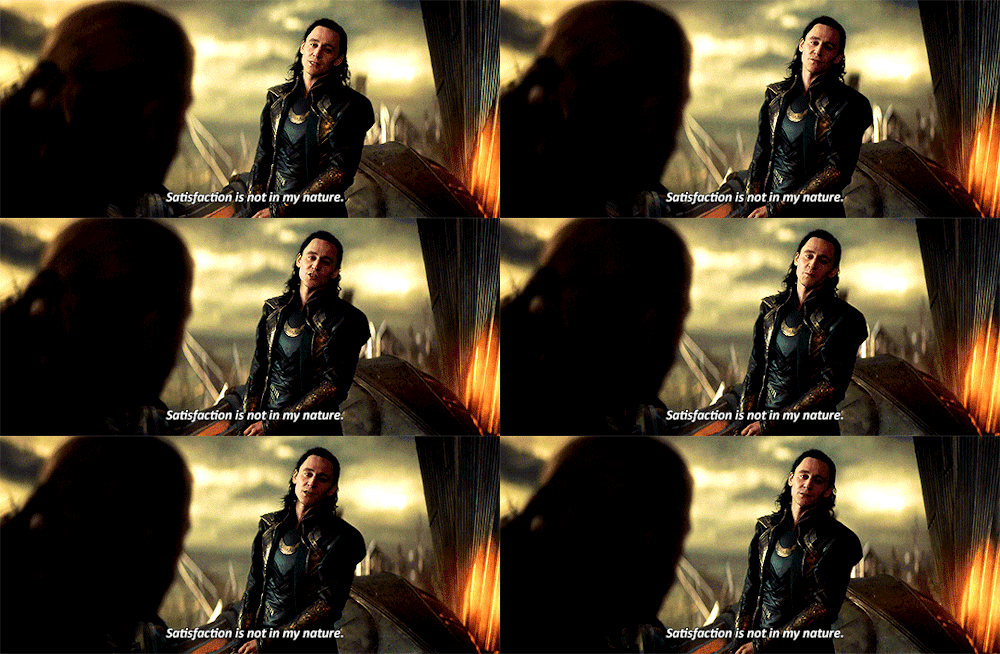
I’ve been thinking about this line a lot. And I’m not sure it’s given all the credit it deserves. It is well overshadowed by Thor’s immediate response (”surrender’s not in mine”), and by the line that steals this whole scene: “Trust my rage.”
But there’s something about this line that gets me, and I think it’s because it is probably the truest thing Loki has ever said about himself.
Loki, as we well know, is a master of avoiding his own problems, or else manipulating them to look like everyone else’s. He has told himself so many lies that he has begun to believe them: that he is hated, that he is alone, that he will never be anything but Loki. Frigga even points this out: “Always so perceptive, about everyone but yourself”. Loki can read everyone else, but when it comes to reading himself? Oh, Hel no. Those are dangerous waters, and he would rather not drown there.
And that’s why this line is so surprising and just so good. The fact that Loki is never satisfied is, when you think about it, pretty much the root of all his problems (at least ones that he can control). As a child and young adult, he appears to have mastered magic, but that was never enough, because it wasn’t like Thor, it wasn’t what Asgard wanted, it wasn’t what Odin wanted (or so he thought). He wants to be Thor’s equal, little realising that in many ways he is, but that, too, is not enough. He tries to be Thor, and is never satisfied. He tries to be Loki, and is never satisfied. He goes out of his way to prove himself to his family, and still he craves more. And so it escalates. A throne. A planet. He keeps reaching and reaching, oblivious to the fact that whilst he is grasping for the mountain’s peak, the rocks beneath him are slipping away.
And now we come to Ragnarok, and Loki has what he claims he has always wanted: the throne. A chance to rule. And I don’t think for a moment it is what he expects. Because once he has something, it no longer fulfills him; and he is stuck without a family, bearing the weight of the kingship, and I’m nintey-nine percent sure all he can do is sit there thinking ‘Well. Now what?’
And this is why happiness is so foreign to Loki, and always will be, and why he has doomed himself: for contentment, he must learn to settle, and because he is Loki, he will never settle. And so the cycle continues, and he proves time and time again that Loki’s worst enemy will always be Loki.
On some points, I agree. Without a doubt, Loki’s greatest and most persistent enemy is himself. Fueled by insecurity, he twists words and/or his own thoughts/memories, refuses to trust and doubts/denies the love that others show him, and avoids confronting problems by pushing them aside, running, or retaliating with some prank (or worse). “Satisfaction is not in my nature,” is one of the truest lines Loki’s spoken. There is an element of never settling. Intelligent people often struggle with restlessness. There’s an urge for more, more, more to satisfy a brain that keeps turning (especially when that brain will turn on itself if left to its own devices). However, a far bigger reason that satisfaction is not in Loki’s nature is because he struggles with mental illness. Happiness is foreign to Loki not because he refuses to be content with what he has, but because he’s incapable, through no fault of his own, of being happy.
Now, till this point I’ve allowed the assumption that Loki should be content if he were capable of being so, but that’s not the case.
As a child and young adult, he appears to have mastered magic, but that was never enough, because it wasn’t like Thor, it wasn’t what Asgard wanted, it wasn’t what Odin wanted (or so he thought).
There’s no indication Odin wanted Loki to master magic. Odin never, in any movie, showed he felt an ounce of pride in Loki’s accomplishments. He does mention that Frigga would be proud, and perhaps it’s implied that he’s impressed as well. Asgard, too, doesn’t respect Loki’s skills. We’re given a clear example of this in a deleted scene (the servant laughing when Thor says that some do battle while others just tricks). Asgard adores Thor. They eat up his showboating when he enters his coronation.
He wants to be Thor’s equal, little realising that in many ways he is, but that, too, is not enough.
It’s true that Loki is Thor’s equal in many respects. He’s powerful and cunning. His strengths are Thor’s weaknesses, and vice versa. They balance one another out. However, Asgard does not treat them as equals. Even Thor slips into putting Loki in his place. We are shown this on Jotunheim.
Even if Loki’s problem was that he refuses to be content, that does not mean that that refusal is unjustified or unhealthy. Should he be content in a position where he’s disrespected, where he’s reminded of his place when he attempts to council Thor, and where people are quick to mistrust him? (Regardless of the fact that Sif and the Warriors Three are correct about Loki’s crimes in Thor, they come to that conclusion with little to no compelling evidence, and become angry that Loki told a guard to go to Odin despite the fact that this saved their lives.)
And now we come to Ragnarok, and Loki has what he claims he has always wanted: the throne. A chance to rule.
Loki claims he wants a throne. However, Loki’s never desired a throne because he wants to rule. He desires a throne because he wants respect and deference and freedom (which power supposedly provides).
I think people assume that Loki got a chance at everything he desired in between TDW and Ragnarok, and found, unsurprisingly, it wasn’t enough. The truth is Loki has never had what he wants. What he wants is freedom and for people to respect and accept him for who he is. He wants this without having to compromise what makes him Loki (and another struggle, of course, is discovering what exactly it means to be Loki, and whether Loki’s someone worth being). Disguised as Odin, Loki is not respected. Odin is. It’s true he rules, but under another’s name and face. Nothing about his time as Odin achieves Loki’s desires save for, perhaps, a feeling a security against the looming threat of Thanos.
It’s entirely possible that even if Loki had respect, freedom, acceptance, and good mental health he’d still feel discontent, but that’s not the situation we see in the MCU. The Loki we see deals (very poorly and (self-)destructively) with legitimate grievance about his treatment, and suffers from wretched mental health. The fix for that is not, and never will be, to learn to settle for what you’ve got. Or, to put it in the terms of so many people I’ve encountered in my life, to “choose happiness”.
I think @foundlingmother is exactly right about what Loki’s problem is and what he ultimately wants. But I suspect it’s not so easy to draw a line between his shoddy treatment in Asgard and his mental illness. We know very little about the etiology of mental illness: how much is inherited, how much is acquired due to environmental factors. Early childhood experiences seem to be very important in the development of a person’s “attachment style,” so called; though of course Loki does not remember being abandoned as a baby and spending a day or two hungry, cold, and alone, that experience might still have imprinted itself on his emotional systems and left him extremely insecure and convinced, regardless of the evidence, that anyone he cares about will eventually abandon him.
Whether or not that was a factor, his insecurity about his own worth and his reliance on the approval of others was almost certainly reinforced by all the signals he received throughout childhood and youth, subtle or explicit, that he was not as good as Thor, and that his talents were less valuable. Take a close look at his interactions with Thor and the Warriors Four in the first Thor movie – including Hiddleston’s body language – and you can take a guess at what his childhood was like: he’s quiet, withdrawn, a little strange; the other kids think he’s weird and don’t really like him but put up with him because he’s Thor’s brother; Thor knows him well and values his opinions, at least in private, but in front of other people he pushes Loki aside to assert his own authority. Was Loki quiet and withdrawn to begin with because he already had social anxiety, innately or due to early childhood trauma, or just because he’s an introvert? Or did he develop social anxiety because of this inconsistent treatment (Do Thor & friends like/respect me or not? How can I tell?) and become more quiet and withdrawn as a result?
To be completely clear: I do not hate Thor and the W4; I do not (unlike some Loki stans) think they’re nothing but terrible abusive bullies. I think Thor had his own insecurities and took them out on Loki; I think Loki probably was kind of a little shit independent of all the other stuff, and the W4 may well have had some legitimate reasons for not liking him. Like many fans, I characterize Loki as being very similar to myself, and I know that I am an acquired taste; I have a dry, very nerdy, sometimes pretentious, often bitchy sense of humor; I’m an unabashed snob (about some things) and misanthrope. People who are very earnest tend not to like me, and that’s fine. Loki’s problem may have been that he had trouble finding people in Asgard who shared his mindset, and he ended up going along with Thor’s friends by default. I get the sense that Fandral was the one of Thor’s friends who liked Loki the most (he’s the first to jump to his defense when Hogun accuses him in Thor, and in TDW, he never threatens to kill Loki for betrayal), and that makes perfect sense if Loki is like me in the ways I’ve suggested.
Finally, a bit of completely unnecessary riding of my own hobby horse: you know who wrote that perceptive line, “Satisfaction’s not in my nature” (as well as the beautiful and memorable lines that follow it up)? That’s right: Joss Whedon. Perhaps Tumblrites should consider that the next time they insist as proof of their own moral purity that he’s a terrible writer of character and dialogue.
 Loki is the Philosopher King