

This person is my new best friend
Farming systems need to fit into their natural and social environment. Sometimes we describe this as a socio-ecological niche.
Caption;
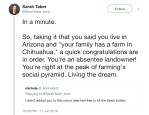
In a minute.
So, taking it that you said you live in
Arizona and “your family has a farm in Chihuahua,” A quick
congratulations are in order. You’re an absentee landowner! You’re
right at the peak of farming’s social pyramid. Living the dream.So you probably don’t participate in
the day-to-day management, you just collect checks. Pretty common
situation for absentee landlords. From that distance, it’s
understandable that you have a poor grasp on water, land, and how
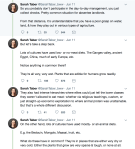
they play out in various types of agriculture.But let’s take a step back.
Lots of cultures have used low or no
meat diets. The Ganges valley, ancient Egypt, China, much of early
Europe, ect.Notice anything in common there?
They’re all very, very wet. Plants that
are edible for humans grow readily.They also had intense hierarchies where
elites could just tell the lower classes they weren’t allowed to eat
meat-whether via religious teachings, custom, or just straight-up
economic exploitation to where animal protein was unattainable. But
that’s a whole different discussion.On the other hand, lots of cultures
have used mostly or all animal diets.E.G. The Bedouin, Mongols, Maasai,
Inuit, ect.What do these have in common? They’re
in places that are either very dry or very cold. Either the plants
that grow are very sparse & tough, or none at all.Humans can only digest specific types
of plant matter. We need tender stems, leaves & fruit; enlarged
seeds, or energy storing roots.The entire rest of the plant is
inedible for us. Stalk, branch, dry leaves, ect.And without intense irrigation, the
only plants that grow in dry areas are entirely made of things
that humans can’t digest. They’re almost entirely cellulose. Tough
stalks, fibrous leaves covered in wax and hair, thorns, ect.That’s why we call these areas ‘scrub’.
The only use humans can make of the natural vegetation is to scrub
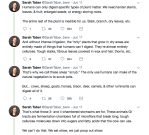
pots.But…cows, sheep, goats, horses,
bison, deer, camels & other ruminants can digest all of it.That’s what those 3 and 4 chambered
stomachs are for. These animals GI tracts are fermentation chambers
full of microflora that break long, tough cellulose molecules down
into sugars and fatty acids that the cow can use.We can’t do that. We eat straw, we just
poop out straw.That’s why people living in deserts,
scrub & dry grasslands aren’t vegetarian. They’d starve. They
kept close to the animals that can digest what grows there;
ruminants.(The oceanic food chain that Inuit &
other maritime peoples are looped into is a whole ‘nother
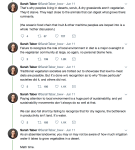
discussion.)Failure to recognize the role of local
environment in diet is a major oversight in the vegetarian community
at large, so again, no personal blame here.Traditional vegetarian societies are
trotted out to showcase that low/no meat diets are possible. But it’s
done w/o recognition as to why ‘those particular’ societies did it,
and others did not.Paying attention to local environment
is a huge part of sustainability, and yet sustainability movements
don’t always do so well at that.We can also fall short by failing to
recognize that for dry regions, the bottleneck in productivity isn’t
land, it’s water.As an absentee landowner, you may or
may not be aware of how much irrigation water it takes to grow
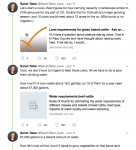
vegetables in a desert. Math time.Let’s start w. cows. Best figures for
cow carrying capacity in landscape similar to Chihuahua are for dry
part of CO. Double that for Chihuahua’s longer growing season, and 10
cows would need about 73 acres to live on (wild scrub w no
irrigation.)Cool, so we don’t have to irrigate to
feed those cows. All we have to do is give them drinking water. How
much? A cow needs about 18.5 gal/day, so 10 of them for a year would
need about 67,000 gallons.67,000 gallons is a decent amount of
water.Now let’s look at how much it takes to
grow vegetables on that same land.Most plant crops need about an
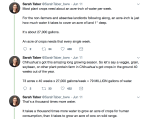
acre-inch of water per week.For the non-farmers and absentee
landlords following along, an acre-inch is just how much water it
takes to cover an acre of land 1” deep.It’s about 27,000 gallons.
An acre of crops needs that every
single week.Chihuahua’s got this amazing long
growing season. So let’s say a veggie, grain, soybean or other plant
protein farm in Chihuahua’s got crops in the ground 40 weeks out of
the year.73 acres x 40 weeks x 27,000
gallons/week = 79 MILLION gallons of water.That’s a thousand times more water.
It takes a thousand times more water to
grow an acre of crops for human consumption, than it takes to grow an
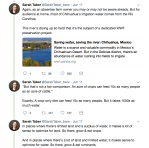
acre of cow on wild range.Again, as an absentee farm owner you
may or may not be aware already. But for audience at home, most of
Chihuahua’s irrigation water comes from the Rio Conchos.The river’s drying up so hard that it’s
the subject of a dedicated WWF preservation project.“But that’s not a fair comparison. An
acre of crops can feed 10x as many people as an acre of cattle.”Exactly. A crop-only diet can feed 10x
as many people. But it takes 1000x as much water.In places where there’s limited land
and a surplus of water, it makes a lot of sense to optimize for land,
so there, grow & eat crops.And in places where there’s a lot of
land and limited water, it makes sense to optimize for water, So
there, grow & eat ruminants.It’s really interesting to me that the
conversation around vegetarianism & the environment is so
strongly centered on assumptions that every place in the world is on
the limited land/surplus plan.You know what region that describes
really well? Northwestern Europe.In many ways, viewing low/no meat diets
as the One True Sustainable Way is very much a vestige of
colonialism. It found a farmway that works really well in NW Europe,
assumed it must be universal, and tries to apply it to places where
it absolutely does not pencil out.What a nice accessible description of a very important perspective! Now obviously not all of it can apply to every biome or social niche (a key problem with factory farming is the emphasis on forcibly terraforming land to suit the needs of cows – this is, among other things, lethal to the local ecology) but such a vividly painted picture of the nuance of food networks and the relationships between humans and our ecology. The reason I think it’s important to reblog it is that it begins to introduce people to that nuance, that concept of a complex ecology that we still belong to, in which current trends and moral judgments are …. barely a scratch on the surface, the equivalent of buying a different flavour of potato chips.
That’s basically it, the current discourse we have around food is at the level of what flavour of potato chips is Best For The World (And Grants Me The Most Imaginary Performance Points When I Purchase It) and we get people fighting over what colour packet they think everyone else should buy. But they’re all the same Walkers brand potato chips in the same bag, they just have different levels of artificial flavouring and slightly different colours on the front. We ought to raise each other up to the level of interrogating potato chips, asking why we are consuming a single brand, teaching each other to make our own, learning about different relationships other people can have with chips, seeking and supporting other brands, learning about other ways to use potatoes, pressuring the big producers to make better global choices. forcibly changing the fashion so that the disposable crinkly packets become passé and unmarketable, and everyone insists on having them packaged in sustainable recyclable paper. That’s the difference between the discourse we have and the discourse we could be having.
I would love to see us bringing this depth and nuance to all of our discussions about food.
 Loki is the Philosopher King